

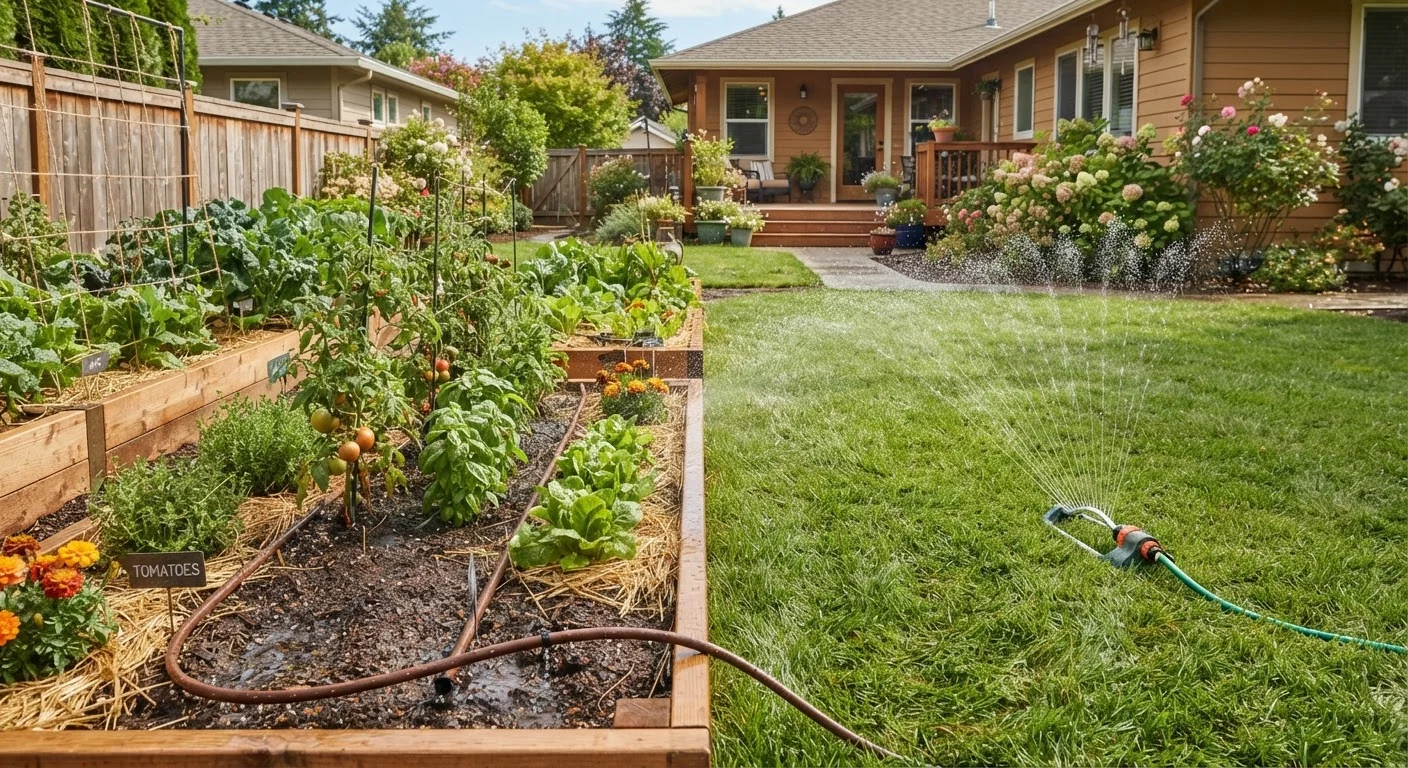
Option A
Drip Irrigation
The precision, water-conserving approach for garden beds and individual plants.
Best for: Best for vegetable gardens, flower beds, shrubs, and drought-sensitive landscapes where targeted watering matters.
Option B
Sprinkler Systems
The broad-coverage solution for lawns and large open areas.
Best for: Best for grass lawns, large turf areas, and any space where even, wide-area coverage is the priority.
How Each System Delivers Water
Understanding how these two systems work at a mechanical level makes it much easier to see why each suits different situations.
Drip irrigation runs a network of low-pressure tubing along the soil surface or just below it, releasing water slowly through small emitters positioned near individual plants or along a planting row. Water goes directly to the root zone - very little is lost to air or hits the foliage at all. Flow rates are typically measured in gallons per hour rather than per minute, reflecting just how slow and deliberate the delivery is.
Sprinkler systems spray water through the air in a wide arc, mimicking rainfall across a large area. In-ground systems use pop-up heads that retract after each cycle; above-ground oscillating or rotary sprinklers work on the same principle. Coverage is broad and relatively uniform, which makes sprinklers the natural fit for turf grass - but that airborne water is also more vulnerable to wind drift and midday evaporation.
For a deeper look at how watering mistakes affect plants, see why overwatering is a bigger problem than underwatering.
| Criterion | Drip Irrigation | Sprinkler Systems |
|---|---|---|
| Water efficiency | Very high - minimal evaporation | Moderate - wind and heat cause losses |
| Coverage area | Targeted - individual plants or rows | Broad - wide turf and open areas |
| Best plant types | Vegetables, shrubs, trees, beds | Grass lawns, ground covers |
| DIY friendliness | Moderate - planning required | Low for in-ground; higher for above-ground |
| Upfront cost | Lower for basic setups | Higher for in-ground systems |
| Maintenance | Emitter checks, tubing upkeep | Head adjustments, winterization |
| Foliage wetting | None - water goes to roots only | Yes - can promote fungal issues |
| Smart controller compatibility | Yes | Yes |
Water Efficiency: Where the Numbers Matter
Water efficiency is where drip irrigation earns its reputation. Because water is delivered slowly at soil level, evaporation is minimal and runoff is rare. Sprinkler systems, by contrast, spray water into the air where heat and wind can reduce delivery efficiency - a meaningful concern in hot, dry climates or during peak summer watering months.
30-50%
Water savings with drip vs. sprinklers
The EPA's WaterSense program estimates drip irrigation can use 30-50% less water than conventional sprinkler systems in comparable garden applications.
50%
Outdoor water use lost to inefficiency
According to the EPA, roughly half of all outdoor residential water use is wasted due to evaporation, wind, and runoff from inefficient irrigation practices.
9 billion gallons
Water used by U.S. households daily outdoors
The EPA estimates American households use about 9 billion gallons of water per day outdoors, with landscape irrigation representing the largest share.
That said, efficiency depends heavily on how a system is used. A sprinkler running at the wrong time of day - say, midday in summer - wastes substantially more water than one running at dawn. Scheduling matters just as much as hardware. Both system types are available with smart controllers that adjust run times based on local weather data, soil moisture sensors, or evapotranspiration rates, which can improve real-world efficiency for either setup.
If you're exploring broader landscaping strategies that naturally reduce watering demand, native plants vs. traditional landscaping is worth reading alongside this comparison.
Installation, Maintenance, and Cost Considerations
Installation complexity differs considerably between the two systems. A basic drip irrigation setup can be a straightforward DIY project - kits with tubing, emitters, and connectors are widely available at hardware stores. However, designing an effective system for a larger or more complex garden requires planning: mapping plant locations, calculating flow rates, and ensuring the water pressure at your hose bib is appropriate for the emitters you choose.
In-ground sprinkler systems are more involved. Running underground supply lines typically requires trenching, and most homeowners hire a licensed irrigation contractor for the job. Permits may be required in some municipalities, and the system needs proper winterization in freeze-prone climates to avoid pipe damage. Above-ground sprinklers avoid the installation complexity but lack the permanence and polished look of in-ground systems.
Maintenance for drip systems centers on checking emitters for clogs (mineral buildup is common in hard-water areas) and replacing tubing damaged by UV exposure or garden tools. Sprinkler systems need periodic head adjustments, leak checks, and seasonal start-up and shutdown routines. Neither system is maintenance-free, but drip systems generally involve lower repair costs when components fail.
For homeowners thinking about overall yard strategy, low-maintenance landscaping ideas can help frame irrigation choices alongside broader design decisions.
Which Plants Thrive Under Each System
Plant type is often the deciding factor when choosing a watering method - and many yards benefit from using both systems in different zones.
Drip irrigation suits:
- Vegetable and herb gardens, where consistent root-zone moisture supports production
- Shrubs, trees, and perennial beds where deep, infrequent watering encourages strong root development
- Row crops and raised beds where overhead watering would promote fungal disease on foliage
- Container plants and slope plantings where runoff is a concern
Sprinkler systems suit:
- Established grass lawns requiring even, broad coverage
- Newly seeded lawn areas that need frequent, light moisture across the entire surface
- Ground covers and low-growing plants spread over large areas
A healthy lawn is only part of the picture. Practices like lawn aeration also affect how well your soil absorbs water, regardless of which irrigation method you use. And if you're deciding how to establish turf in the first place, grass seed vs. sod covers how each method affects early watering needs.
The content on this site is for informational purposes only and is not a substitute for professional advice. Always consult a qualified professional for guidance specific to your situation.