

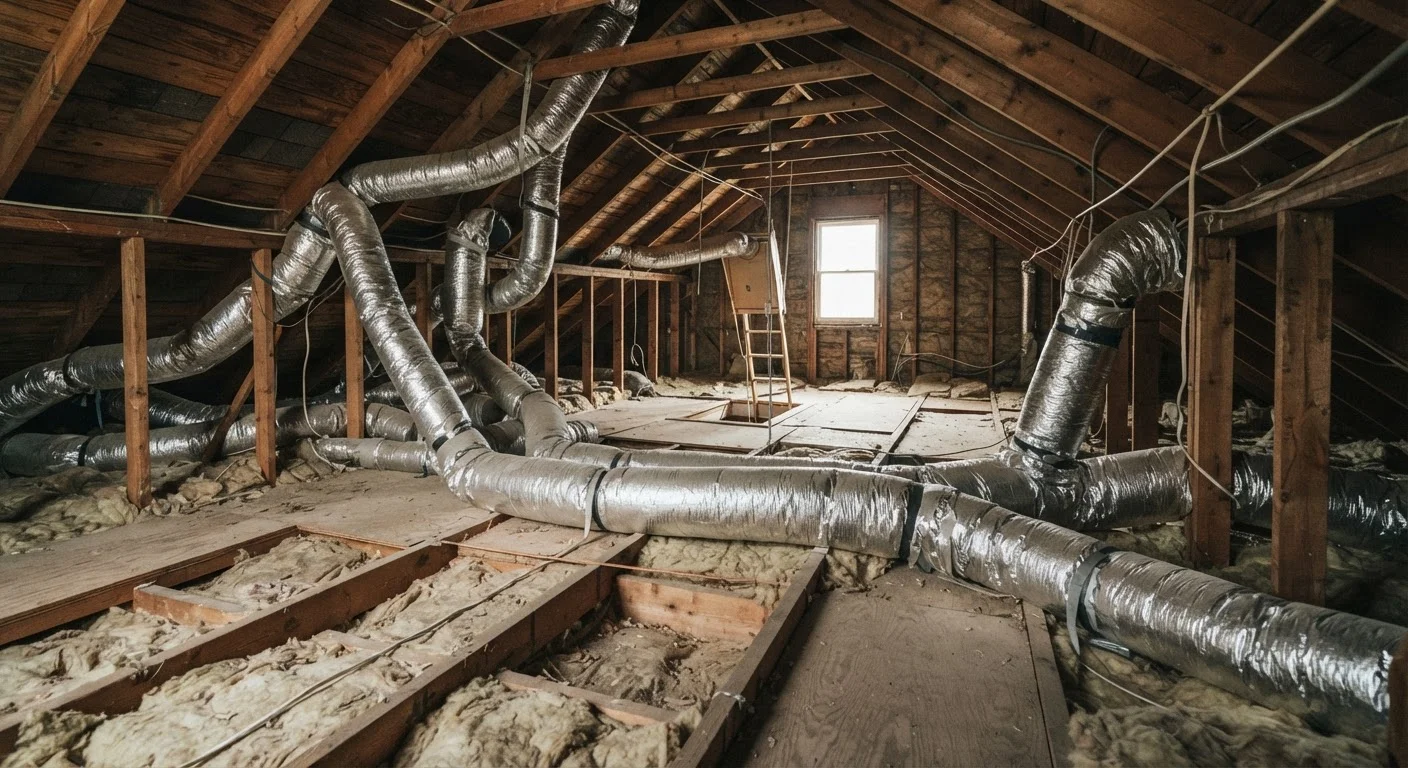
What Ductwork Actually Does
Your furnace or air conditioner conditions air - heating or cooling it to the temperature you've set on your thermostat. But that conditioned air doesn't magically appear at each register in your home. It travels through a branching network of ducts: first through the supply side, which pushes treated air into each room, then back through the return side, which pulls room air to the air handler to be reconditioned.
This continuous loop is what makes forced-air systems work. If you want a deeper look at how those systems compare to other heating methods, our comparison of forced air and radiant heat explains the differences clearly.
Ducts come in several forms: rigid sheet metal (the most durable), fiberglass duct board, and flexible plastic-and-wire tubing. Each has appropriate applications, but all require proper installation and sealing to function efficiently.
Why Duct Condition Has a Bigger Impact Than Most People Realize
The U.S. Department of Energy has estimated that duct leakage can account for the loss of roughly 20-30% of conditioned air in a typical home - meaning your system may be working significantly harder than it needs to, and you're paying for air that never reaches your living space.
20-30%
Conditioned air lost through duct leaks
The U.S. Department of Energy estimates that leaky ducts can account for this range of energy loss in a typical home.
~$400
Estimated annual energy wasted by leaky ducts
Energy Star program guidance suggests duct leakage can cost homeowners hundreds of dollars per year in wasted heating and cooling energy.
10-15 yrs
Typical lifespan of flexible ductwork
Flexible duct materials can degrade significantly within this window, particularly in hot attic environments or where improper installation caused stress.
Leaks tend to occur at joints, connections, and where ducts pass through walls or framing. Ducts in attics or crawl spaces face additional challenges: without adequate insulation, the air inside can gain or lose heat before it ever reaches a room. Understanding attic insulation options can help you assess whether your duct runs are adequately protected.
Poor duct design - undersized runs, too many sharp bends, or insufficient return capacity - creates pressure imbalances that strain the HVAC equipment itself. This is one of the less-discussed reasons HVAC systems wear out ahead of schedule.
Signs Your Ductwork May Be Underperforming
Because ducts are hidden, homeowners rarely inspect them. But several symptoms can point to duct problems without any special tools:
- Uneven room temperatures: One room is always stuffy or cold regardless of thermostat settings.
- Elevated energy bills: Costs rise without a clear change in usage patterns or weather.
- Excessive dust at vents: Can indicate leaks pulling unconditioned, dusty air from attic or crawl spaces into the duct system.
- System runs constantly: The HVAC unit struggles to reach set temperatures because conditioned air is escaping before delivery.
- Musty or unusual odors: May indicate moisture in ductwork, which can support mold growth.
If you notice several of these signs together, scheduling a professional inspection is a reasonable next step. A trained technician can perform pressure testing that precisely identifies leakage - far more reliable than visual inspection alone.
Use the Right Tape for Duct Sealing
Standard cloth duct tape - despite the name - is not appropriate for sealing HVAC ductwork. It degrades quickly under heat cycling. Use mastic sealant (applied with a brush) or UL-listed metal-backed foil tape for joints and connections. These materials hold up over years of temperature swings inside a duct system.
What Homeowners Can Do
Some basic duct maintenance is accessible to homeowners; other work is best left to licensed HVAC professionals.
What you can handle
- Keep supply and return vents unobstructed by furniture, rugs, or curtains.
- Change HVAC filters on schedule - a clogged filter forces the system to work harder, which can worsen pressure imbalances.
- In accessible areas like basements or utility closets, visually check duct connections for obvious gaps or disconnections.
When to call a professional
- Sealing leaks with mastic sealant or proper metal-backed foil tape requires training to do correctly.
- Re-insulating duct runs in attics or crawl spaces involves safety considerations in confined, unconditioned spaces.
- Duct redesign or replacement is a significant project that should be scoped and executed by a licensed HVAC contractor.
Ductwork maintenance fits naturally into broader seasonal home upkeep. The seasonal home systems maintenance checklist includes HVAC-related tasks that pair well with keeping an eye on your duct system's condition.
Similarly, if you're looking at duct leaks as part of a broader air-sealing effort, sealing air leaks around the house covers the complementary work happening at your walls, windows, and building envelope.
Frequently Asked Questions
Common signs include rooms that never reach the set temperature, unusually high energy bills, and dusty supply vents. A professional can perform a duct blaster or blower door test to measure leakage precisely. Some leaks are also visible as disconnected sections in accessible attic or crawl space areas.
Well-installed sheet metal ducts can last 25 years or more, but flexible ductwork - common in homes built after the 1980s - may degrade in 10-15 years, especially if it was kinked or improperly supported during installation. Regular inspections help catch deterioration early.
Sealing is often sufficient for ducts with minor leaks at joints and connections, using mastic sealant or metal-backed tape. Full replacement is typically considered when ducts are severely deteriorated, improperly sized, or laid out in a way that creates persistent airflow problems. A licensed HVAC contractor can evaluate which approach makes sense.
Yes - especially for ducts running through unconditioned spaces like attics or crawl spaces. Uninsulated ducts in an attic can lose significant heating or cooling energy before conditioned air even reaches the living space. Insulating these runs is one of the more impactful efficiency upgrades a homeowner can make.
Standard cloth duct tape is not recommended for sealing HVAC ducts - it degrades quickly under heat cycling and loses adhesion. HVAC professionals use mastic sealant (a paste-like compound) or UL-listed metal-backed foil tape for durable, code-compliant sealing.
Ducts can accumulate dust, debris, and in some cases mold - particularly if there has been moisture infiltration. While routine cleaning is not always necessary, the EPA recommends considering duct cleaning if there is visible mold growth, pest infestation, or significant debris buildup causing airflow restrictions.
The content on this site is for informational purposes only and is not a substitute for professional advice. Always consult a qualified professional for guidance specific to your situation.