

Option A
Forced Air Heating
The dominant, versatile workhorse of American home heating.
Best for: Homeowners who want a dual-purpose system that heats and cools through existing ductwork and responds quickly to thermostat changes.
Option B
Radiant Heat
The quieter, even-tempered alternative that heats from the floor up.
Best for: Homeowners prioritizing consistent, draft-free warmth and are open to a dedicated heating-only installation, often during new construction or major renovation.
How Each System Actually Works
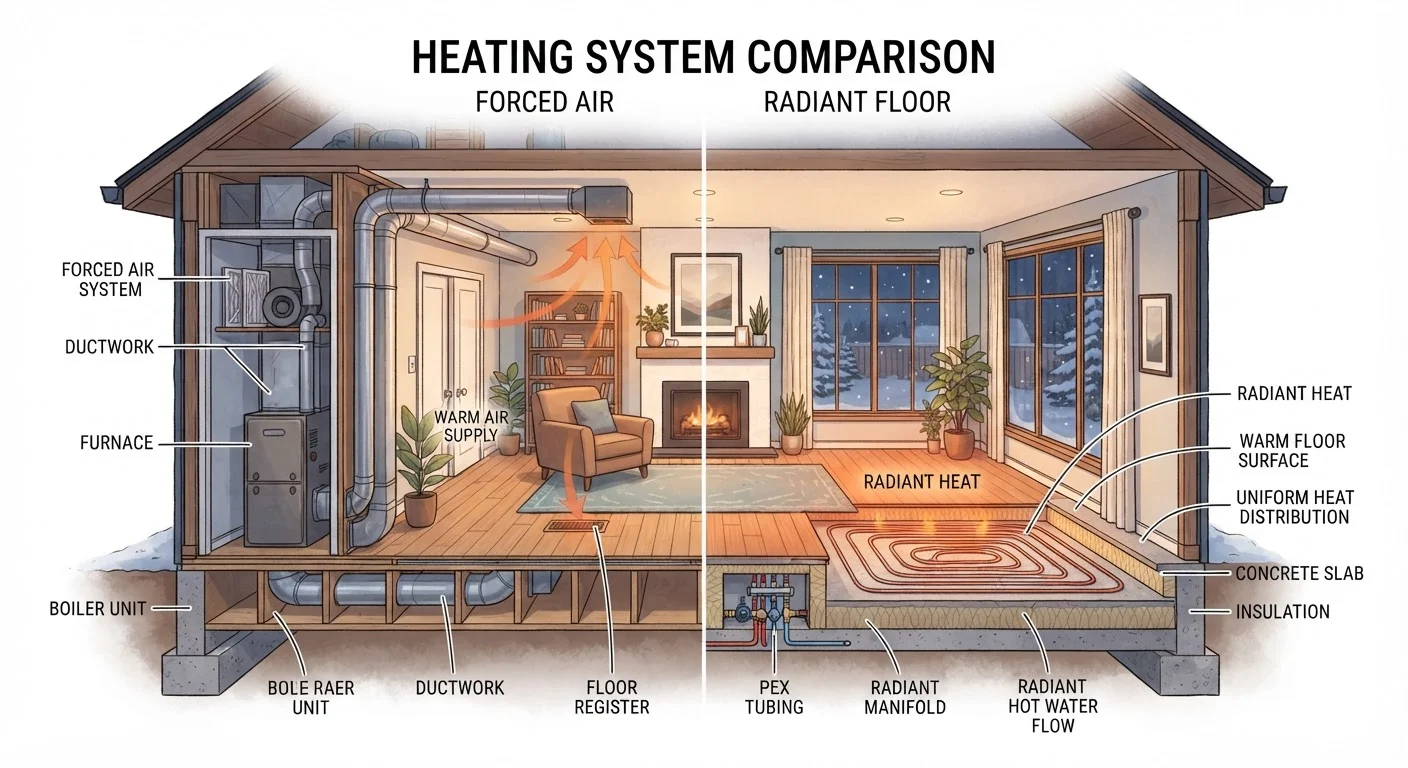
Understanding the comfort difference between forced air and radiant heat starts with understanding the physics of each approach.
Forced air heating uses a furnace - powered by natural gas, propane, oil, or electricity - to heat air, then push it through a network of ducts and out through vents into each room. A thermostat signals the system to run, the furnace fires, and warm air is distributed relatively quickly. The same ducts, when paired with a central air conditioner, carry cool air in summer. For a deeper look at how this fits into your home's overall mechanical picture, see how HVAC, plumbing, and electrical work together.
Radiant heat works on a different principle entirely: it warms surfaces rather than air. There are two main types. Electric radiant uses heating cables or mats installed beneath flooring. Hydronic radiant - the more common whole-home option - circulates hot water through flexible tubing laid under floors or embedded in walls and ceilings. That warmth then radiates outward, gently heating the room from the surface up rather than blowing heated air in from above.
The result is a fundamentally different feel. Forced air creates air movement and temperature cycles; radiant creates a steady, ambient warmth that many people describe as more natural and comfortable.
| Criterion | Forced Air | Radiant Heat |
|---|---|---|
| Heat delivery method | Heated air through ducts and vents | Warm surfaces radiate heat outward |
| Temperature consistency | Cycles on/off; some hot and cold spots | Even, steady ambient warmth |
| Air movement and allergens | Circulates air and particles | No air movement; no particle circulation |
| Can share with AC system | Yes - uses same ductwork | No - separate cooling required |
| Typical upfront cost | Moderate (lower in existing homes) | Higher, especially for hydronic retrofit |
| Best installation scenario | Existing ducted homes or retrofits | New construction or major renovation |
| Key maintenance task | Filter changes; annual furnace inspection | Annual boiler check; pressure monitoring |
Comfort, Air Quality, and Efficiency Trade-Offs
Each system's delivery method creates real differences in day-to-day comfort and operating costs.
Temperature consistency is a common complaint with forced air. Because the furnace runs in cycles - on, then off - rooms can feel warm when air blows, then slightly cooler between cycles. Vents also create hot and cold zones depending on duct design and distance from the furnace. Radiant systems maintain more even surface and ambient temperatures because the heat source is distributed across the floor or wall rather than concentrated at a vent. The condition of your ductwork plays a major role in forced air performance - leaky or poorly insulated ducts can significantly undercut efficiency.
Indoor air quality is another consideration. Forced air systems move air, which means they also move whatever is in it - dust, pet dander, mold spores - unless a quality filter is maintained and changed regularly. Radiant systems produce no air movement, so they don't distribute airborne particles. However, they also don't filter air, so homes with radiant heat may still need separate ventilation or air purification strategies.
Energy efficiency depends heavily on your home's insulation, local climate, and the specific equipment installed. Hydronic radiant systems are often cited as efficient because water carries heat more effectively than air, and lower water temperatures can still deliver comfortable warmth. However, efficiency gains are most realized in well-insulated homes. Adding or improving attic insulation benefits both systems by reducing overall heat loss.
~90%
U.S. homes using forced air heating
The U.S. Energy Information Administration estimates that the large majority of American homes rely on ducted forced-air systems as their primary heating method.
25-30%
Heat lost through leaky ducts
The U.S. Department of Energy has noted that duct leakage can account for significant heating and cooling losses in typical homes with forced air systems.
Installation, Cost, and Maintenance Realities
Installation context matters enormously when comparing these two systems.
Forced air systems are installed in the vast majority of American homes, which means the contractor base is wide, parts are readily available, and retrofitting into an existing home is generally feasible - though adding new ductwork to a home that lacks it is still a significant project. Maintenance centers on regular filter changes (typically every one to three months depending on filter type and household), annual furnace inspections, and periodic duct cleaning or sealing. Central air conditioning can share the same duct system, making forced air a practical all-season infrastructure. For comparison, see how similar dual-use trade-offs apply with water heater choices.
Radiant systems - especially hydronic - carry higher upfront installation costs, particularly in retrofit situations where flooring must be removed and replaced. For this reason, they are most cost-effectively installed during new construction or significant floor renovations. Maintenance for hydronic systems involves annual boiler inspections, monitoring system pressure, and occasional checks of the tubing and manifolds. Electric radiant, while simpler to install in targeted areas like bathrooms, tends to have higher ongoing operating costs due to electricity pricing.
Permits and Professional Installation Required
Both forced air and radiant heating installations typically require permits and must meet local building codes. Hydronic radiant systems involve gas lines and plumbing connections that require licensed contractors. Forced air furnace replacements also generally require professional installation and inspection. Always verify local permit requirements before beginning any HVAC project.
Neither system is universally superior. The right choice depends on your home's existing infrastructure, your budget for upfront installation versus long-term operating costs, and the comfort priorities of your household.
The content on this site is for informational purposes only and is not a substitute for professional advice. Always consult a qualified professional for guidance specific to your situation.