

Our Verdict
Tank water heaters remain a reliable, affordable choice for households that want simplicity and low upfront cost. Tankless units reward homeowners who prioritize long-term energy savings, have space constraints, or run hot water in multiple locations simultaneously without a heavy overlap in peak demand. Both systems require professional installation, and the best fit hinges on your home's fuel supply, household size, and budget.
Homeowners replacing an aging unit on a tight budget will generally find tank heaters more accessible, while those renovating or building new - and willing to invest upfront - may benefit more from a tankless system.
How Each System Works
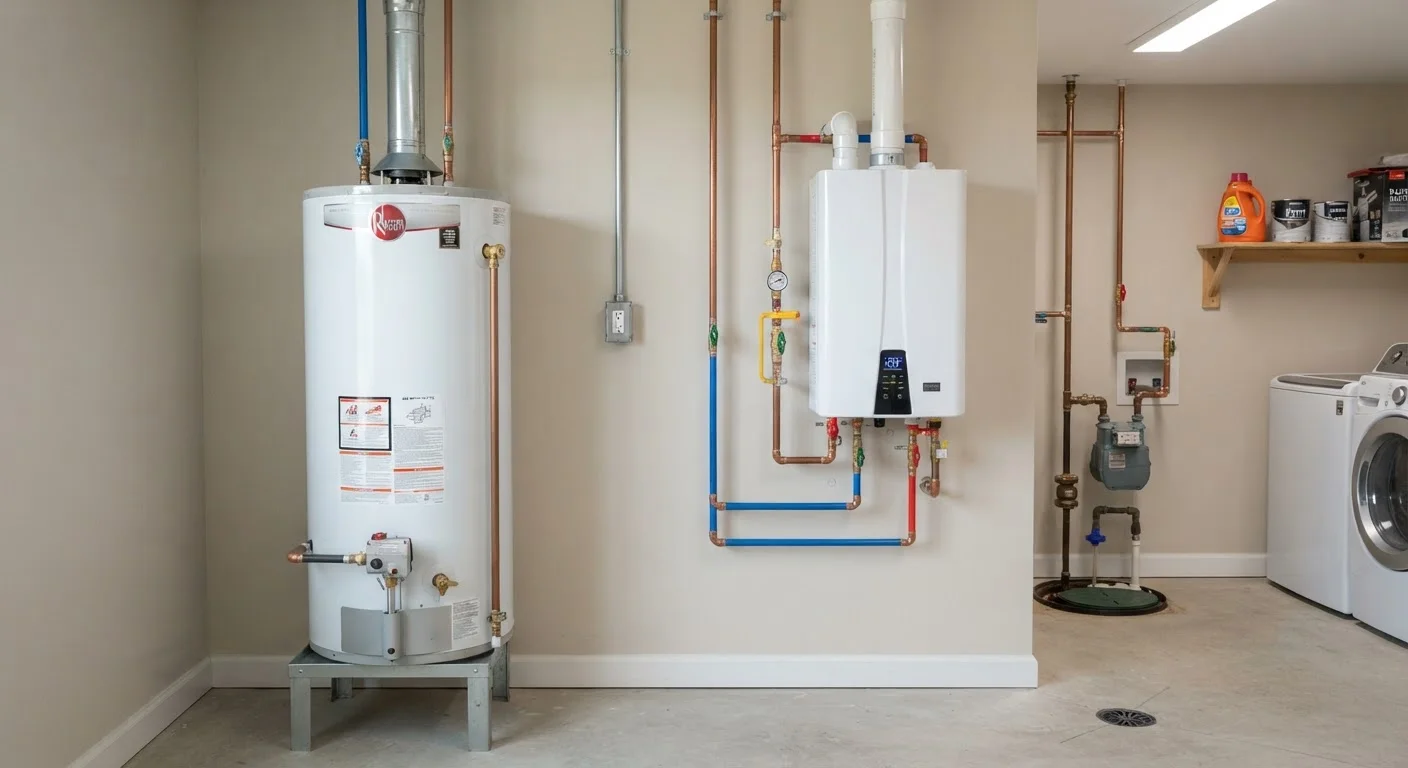
A tank water heater stores a set volume of water - commonly 40 to 80 gallons - in an insulated tank and keeps it heated around the clock. When you turn on the hot tap, pre-heated water flows out and cold water enters the tank to be reheated. The continuous heating cycle, even when no one is using hot water, is called standby heat loss.
A tankless water heater (also called an on-demand or instantaneous heater) has no storage tank. Instead, cold water passes through a heat exchanger - powered by gas burners or electric heating elements - only when a hot-water tap is opened. Once the tap closes, heating stops. This eliminates standby heat loss but introduces other considerations, particularly around flow rate capacity.
Understanding this fundamental difference explains nearly every trade-off that follows, from energy bills to installation complexity. For related context on how water behaves through your home's pipes, see our guide to water pressure.
Cost: Upfront vs. Long-Term
Tank heaters are considerably less expensive to purchase and install. A standard gas tank unit typically costs less than half the price of a comparable tankless model before labor. Installation is straightforward for most licensed plumbers, as the infrastructure - gas lines or electrical circuits, flue venting - is already familiar to local tradespeople.
Tankless units carry a higher purchase price and often require upgrades: larger gas lines, new venting configurations, or upgraded electrical panels for electric models. These retrofitting costs can be substantial in older homes.
8-12 yrs
Typical tank water heater lifespan
With routine maintenance such as annual flushing and anode rod replacement, most tank heaters fall within this range before needing replacement.
15-20 yrs
Typical tankless water heater lifespan
Tankless units generally outlast tank models by a significant margin, provided the heat exchanger is descaled regularly.
24-34%
Potential energy savings with tankless (moderate use)
The U.S. Department of Energy estimates tankless heaters can be 24-34% more energy efficient for homes using around 41 gallons or less of hot water daily.
Over time, the energy efficiency advantage of tankless systems can offset some of that upfront gap. The U.S. Department of Energy has noted that tankless water heaters can be more energy-efficient than storage models for homes that use a moderate amount of hot water daily, though actual savings vary based on fuel costs, usage habits, and local utility rates. Budget-conscious homeowners should calculate total cost of ownership - not just sticker price - before deciding.
Performance and Household Fit
Tank heaters excel at delivering a consistent flow of hot water simultaneously to multiple fixtures - shower, dishwasher, and laundry - as long as the tank's stored supply lasts. When demand exceeds the tank's capacity, you'll experience a cold-water gap while the tank reheats, which can take 20 to 40 minutes.
Tankless systems offer a theoretically unlimited supply of hot water, but they're constrained by flow rate - measured in gallons per minute (GPM). A single tankless unit may struggle to supply multiple high-demand fixtures running at the same time, particularly in larger households. Some homeowners install two units or a dedicated unit for high-use areas to manage this.
Hard Water and Tankless Heaters
In regions with high mineral content in the water supply, tankless units are particularly vulnerable to scale buildup inside the heat exchanger. Homeowners in hard-water areas should budget for annual descaling service and may want to consider a whole-home water softener. Ignoring scale buildup is one of the most common reasons tankless systems underperform or fail prematurely.
Cold climates present an additional challenge for tankless systems. The colder the incoming water, the harder the unit must work to reach the desired output temperature - which can reduce effective flow rate in winter. This is worth factoring in for homeowners in northern states.
If you're evaluating whole-home system efficiency more broadly, our comparison of forced-air and radiant heat covers similar trade-off thinking for heating systems.
Lifespan, Maintenance, and Installation
Tank water heaters typically last 8 to 12 years with routine maintenance - primarily flushing sediment annually and replacing the anode rod every few years. Neglecting maintenance accelerates corrosion and shortens the unit's life.
Tankless units generally last 15 to 20 years, and in areas with hard water, regular descaling of the heat exchanger is essential. Skipping this maintenance can significantly reduce efficiency and lifespan.
Both systems require professional installation. Work involving gas lines, venting, or electrical panel upgrades should always be performed by a licensed contractor - not as a DIY project. Many jurisdictions require permits for water heater replacement; verify your local requirements before any work begins.
Lower upfront purchase and installation cost
Tank heaters are widely available and use standard infrastructure, keeping both equipment and labor costs accessible for most homeowners.
Simultaneous multi-fixture hot water delivery
A full tank can supply showers, dishwashers, and washing machines running at the same time without performance loss - up to its storage capacity.
Simpler installation in existing homes
Most homes already have the venting and utility connections sized for a tank unit, avoiding costly retrofitting.
Unlimited hot water on demand (tankless)
Without a storage tank to deplete, tankless units can supply hot water continuously as long as flow rate demands stay within the unit's capacity.
Longer lifespan with proper maintenance (tankless)
Tankless units commonly last 15 to 20 years - roughly double that of a tank heater - reducing replacement frequency over time.
Eliminates standby heat loss (tankless)
Heating water only when needed avoids the energy consumed by keeping a large tank warm around the clock, which can improve efficiency.
Space savings with tankless design
Wall-mounted tankless units free up floor space in utility rooms or closets, which can be meaningful in smaller homes.
Standby heat loss reduces efficiency (tank)
Continuously reheating stored water consumes energy even when the household is asleep or away, adding to utility bills over time.
Finite hot water supply can run out (tank)
Large families or back-to-back showers can deplete a tank's supply, causing a 20-40 minute wait for reheating.
Higher upfront cost for tankless systems
Tankless units cost more to purchase, and retrofitting older homes with appropriate gas lines or electrical capacity adds to the investment.
Flow rate limitations under high demand (tankless)
Running multiple hot-water fixtures simultaneously can exceed a single tankless unit's GPM capacity, resulting in lukewarm output.
Cold climates reduce tankless efficiency
Very cold incoming water temperatures force the unit to work harder, which can reduce effective flow rate during winter months.
Descaling required in hard-water areas (tankless)
Mineral buildup in the heat exchanger is a real maintenance burden that, if neglected, shortens unit life and reduces performance.
Tank heaters have shorter average lifespan
At 8 to 12 years, tank units need more frequent replacement than tankless systems, contributing to higher long-term ownership costs.
The content on this site is for informational purposes only and is not a substitute for professional advice. Always consult a qualified professional for guidance specific to your situation.