

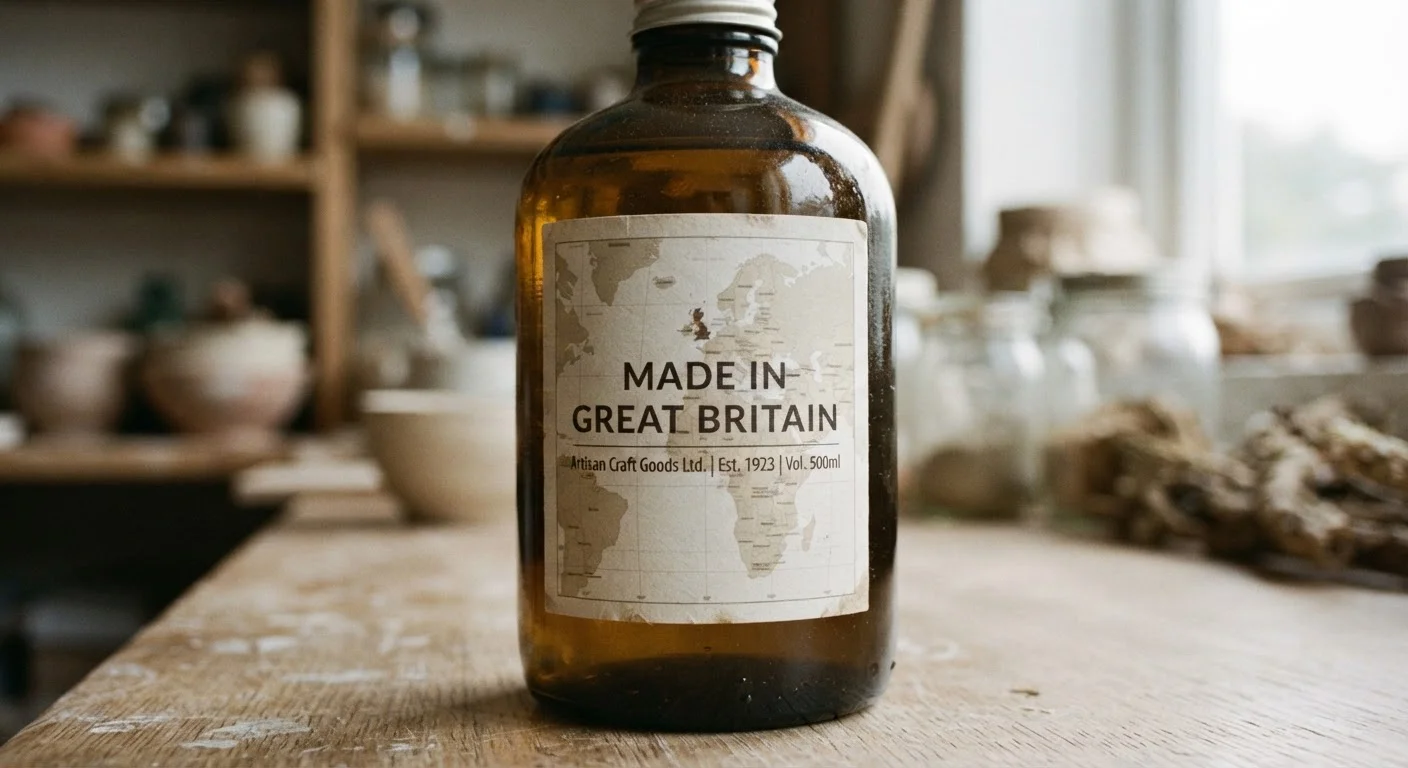
What 'Made In' Actually Means Under U.S. Law
The phrase "Made in USA" carries a specific legal definition enforced by the Federal Trade Commission (FTC). To use it without qualification, a product must be "all or virtually all" made in the United States - meaning all significant parts, processing, and labor must originate domestically. That's a high bar, and most products on store shelves can't clear it.
For imported goods, Customs and Border Protection (CBP) generally requires that the country of origin reflect where the product was substantially transformed - the last place where a meaningful change in form, function, or character occurred. In practice, this often means final assembly. A garment cut and sewn in Vietnam from fabric woven in China and yarn spun in India is legally "Made in Vietnam." None of that is hidden or deceptive - it's simply how the rule works.
Different product categories are governed by different rules. Automobiles, for instance, must display the percentage of U.S. and Canadian content under the American Automobile Labeling Act. Textiles must disclose fiber content and country of origin. Food products follow USDA and FDA origin rules, which are more complex still. There is no single, unified standard that applies everywhere.
45%
U.S. content threshold for auto labeling disclosure
Under the American Automobile Labeling Act, vehicles with 15% or more foreign content must disclose that percentage; the law sets 45% as a key threshold for additional transparency requirements.
~60
Countries with mandatory origin labeling for some goods
The World Trade Organization tracks that roughly 60 member countries maintain some form of mandatory country-of-origin labeling, with rules varying widely by product category and sector.
Common Myths About Country-of-Origin Labels
Misreading origin labels is one of the most common ways consumers misjudge product quality. The myths below are widespread - and correcting them changes how you shop.
Myth
"Made in USA" means every component was produced in America.
Fact
The FTC's 'all or virtually all' standard is strict for unqualified claims, but many products use qualified language like 'Assembled in USA' that permits foreign-sourced parts.
Watch for qualifiers on labels. "Assembled in USA from domestic and imported parts" is a legal, permitted claim - and it means some or all components may have been manufactured abroad. Only the unqualified "Made in USA" triggers the FTC's highest standard. Qualified claims are not deceptive, but they do signal a more complex supply chain than the label might initially suggest.
Myth
Products made in countries with lower labor costs are automatically lower quality.
Fact
Manufacturing quality depends on processes, materials, and oversight - not solely on labor cost or geography.
Many high-precision and high-reliability goods - semiconductors, medical devices, luxury goods - are produced in a wide range of countries. Quality is determined by engineering standards, quality-control systems, and material specifications. A product assembled in a low-wage country to exacting tolerances can outperform a domestically assembled product with loose quality control. Judging by country alone is an unreliable proxy.
Myth
If something is made domestically, it's automatically safer for consumers.
Fact
Safety depends on regulatory compliance and testing standards, which apply regardless of where a product was manufactured.
The Consumer Product Safety Commission (CPSC) regulates product safety for goods sold in the U.S. market whether they are imported or domestically produced. Both categories are subject to recalls. Domestic production does not exempt a product from safety failures, and imported products that meet applicable standards are not inherently more hazardous. The relevant question is whether a product has been tested and certified to the appropriate standard - not where it was made.
Myth
The country on the label reflects the full supply chain.
Fact
Origin labels identify the country of final substantial transformation, not the origin of every material or sub-component.
Global supply chains are layered. Raw materials, intermediate components, and final assembly frequently occur in different countries - sometimes five or more. A label reflects the last significant production step, which may tell you nothing about where the steel, fabric, circuit board, or resin originated. Brands that voluntarily disclose their full supply chain are the exception, not the rule, which is why certifications and material disclosures carry more weight than geography alone.
Myth
Buying domestic always supports local workers more than buying imported goods.
Fact
The economic impact of a purchase depends on the full value chain, including distribution, retail, and brand ownership - not just where assembly occurred.
A product assembled domestically may use almost entirely imported inputs, with overseas suppliers capturing most of the value added. Conversely, an imported product sold by a domestic company may generate substantial local employment in design, logistics, retail, and customer service. Neither scenario is straightforwardly "more local" than the other. Consumers who care about supporting domestic employment benefit from looking at a brand's overall operational footprint rather than relying on a single label.
For a closer look at how to decode the material composition labels that often appear alongside origin claims, see our guide on reading material labels without the jargon.
What to Look At Instead
Country-of-origin labels work best as one data point among several - not as a quality shortcut. Here's what tends to provide more signal:
- Material disclosures: Specific fiber, alloy, or ingredient content tells you far more about durability and safety than where something was assembled.
- Third-party certifications: Standards like OEKO-TEX (textiles), NSF (water and food safety), or UL (electrical safety) require independent verification. They represent auditable claims, not marketing language. Our companion piece on what product certifications actually mean breaks these down in detail.
- Brand transparency: Manufacturers that publish supplier lists, factory audit results, or third-party environmental reports give you a more complete picture than any label can.
- Regulatory compliance history: CPSC recall databases and similar public records can reveal whether a manufacturer has a pattern of safety failures, regardless of where products were made.
Labels Don't Replace Independent Research
No single label - origin, certification, or material - gives you a complete picture of a product's quality, safety, or ethical profile. Treat labels as prompts to investigate further, not as guarantees. When a purchasing decision is significant, cross-reference label claims with regulatory databases, independent testing results, and brand transparency disclosures before concluding.
Vague sustainability claims - "eco-friendly," "responsibly sourced," "green" - often appear alongside origin labels and carry even less regulatory weight. Learn how to separate meaningful credentials from hollow language in our guide on spotting greenwashing in product marketing.
Origin labels are a starting point for curiosity, not a finishing line for judgment. The most informed shoppers treat them as a prompt to ask further questions - not as an answer in themselves.
The content on this site is for informational purposes only and is not a substitute for professional advice. Always consult a qualified professional for guidance specific to your situation.