

Why Material Labels Matter More Than the Marketing Copy
The front of a product tells you what the manufacturer wants you to believe. The material label - whether stitched into a garment, stamped on a metal component, or listed in fine print on a furniture tag - tells you something closer to what the product actually is. Learning to interpret these labels helps you evaluate quality objectively, rather than relying on vague descriptors like "premium" or "professional grade."
For a broader framework on reading quality signals, see our guide to evaluating product quality as a consumer.
Fabric Content Labels: What the Percentages Mean
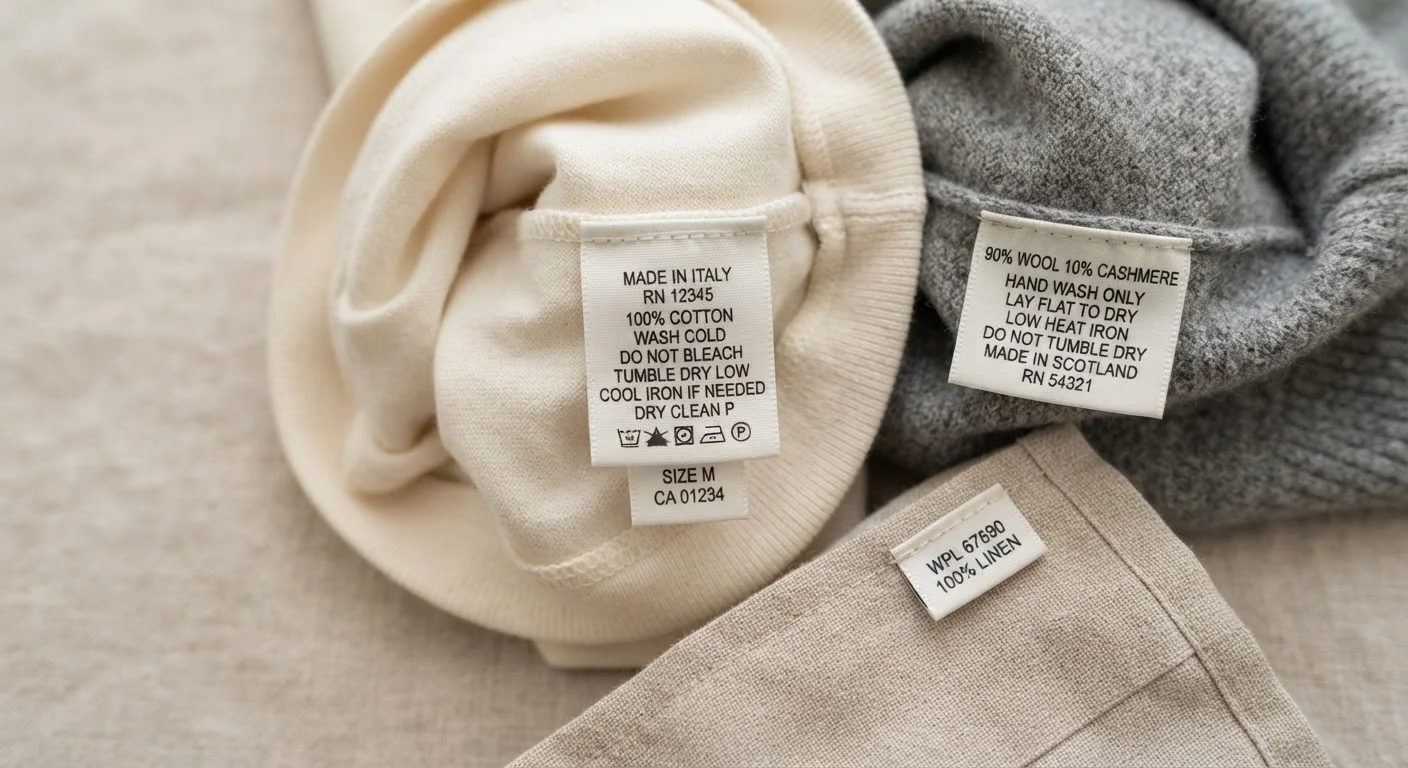
In the U.S., the Textile Fiber Products Identification Act requires manufacturers to list every fiber making up 5% or more of a fabric's weight, in descending order. That means the first ingredient listed is the dominant one - and the proportions matter significantly for performance and durability.
A few key things to understand:
- 100% natural fibers (cotton, wool, linen, silk) tend to breathe well and age predictably, but may shrink or wrinkle more than blends.
- Synthetic fibers (polyester, nylon, acrylic) generally resist moisture and hold their shape, but can trap heat and pill over time depending on construction quality.
- Blends are engineered trade-offs. A 60% cotton / 40% polyester shirt, for instance, is designed to combine cotton's comfort with polyester's wrinkle resistance - neither fully one nor the other.
- Fiber quality within categories varies. "100% wool" can mean anything from fine merino to coarse generic wool. The label tells you the category, not the grade - so weight, yarn twist, and hand-feel still matter.
Fiber content label
A required tag listing the types and percentages of fibers in a textile product, by weight, in descending order. It tells you what a fabric is made of, though not the quality grade of those fibers.
Bonded leather
A material made from shredded leather scraps bonded to a fiber or polyurethane backing. It contains real leather but behaves more like a synthetic and tends to peel or crack sooner than full-grain or top-grain leather.
Engineered wood
A category of wood-based products - including plywood, MDF, and particleboard - made from wood fibers, veneers, or chips bonded with adhesives. Properties vary significantly by product type.
Alloy grade
A standardized designation that identifies the composition of a metal alloy, such as 6061 aluminum or 18/10 stainless steel. The grade indicates specific ratios of elements that determine strength, corrosion resistance, and other properties.
Zamak (zinc alloy)
A family of alloys made primarily of zinc with small amounts of aluminum and copper, commonly used in die-cast hardware and fixtures. It is lighter and less expensive than brass but more brittle under mechanical stress.
Wood veneer
A thin slice of real wood applied to the surface of an engineered wood substrate. It provides the appearance of solid wood at lower cost, but the durability depends heavily on the core material beneath.
When a fabric is labeled "genuine leather" versus "bonded leather" versus "faux leather," those distinctions carry real implications for durability. Genuine leather is a natural hide; bonded leather is reconstituted scrap adhered to a backing and tends to peel sooner; faux (synthetic) leather varies widely in longevity depending on the base material.
Metal and Alloy Labels: Cutting Through Grade Confusion
Metal products - cookware, fasteners, tools, cutlery - often reference grades or alloys that sound meaningful but require context to interpret.
"Surgical Steel" Is a Marketing Term, Not a Standard
You'll see "surgical steel" on everything from earrings to kitchen knives, but there is no single standardized alloy behind the phrase. It's commonly used to imply medical-grade quality without a binding specification. If precision matters - for implant-grade jewelry, for example - look for a specific ASTM or ISO grade designation rather than the marketing label alone.
- Stainless steel grades: "18/10" refers to the chromium and nickel content (18% chromium, 10% nickel). Higher nickel content generally improves corrosion resistance and luster. "18/0" is also stainless but contains no nickel - it's more magnetic and slightly more prone to rust over time.
- Aluminum alloys: A four-digit number like 6061 or 7075 identifies the alloy series. The 7000 series is stronger and used in aerospace-grade applications; 6000 series is more common and still robust for most consumer uses. A label simply saying "aluminum" tells you little about strength.
- Brass vs. zinc alloy (zamak): Both are used in hardware and fixtures. Brass (copper-zinc) is denser, more corrosion-resistant, and holds threads better. Zinc alloy is lighter and cheaper to cast but more brittle under stress. Labels may say "solid brass" or "die-cast metal" - the latter is often zamak.
For more on how spec sheets handle - and sometimes obscure - material details, see reading between the lines of a product spec sheet.
Wood and Composite Labels: Solid vs. Engineered
Wood labeling has less federal standardization than textiles, so terminology can be used loosely. These distinctions are worth knowing:
- Solid wood means the piece is made from milled lumber of a single species. It can be refinished and typically lasts longer.
- Engineered wood covers a range of products - plywood (layers of veneer glued cross-grain), MDF (medium-density fiberboard, made from wood fibers and resin), and particleboard (compressed wood chips). These aren't inherently inferior - plywood, for instance, resists warping better than solid wood in some applications - but they respond differently to moisture and wear.
- Wood veneer is a thin slice of real wood applied over an engineered core. It looks like solid wood but behaves more like its substrate underneath.
- Species names can be used creatively. "Asian hardwood" is not a species - it's a category that could include dozens of different trees with varying density and durability.
It also helps to understand that country-of-origin labels don't tell you whether wood was responsibly sourced or what grade of lumber was used. Our article on why "Made in" labels tell an incomplete story covers this in more depth.
This article provides general consumer education about product labeling and is not a substitute for professional advice when making significant purchasing decisions. Label regulations may vary and change over time; verify current requirements with the relevant regulatory body.
The content on this site is for informational purposes only and is not a substitute for professional advice. Always consult a qualified professional for guidance specific to your situation.