

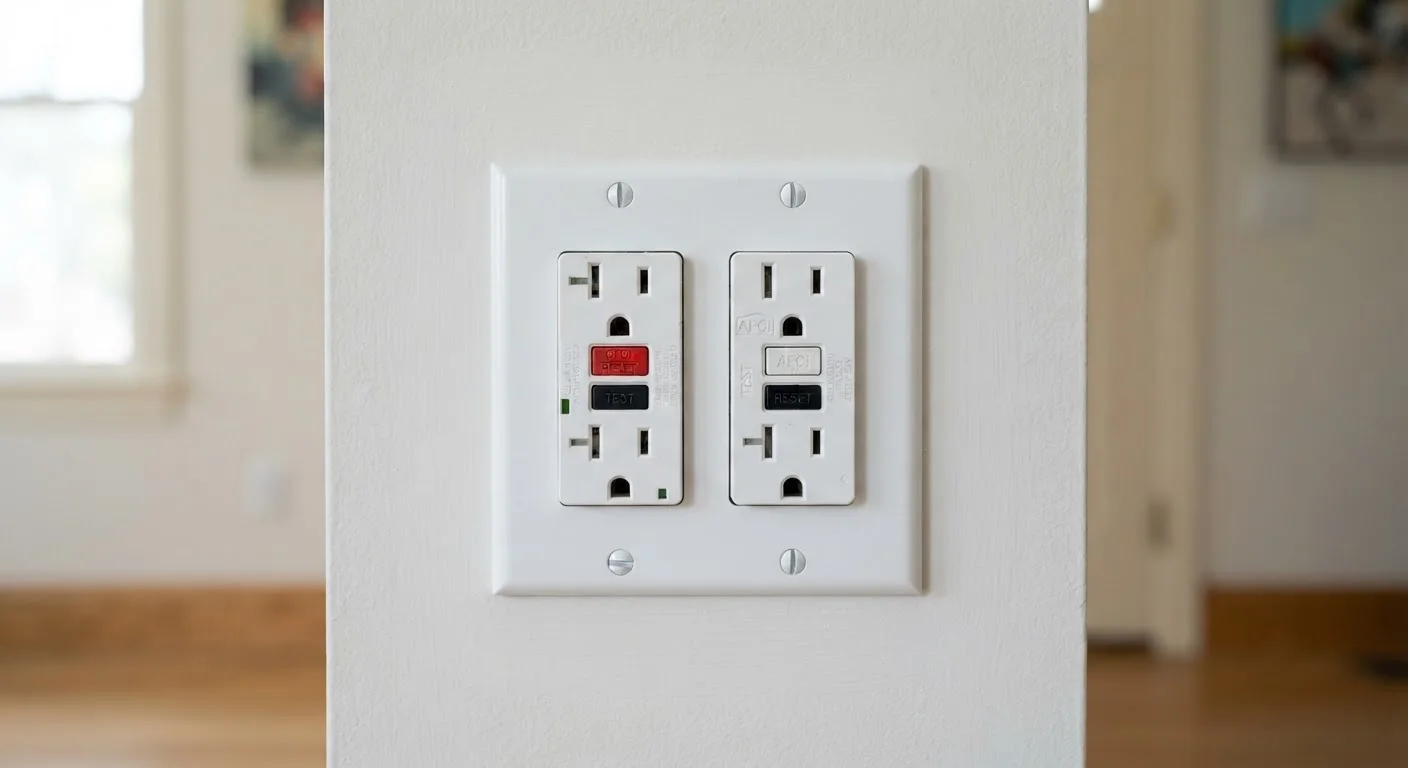
Option A
GFCI (Ground Fault Circuit Interrupter)
The shock-prevention specialist for wet locations.
Best for: Kitchens, bathrooms, garages, and outdoor areas where water and electricity may come into contact.
Option B
AFCI (Arc Fault Circuit Interrupter)
The fire-prevention specialist for hidden wiring hazards.
Best for: Bedrooms, living rooms, and other areas where damaged or aging wiring could produce dangerous electrical arcs.
Two Devices, Two Very Different Threats
At first glance, a GFCI outlet and an AFCI outlet are nearly impossible to tell apart. Both have small buttons labeled TEST and RESET. Both cut power when they detect a problem. But the problems they detect - and the dangers they prevent - are fundamentally different.
A Ground Fault Circuit Interrupter (GFCI) monitors the balance of current flowing out through the hot wire and returning through the neutral wire. When those two values diverge by as little as 4-6 milliamps - meaning current is taking an unintended path, potentially through a person - the GFCI trips in as little as 1/40th of a second. That speed is fast enough to prevent a lethal shock in most scenarios. This is why GFCIs belong wherever electricity and moisture can meet: kitchen counters, bathroom outlets, garages, pools, and outdoor receptacles.
An Arc Fault Circuit Interrupter (AFCI) works differently. It continuously analyzes the electrical waveform on the circuit, looking for the distinctive signature of an arc - the kind of irregular, high-energy discharge that occurs when wiring is damaged, connections are loose, or a cord is pinched under furniture. These arcs don't necessarily trip a standard breaker, because the current involved may not be high enough. But they generate intense heat and can ignite insulation or framing inside walls. AFCIs are designed to recognize that waveform pattern and disconnect the circuit before a fire starts.
| Criterion | GFCI | AFCI |
|---|---|---|
| Primary hazard prevented | Electric shock | Electrical fire |
| What it detects | Current leaking to ground (imbalance) | Arcing waveform in circuit |
| Trip threshold | ~4-6 milliamp ground fault | Arc signature in waveform analysis |
| Typical locations required | Kitchens, baths, garages, outdoors | Bedrooms, living rooms, most living spaces |
| NEC requirement since | 1971 (expanded over decades) | 1999 (bedrooms); broader since 2014 |
| Available as | Outlet receptacle or panel breaker | Outlet receptacle or panel breaker |
| Can replace the other? | No | No |
Where Building Codes Require Each
The National Electrical Code (NEC) - which most U.S. jurisdictions adopt, sometimes with a lag - specifies where each device type is mandatory. Local codes can be stricter or use older editions, so always verify requirements with your local authority having jurisdiction (AHJ) or a licensed electrician.
GFCI requirements have been in the NEC since 1971 and now extend to bathrooms, kitchens (countertop receptacles), garages, crawl spaces, unfinished basements, outdoor outlets, boathouses, and areas near swimming pools and hot tubs.
AFCI requirements are more recent. The 2014 NEC expanded mandatory AFCI protection to nearly all 15- and 20-amp circuits in dwelling units - including bedrooms, living rooms, hallways, and dining rooms. The 2020 NEC broadened this further. However, because many jurisdictions adopt code updates years after they're published, a home built in 2010 under a 2005 code edition may legally have AFCI protection only in bedrooms.
Combination AFCI/GFCI Devices Exist
In areas where both types of protection are required - such as a kitchen with an older wiring system - combination AFCI/GFCI breakers and outlet receptacles are available. These satisfy both requirements with a single device. They're more complex and typically cost more than single-function units, but they eliminate the need to install two separate devices on one circuit. Ask a licensed electrician whether a combination device is appropriate for your specific situation and local code edition.
For a broader look at how to interpret your home's electrical panel and understand what protection is already in place, see our guide to reading your circuit breaker panel.
Installation, Testing, and What Homeowners Can Do
Both GFCI and AFCI devices are available in two forms: as outlet receptacles (the plug-in type you see on the wall) or as breakers installed in the electrical panel. A GFCI outlet protects only the receptacles downstream on that circuit; a GFCI breaker protects everything on the circuit. The same logic applies to AFCIs.
Testing regularly is the most important maintenance task. Both devices have a TEST button for a reason. Pressing it should immediately cut power to the outlet; pressing RESET restores it. Most manufacturers and electrical safety organizations recommend testing these devices monthly. A GFCI or AFCI that fails the test - meaning power doesn't cut when you press TEST - should be replaced promptly.
Installation considerations: Replacing an existing standard outlet with a GFCI receptacle is a task some experienced DIYers undertake, but working inside an electrical panel - including installing AFCI or GFCI breakers - should be left to a licensed electrician. Electrical panel work carries serious shock and fire risk, and permits or inspections are typically required. If you're noticing signs that your home's wiring may need attention beyond routine outlet swaps, review what warning signs may indicate a wiring problem before proceeding.
If you're planning a larger renovation or an inspection, knowing what to expect ahead of time helps. Our article on what homeowners should know before an electrical inspection covers how inspectors evaluate protection devices and what findings typically require follow-up.
This article provides general educational information about residential electrical safety devices. It is not a substitute for guidance from a licensed electrician, and all electrical work should comply with local codes and be performed by qualified professionals where required.
The content on this site is for informational purposes only and is not a substitute for professional advice. Always consult a qualified professional for guidance specific to your situation.