

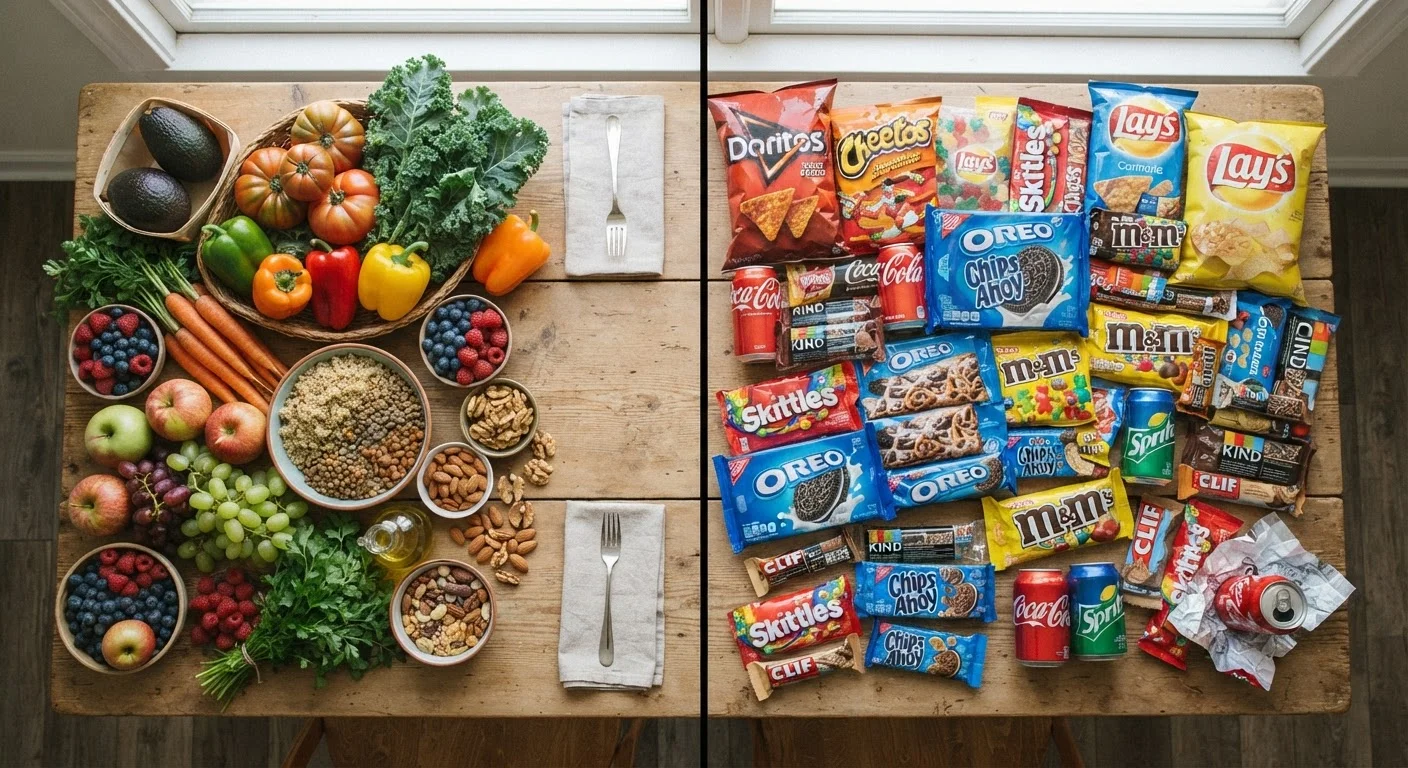
Option A
Whole Foods
Foods in their natural or minimally altered state.
Best for: People looking to maximize nutrient density and minimize added ingredients in their everyday eating.
Option B
Processed Foods
Foods altered from their original form during manufacturing.
Best for: Convenience-driven eating situations, though the degree of processing varies widely and matters greatly.
Defining the Terms: What Do 'Whole' and 'Processed' Actually Mean?
The phrase whole food refers to any food eaten in its natural or near-natural state - think fresh fruit, raw nuts, dried legumes, plain oats, or a fillet of fish. These foods haven't been significantly altered by manufacturing. They may be washed, cut, or frozen, but their fundamental nutritional structure remains intact.
Processed food is a much broader category. Food scientists and public health researchers commonly use the NOVA classification, which organizes foods into four groups based on the extent and purpose of processing - from minimally processed (plain frozen vegetables) to ultra-processed (packaged snacks engineered with industrial ingredients). That distinction is important: a bag of pre-washed baby carrots is technically processed, but it's nutritionally worlds apart from a flavored chip with a 30-ingredient label.
When nutrition conversations focus on the risks of processed foods, they're typically referencing the ultra-processed end of the spectrum - products reformulated with refined starches, added sugars, hydrogenated fats, artificial colorings, and preservatives. Understanding this spectrum helps avoid the false assumption that all packaged food is harmful or that avoiding processing entirely is either realistic or necessary.
| Criterion | Whole Foods | Processed Foods (Ultra-Processed End) |
|---|---|---|
| Ingredient complexity | One or very few recognizable ingredients | Often 10-30+ ingredients, many industrial |
| Fiber content | Naturally high in many whole plant foods | Often removed or significantly reduced |
| Added sugars | None added; natural sugars only | Frequently added in multiple forms |
| Sodium levels | Naturally low in most whole foods | Often elevated for flavor and preservation |
| Vitamins & minerals | Retained in natural matrix | May be lost in processing; sometimes re-added |
| Shelf life | Shorter; requires refrigeration or use soon | Extended through preservatives and packaging |
| Convenience | Requires preparation; perishable | Ready-to-eat or quick to prepare |
Nutrient Density: Where Whole Foods Have a Clear Advantage
One of the most meaningful differences between whole and ultra-processed foods is nutrient density - the ratio of beneficial nutrients to calories. Whole foods tend to deliver vitamins, minerals, antioxidants, and fiber alongside their calories. Ultra-processed foods often deliver calories with relatively fewer of these co-nutrients. For a deeper look at how this concept works, see our guide on nutrient density vs. calorie density.
Fiber is one of the clearest illustrations of this gap. Whole grains, legumes, fruits, and vegetables are among the richest dietary fiber sources available. Refining grains - a common processing step - removes the bran and germ layers where most fiber and micronutrients live. The end product is smoother and shelf-stable, but nutritionally leaner. Learn more about fiber's role in why fiber matters for digestive health.
Processing also affects fats. Many ultra-processed foods contain refined oils or partially hydrogenated fats that weren't part of the original food. For a grounded explanation of how different fat types compare, our fat explainer covers the key distinctions.
~57%
Share of U.S. calories from ultra-processed foods
Research published in BMJ Open estimated that ultra-processed foods accounted for roughly 57% of energy intake among U.S. adults based on national dietary survey data.
Up to 90%
Fiber loss during grain refining
Studies on grain milling indicate that refining whole grains into white flour can remove the majority of their dietary fiber, along with key B vitamins and minerals.
5 or fewer
Ingredients in most minimally processed foods
Nutrition educators commonly use a short, recognizable ingredient list as a practical proxy for lower levels of processing when evaluating packaged foods.
Ingredients Lists and Labels: Reading Between the Lines
A practical way to assess a food's level of processing is to look at its ingredient list alongside the Nutrition Facts panel. Whole foods generally have no ingredient list - or one that matches exactly what you'd expect. A can of black beans ideally lists: black beans, water, salt. An ultra-processed product may list dozens of inputs, many unrecognizable as food in their own right.
Added sugars are one of the most significant markers. Sugars occur naturally in fruit and dairy, but ultra-processed foods frequently add sweeteners - under names like high-fructose corn syrup, dextrose, or maltose - that aren't inherently part of the original ingredient. The difference between naturally occurring and added sugars is explored more fully in our article on natural sugars vs. added sugars.
If decoding a Nutrition Facts panel feels confusing, our guide to reading a Nutrition Facts label walks through every line in plain language. Developing this skill helps consumers make more informed choices regardless of where a food lands on the processing spectrum.
This article is for general informational and educational purposes only and is not a substitute for personalized medical or dietary advice. Consult a qualified healthcare or nutrition professional for guidance tailored to your individual health circumstances.
The content on this site is for informational purposes only and is not a substitute for professional advice. Always consult a qualified professional for guidance specific to your situation.