

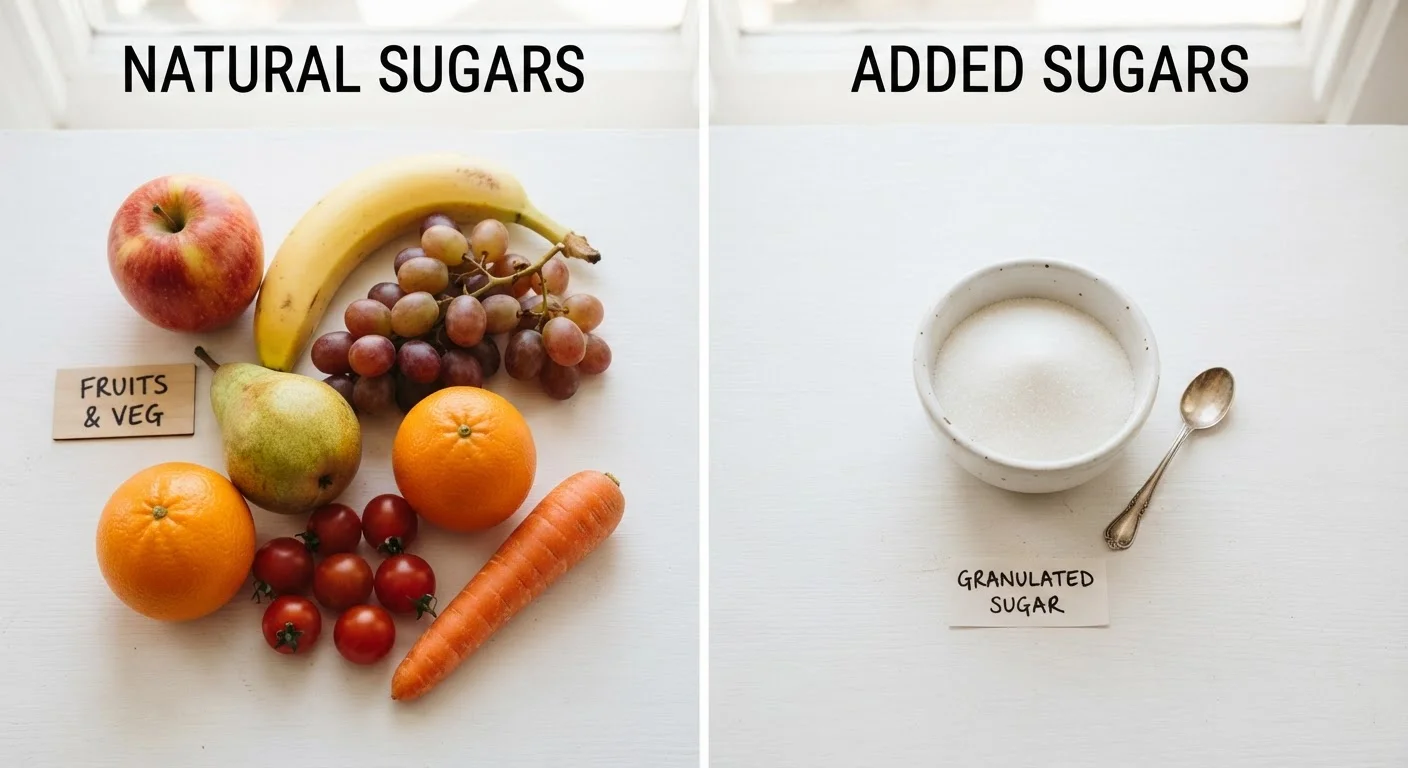
Option A
Natural Sugars
Sugars that occur inherently within whole foods.
Best for: People seeking to understand the nutritional context sugars carry when packaged inside whole foods like fruit, dairy, and vegetables.
Option B
Added Sugars
Sugars incorporated into foods during processing or preparation.
Best for: People trying to identify and moderate sources of sugar that deliver calories with little accompanying nutritional value.
What Makes a Sugar 'Natural' or 'Added'?
The terms sound straightforward, but the distinction goes beyond where sugar physically comes from. Natural sugars are those that exist inherently within a food - lactose in milk, fructose in an apple, or glucose in a carrot. Added sugars, by contrast, are any sugars or caloric sweeteners introduced to a food during processing, manufacturing, or home preparation. This includes cane sugar stirred into oatmeal, high-fructose corn syrup in a soft drink, and honey drizzled onto yogurt.
Chemically, the molecules can be identical. A gram of fructose from an orange and a gram of fructose from a processed snack bar are structurally the same. What differs profoundly is the nutritional company that sugar keeps - and that context changes how the body responds to it.
Understanding this difference is a foundational nutrition skill. If you want to put it into practice while shopping, reading a Nutrition Facts label is the logical next step.
How the Body Handles Each Type
When you eat an apple, its natural sugars arrive wrapped in dietary fiber, water, and micronutrients. The fiber slows digestion, moderating the rate at which sugar enters the bloodstream. The vitamins and minerals contribute to overall nutritional status. The result is a more gradual metabolic response compared with consuming an equivalent amount of added sugar in a sweetened beverage, where there is little fiber to slow absorption.
Added sugars in processed foods often come without this buffering matrix. Absorbed more quickly, they can produce sharper rises in blood glucose. Over time, consistently high intakes of added sugars have been associated in population research with higher risks of weight gain, dental cavities, and certain cardiometabolic concerns - though it is important to recognize that diet is complex and individual responses vary.
17 tsp
Average daily added sugar intake for U.S. adults
According to federal dietary survey data, the average American adult consumes roughly 17 teaspoons of added sugar per day - well above recommended limits.
~10%
Recommended daily calorie limit from added sugars
The 2020-2025 Dietary Guidelines for Americans advise limiting added sugars to less than 10% of total daily caloric intake.
39%
Share of added sugar from beverages in U.S. diet
Sweetened drinks - including sodas, energy drinks, and fruit-flavored beverages - account for the largest single share of added sugar in the American diet, per CDC dietary data.
This does not mean natural sugars are entirely consequence-free. Consuming very large quantities of high-sugar whole foods can still affect blood glucose and calorie intake. The key insight is that the nutritional package surrounding sugar matters enormously - a point that connects directly to the broader conversation about whole foods versus processed foods.
Side-by-Side: Natural vs. Added Sugars
The table below contrasts the two across the criteria most relevant to everyday food choices.
| Criterion | Natural Sugars | Added Sugars |
|---|---|---|
| Source | Inherent in whole foods | Added during processing or cooking |
| Common food examples | Fruit, milk, plain yogurt, vegetables | Sodas, candy, sweetened cereals, sauces |
| Accompanying nutrients | Fiber, vitamins, minerals, water | Generally minimal nutritional extras |
| Absorption rate | Typically slower due to fiber matrix | Often faster; fewer buffers present |
| Listed separately on label? | No - part of Total Sugars only | Yes - shown as Added Sugars line |
| Federal dietary guidance | No specific limit set | Limit to under 10% of daily calories |
| Dental health impact | Lower risk in whole food form | More strongly linked to tooth decay |
One practical note: fiber content is a reliable proxy for the nutritional richness surrounding natural sugars. Foods high in fiber tend to temper sugar absorption more effectively. For a deeper look at why fiber matters, see our guide on dietary fiber.
Spotting Added Sugars on Labels and in Everyday Foods
Since 2020, updated Nutrition Facts panels in the United States are required to list Added Sugars as a separate line beneath Total Sugars, expressed both in grams and as a percentage of the Daily Value. This makes it considerably easier to distinguish a food's inherent sugar content from what was introduced during production.
How to Read the Added Sugars Line
On updated Nutrition Facts labels, 'Added Sugars' appears indented under 'Total Sugars.' The grams listed represent only sugars added during production - not those naturally present. The % Daily Value is based on a reference of 50 grams of added sugar per day for a 2,000-calorie diet. A food with 5g of added sugars carries 10% of that daily reference amount. This distinction was not visible on older label formats.
Added sugars appear under more than 60 different names on ingredient lists. Common examples include corn syrup, cane juice, dextrose, maltose, agave nectar, and molasses. Scanning the ingredient list - not just the Nutrition Facts panel - helps identify these sources. Sweetened beverages, flavored yogurts, breakfast cereals, condiments, and packaged snacks are among the highest contributors to added sugar intake in the American diet, according to federal dietary surveillance data.
Natural sugars, by comparison, are found in whole and minimally processed foods: fresh and frozen fruit, plain dairy products, and most vegetables. These foods rarely carry an ingredient list at all - a useful rule of thumb for identifying them.
This article is for general informational and educational purposes only and does not constitute medical or dietary advice. Consult a qualified healthcare professional before making changes to your diet, especially if you have a health condition such as diabetes.
The content on this site is for informational purposes only and is not a substitute for professional advice. Always consult a qualified professional for guidance specific to your situation.