

Why Tire Maintenance Matters
Tires are your vehicle's only contact with the road. Every safety system on a modern car - anti-lock brakes, stability control, traction control - relies entirely on those four patches of rubber gripping the pavement. When tires are underinflated, worn, or damaged, those systems can't do their job.
The good news is that tire maintenance is straightforward and mostly inexpensive when done consistently. Most problems develop slowly and are easy to catch early. Neglecting tires, on the other hand, creates compounding costs: poor fuel economy, premature wear, and eventually the safety risk of a tire failure at speed.
If you're new to vehicle ownership, this guide pairs well with our beginner's car maintenance overview, which covers foundational service concepts.
Maintaining Correct Tire Pressure
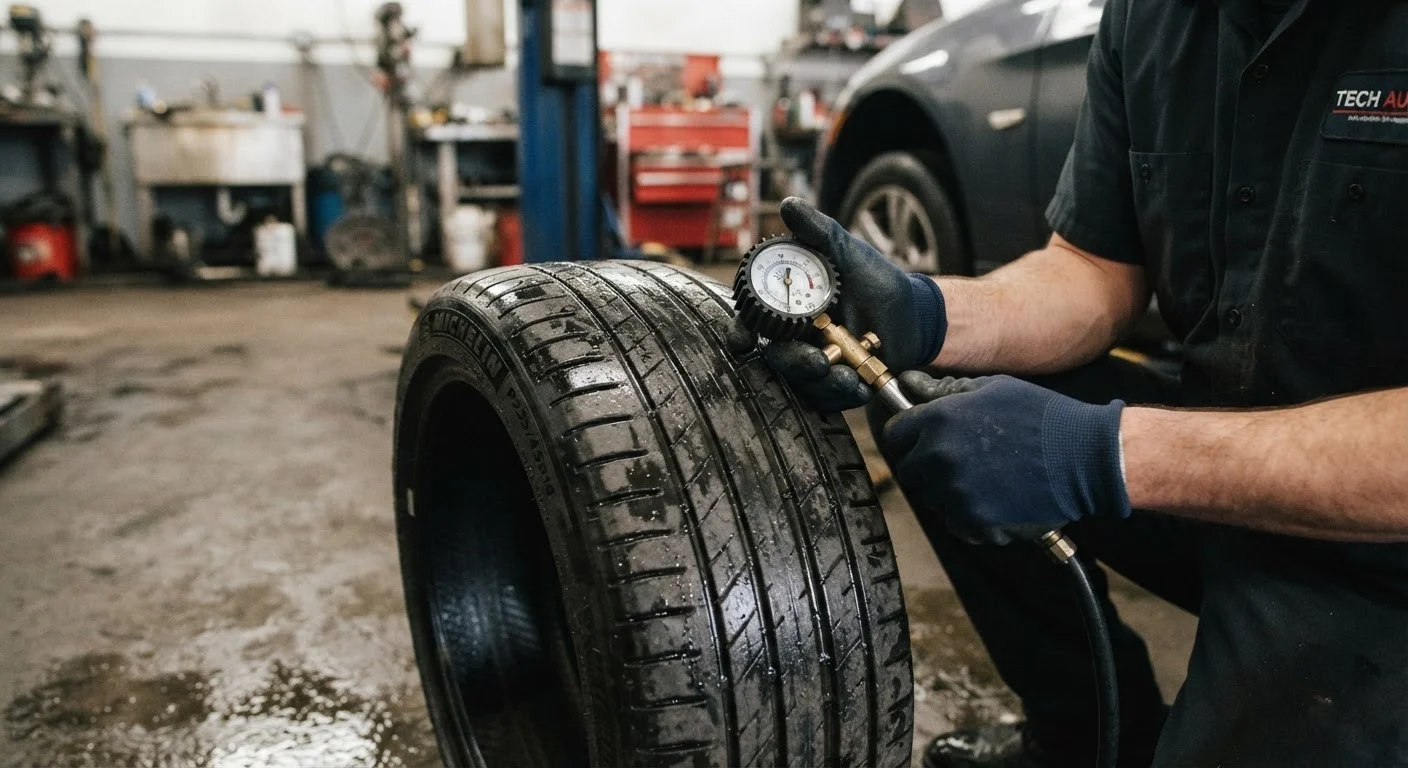
Tire pressure is the most frequently neglected-and most impactful-aspect of tire care. The correct pressure for your vehicle is listed on a sticker inside the driver's door jamb and in your owner's manual. Do not use the number molded on the tire's sidewall; that figure is the maximum the tire can hold, not the recommended operating pressure.
Most passenger vehicles run between 30 and 35 PSI. Tires naturally lose about 1 PSI per month and an additional 1 PSI for every 10°F drop in temperature, which is why pressure checks are especially important as seasons change.
Underinflation is the more dangerous condition. It increases heat buildup inside the tire, accelerates shoulder wear, and reduces handling response. Overinflation stiffens the ride, reduces the contact patch, and can make the center of the tread wear faster than the edges.
Tire Rotation: When and Why
Front tires steer and, on front-wheel-drive vehicles, also propel the car - they wear faster than rear tires. Rotation moves each tire to a different position on the vehicle, spreading wear more evenly across all four and extending the usable life of the full set.
A common rotation interval is every 5,000-7,500 miles, which conveniently aligns with most oil change schedules. Many drivers pair the two services to simplify scheduling. See what you need to know about oil changes for a full breakdown of that service.
The rotation pattern used (straight, cross, or X-pattern) depends on whether your vehicle is front-, rear-, or all-wheel drive, and whether your tires are directional or non-directional. A qualified technician can confirm the right pattern for your setup.
Reading Tread Wear and Recognizing Damage
Tread depth is measured in 32nds of an inch. New tires typically start at 10/32" to 11/32". Most tires include tread wear indicators - small raised bars molded into the grooves. When the tread surface is flush with these bars, the tire has reached 2/32" and needs replacement.
You can also use the penny test as a rough check: insert a penny into a tread groove with Lincoln's head pointing down. If you can see all of Lincoln's head, the tread is at or below 2/32".
Uneven wear patterns signal underlying issues. Wear only on the shoulders (outer edges) suggests underinflation. Wear only in the center suggests overinflation. One-sided wear usually points to an alignment problem. If you notice any of these patterns, address the root cause - not just the tire.
When to Replace Your Tires
Tread depth is the clearest replacement trigger, but it's not the only one. Age also matters. Rubber degrades over time regardless of mileage. Most tire manufacturers and safety organizations recommend inspecting tires carefully after six years and considering replacement after ten, even if they look fine visually.
Other clear replacement signals include: a nail or screw that has penetrated the tread (some punctures in the central tread area can be repaired, but sidewall punctures cannot), vibration that appears or worsens after balancing, or a tire that repeatedly loses pressure without an obvious cause.
When shopping for replacements, consult your owner's manual for the exact size and load rating. Sticking to the manufacturer's specified tire size is important for maintaining accurate speedometer readings, proper clearance, and suspension geometry.
Seasonal Tire Considerations
All-season tires are designed to perform adequately across a range of conditions, but they represent a compromise. In regions with sustained winter temperatures below 45°F or regular snow and ice, dedicated winter tires offer meaningfully better grip because their rubber compound stays pliable in the cold and their tread patterns are engineered to channel slush and bite into snow.
If you do use winter tires, always mount them as a complete set of four - mixing winter and all-season tires creates imbalanced handling. For a full seasonal maintenance perspective, our seasonal car care guide covers what to check when temperatures swing in either direction.
When storing a seasonal set, keep tires in a cool, dry location away from direct sunlight and sources of ozone (such as electric motors). Proper storage preserves rubber integrity between seasons.
The content on this site is for informational purposes only and is not a substitute for professional advice. Always consult a qualified professional for guidance specific to your situation.