

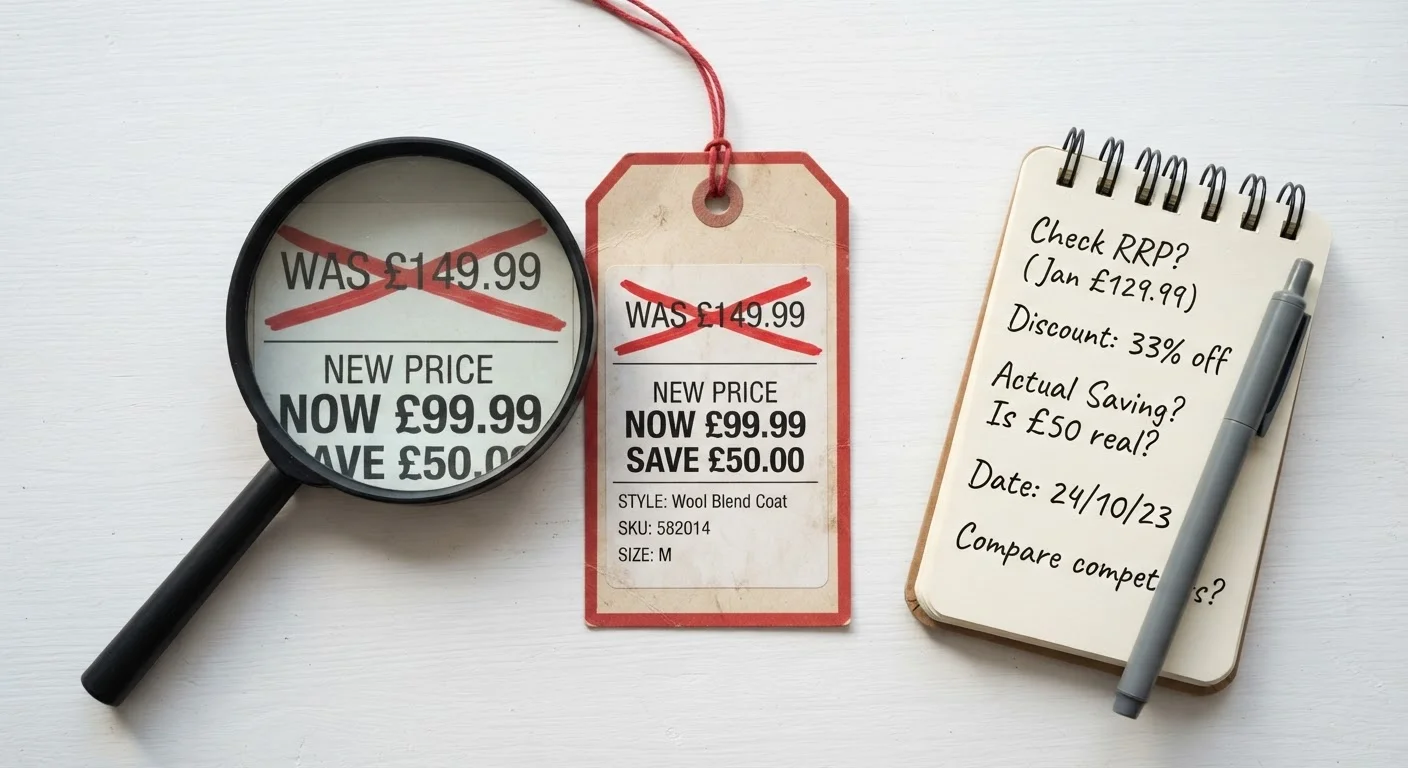
Why the Illusion of a Deal Works So Well
Retailers are skilled at framing prices in ways that feel like savings. The practice is well-documented in consumer psychology research: when shoppers see a higher number crossed out next to a lower one, the brain registers a win - even when the "original" price was rarely, if ever, charged. Understanding the mechanics behind these presentations is the first step to evaluating them clearly.
This isn't about assuming bad faith from every retailer. Many markdowns are legitimate. But the same visual shorthand - the bold slash, the red percentage badge - gets used whether the discount is real or manufactured. Sorting one from the other requires a few consistent habits, not a degree in economics.
For a broader look at how psychological pricing techniques operate at the shelf and checkout level, see our guide to retail pricing tactics.
Myth
A higher "original" price crossed out next to a sale price confirms a genuine markdown.
Fact
Reference prices are sometimes set artificially high and may not reflect what the item was commonly sold for.
In the U.S., the FTC and various state consumer protection laws address reference pricing, but enforcement is inconsistent and the rules leave significant room for interpretation. Retailers may set a "compare at" price based on suggested retail, a brief prior offering, or a competitor's price - none of which guarantee the item ever sold widely at that figure. Checking price history independently gives you a more reliable baseline than the number on the tag.
Myth
Sale events like major shopping holidays reliably offer the deepest prices of the year.
Fact
Analysis of retail pricing data has repeatedly shown that many items sold during high-profile sale events are not at their lowest recorded price.
Multiple consumer research organizations have tracked prices across major retail sale windows and found that a significant share of "deals" are available at equivalent or lower prices at other points in the year. Some items do reach genuine seasonal lows during these events - but many others are simply presented with more prominent discount framing. Checking an item's price history before the event helps identify which category a specific product falls into.
Myth
Buying in bulk or a larger size always costs less per unit.
Fact
Larger package sizes sometimes carry a higher per-unit price than smaller ones, depending on retailer and category.
The assumption that bigger packaging equals better value is common enough that many shoppers don't verify it. Unit price labels on shelves exist precisely because the calculation isn't always obvious. In online retail, unit pricing is less consistently displayed, making the math even easier to miss. Doing the division yourself - total price divided by quantity or weight - takes seconds and regularly surfaces surprising results.
Myth
A countdown timer or "limited stock" notice means an item will actually be unavailable if you wait.
Fact
Many urgency signals in online retail are generated automatically and may not reflect actual inventory constraints.
Dynamic inventory warnings and countdown timers are standard features in e-commerce platforms, and some are triggered by thresholds that have little to do with genuine scarcity. While real stockouts do occur, the presence of a warning alone is not reliable evidence. Checking whether the same item is available from other sellers, or simply waiting a day to see whether the "urgency" was real, is often informative.
Myth
Free shipping always means the total cost is lower than buying locally.
Fact
Free shipping thresholds, handling fees, and delivery timelines can all affect whether the online price is genuinely more economical.
"Free shipping" is a marketing threshold as much as a logistical reality - the cost is often built into product pricing or requires meeting a minimum order value that leads to over-purchasing. For time-sensitive items, expedited shipping fees can eliminate any savings. A complete cost comparison includes the item price, any mandatory fees, shipping, and - critically - what happens if you need to return it. Some retailers charge return shipping, which can substantially change the final math.
Research Habits That Cut Through the Noise
The most reliable defense against illusory savings is a short paper trail. Before purchasing any item where the discount is a significant factor in your decision, a few minutes of price history research can save real money - and real regret.
~60%
Sale items not at lowest annual price
Consumer research tracking retail pricing across major sale events has found that roughly 60% of discounted items were available at the same or lower price at another point during the year.
2-4 weeks
Typical pre-sale price inflation window
Price tracking data across major retailers has shown that many items see a price increase in the two to four weeks before a planned promotional event.
Track prices before major sale events. Many items that appear heavily discounted during promotional periods were quietly raised in price in the weeks prior. Browser extensions and dedicated price-tracking websites log historical pricing for major retail platforms, making it easy to see whether a "sale" price is actually below the item's normal selling range.
Use unit pricing as your baseline. Supersized packaging often carries a higher per-unit cost than the standard size, despite appearing to offer more for less. Most grocery stores are legally required to display unit pricing on shelf tags - apply the same logic when evaluating bulk or multipacks online.
Factor in the full cost of ownership. A lower headline price can mask mandatory fees, shipping charges, or return restrictions that shift the real value. Before you finalize a purchase, review what the total landed cost will be and whether the return policy leaves you protected if the item doesn't meet expectations. Our article on return policy fine print breaks down the clauses most shoppers overlook.
It's also worth remembering that price alone says little about quality. The relationship between what something costs and how well it performs is weaker than intuition suggests - a point explored in depth in our piece on price versus quality assumptions.
Watch for Return Policy Restrictions on Sale Items
Some retailers apply shorter return windows, restocking fees, or "final sale" designations specifically to discounted merchandise. A price reduction that comes with a non-returnable condition shifts real financial risk to the buyer. Always confirm the return terms before purchasing a marked-down item, especially for higher-ticket purchases. Our article on return policy fine print covers the clauses most commonly missed.
Timing, Patience, and Avoiding Buyer Mistakes
Urgency is one of the most effective levers retailers use to accelerate purchasing decisions. Countdown timers, "only 3 left" notices, and flash sale windows all compress the time a shopper has to think critically. In many cases, that pressure is a feature of the sales environment, not an accurate reflection of supply.
Patience is a genuine savings tool. For non-urgent purchases, setting a price alert and waiting for the item to reach a target price - rather than buying under artificial time pressure - tends to produce better outcomes. Categories like consumer electronics, bedding, and seasonal apparel follow reasonably predictable sale cycles that reward shoppers who plan ahead rather than react.
Finally, consider what you're comparing. A deal is only as real as the alternative you're measuring it against. Comparing a "discounted" price to the inflated reference price shown on the same page is the comparison the retailer wants you to make. Comparing it to the item's 90-day price average, or to the cost of a comparable product, gives you a more useful baseline. For insight into similar dynamics in travel and hospitality pricing, our guide to hidden trip costs applies the same scrutiny to a different category.
The content on this site is for informational purposes only and is not a substitute for professional advice. Always consult a qualified professional for guidance specific to your situation.