

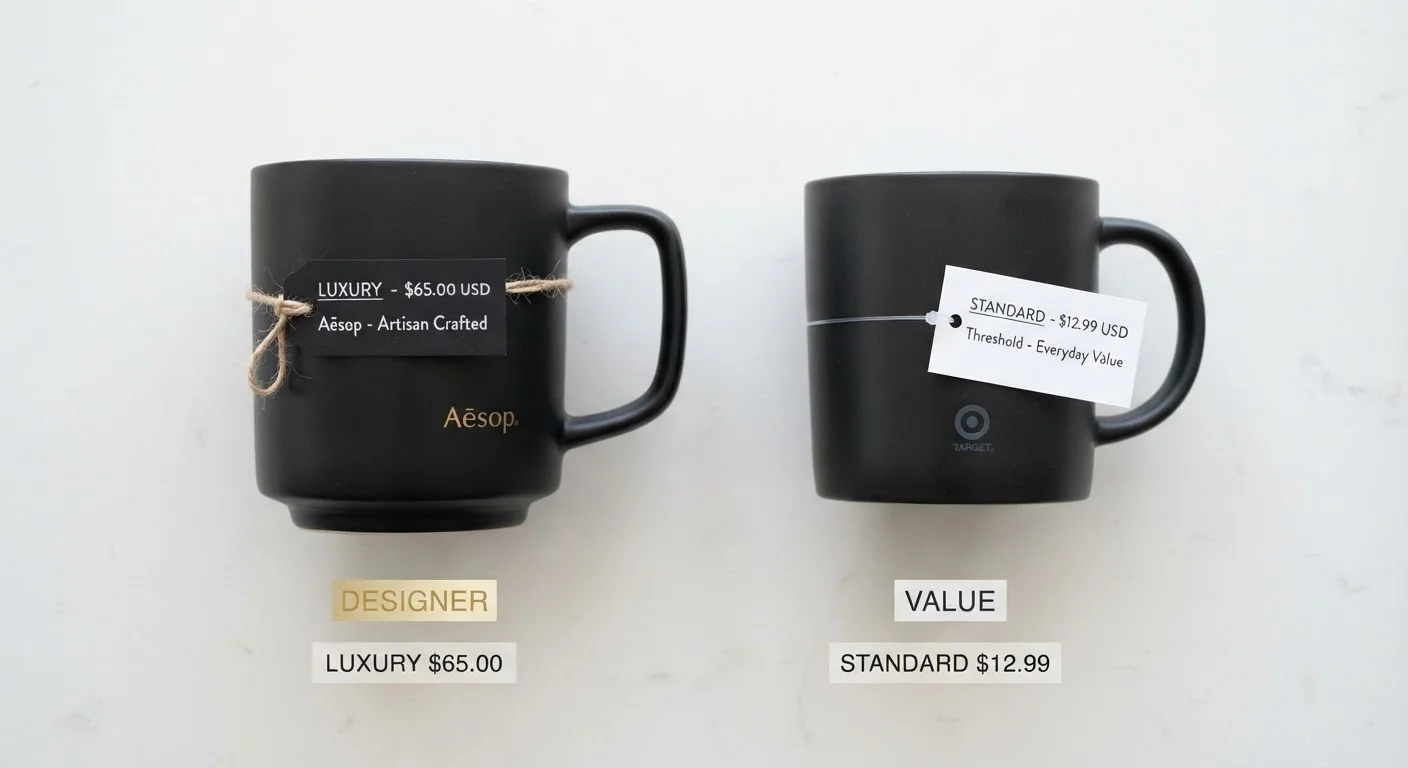
The Psychology Behind the Price-Quality Shortcut
Most of us have made the mental leap at least once: the more expensive option must be the better one. It's an understandable heuristic. When information is scarce or technical knowledge is thin, price feels like a trustworthy summary of everything we don't know. Behavioral economists call this the price-quality heuristic - a cognitive shortcut that substitutes cost for the harder work of actual evaluation.
The problem is that price is a signal of many things simultaneously: manufacturing cost, yes, but also marketing spend, distribution overhead, retail margin, brand licensing, and perceived status. None of those factors directly translate into a product that performs better or lasts longer. A perfume priced at $200 may share nearly identical ingredients with a $40 alternative. A kitchen appliance may cost twice as much largely because it occupies premium shelf space in a specialty retailer.
Understanding why we default to this shortcut is the first step toward overriding it. When you feel the pull of a high price as a quality signal, that's the heuristic at work - not evidence.
Myth
If a product costs more, it must be made with better materials or workmanship.
Fact
Price reflects many variables beyond production quality, including marketing, distribution, and brand positioning.
Manufacturing cost is only one input into retail price. Studies examining price-quality correlations across consumer goods categories have repeatedly found the relationship to be modest at best. A higher price often reflects where and how a product is sold, how heavily it is advertised, or what brand name appears on the label - not what it's made of or how well it performs. Scrutinizing material specs and independent test results gives you far better information than the price tag alone.
Myth
Discount or store-brand products are always lower quality than name-brand equivalents.
Fact
Many store-brand and value-tier products are manufactured in the same facilities as premium-priced alternatives, sometimes with identical formulations.
Contract manufacturing is widespread. A retailer's private-label product and a national brand may come off the same production line. This is especially documented in categories like over-the-counter pharmaceuticals, pantry staples, and household cleaning products, where active ingredients and formulations are regulated and comparable. The name-brand premium often reflects advertising investment rather than a meaningfully different product.
Myth
A steep discount from a high original price means you're getting great value.
Fact
Original prices are often set artificially high to make discounts appear more dramatic than they are.
Anchor pricing - establishing a high reference price so that a marked-down figure looks like a bargain - is a well-documented retail tactic. A product that retails at $200 and is perpetually on sale for $80 may simply have a manufactured anchor. The relevant question isn't how far the price has dropped from its stated original, but whether the current price reflects genuine market value. Our piece on sorting real savings from the illusion of a deal covers this in detail.
Myth
Premium-priced products always last longer and require fewer replacements.
Fact
Longevity depends on design intent, materials, and use conditions - not price tier.
Some high-priced products are designed for aesthetic appeal or a specific market segment rather than extended functional life. Conversely, mid-range products engineered for reliability may outlast flashier premium options in real-world use. Without data from independent durability testing or verified user experience over time, price is a poor predictor of how long something will actually hold up under your specific conditions.
Myth
If a brand is well-known and commands premium prices, its quality must be consistently high.
Fact
Brand recognition reflects marketing success and consumer familiarity, not a guaranteed standard of quality across all products.
Brands extend into product lines where their core competency doesn't apply, license their names to third-party manufacturers, or maintain legacy reputations built before quality declined. A strong brand name earned in one category doesn't automatically transfer to another. Evaluating each product on its own merits - materials, certifications, independent reviews - is more reliable than assuming the brand umbrella covers everything equally.
What Actually Drives Price Up
To see through price as a quality proxy, it helps to understand what genuinely inflates it. Several factors routinely drive up retail cost without meaningfully improving the product you take home.
- Brand premium: Established names command higher prices partly because of consumer trust and partly because marketing spend must be recouped. As explored in our look at brand reputation as a quality signal, a well-known name isn't always backed by superior construction or materials.
- Retail channel markup: Where a product is sold affects its price significantly. Specialty boutiques and department stores carry higher overhead than online-direct or warehouse models, and those costs are passed along.
- Packaging and presentation: Premium unboxing experiences, heavy glass bottles, and embossed labeling are production costs that add to price without adding to function.
- Positioning strategy: Some brands deliberately price high to signal exclusivity, regardless of underlying material differences from lower-priced alternatives.
None of these factors are inherently dishonest - businesses have real overhead - but they mean price can drift far from quality. For a closer look at how retailers engineer your price perception from the start, see our piece on retail pricing tactics and what they actually signal.
Don't Let Urgency Short-Circuit Your Evaluation
Flash sales and countdown timers are specifically designed to compress the time you spend evaluating a purchase. When a high price is suddenly 'discounted,' the combination of perceived savings and time pressure can override careful scrutiny. Pause before any high-pressure purchase and ask whether you've actually checked the product's specifications and independent reviews - not just the price drop.
Better Signals to Rely On Instead
If price is an unreliable guide, what should you actually look at? Several more concrete signals do a better job of predicting quality.
Material specifications: Look past marketing language and find the actual specs - thread count verified by an independent standard, gauge of steel, certifications for food-contact safety, or IP ratings for water resistance. These are harder to fake and more directly tied to performance. Our guide to evaluating product quality walks through how to assess materials and construction category by category.
Third-party certifications: Look for marks from recognized independent bodies relevant to the product category - energy efficiency ratings, safety certifications, or industry standards organizations. These represent external validation rather than a manufacturer's own claims.
Independent testing results: Consumer testing organizations publish comparative evaluations across price tiers. Products that score well at mid-range prices are common findings. When you can't examine a product in person, verified specs and documentation become even more valuable - a skill covered in depth in our piece on evaluating quality when shopping online.
It also helps to separate durability from longevity - two quality dimensions that often get conflated. A product can be built tough but still have a shorter useful life than a lighter one, depending on design intent and conditions of use. For more on that distinction, see our article on durability vs. longevity.
For practical strategies on building these habits more broadly, the Smarter Buying Habits hub is a useful starting point.
~0.25
Average price-quality correlation across consumer goods
A meta-analysis published in the Journal of Marketing Research found the average correlation between price and objective quality across consumer goods categories was roughly 0.25 - a weak positive relationship, not the strong link most shoppers assume.
~80%
Share of U.S. groceries available as private label
According to the Private Label Manufacturers Association, private-label products are available in roughly 80% of U.S. grocery categories, many produced in shared facilities with national brands.
The content on this site is for informational purposes only and is not a substitute for professional advice. Always consult a qualified professional for guidance specific to your situation.