

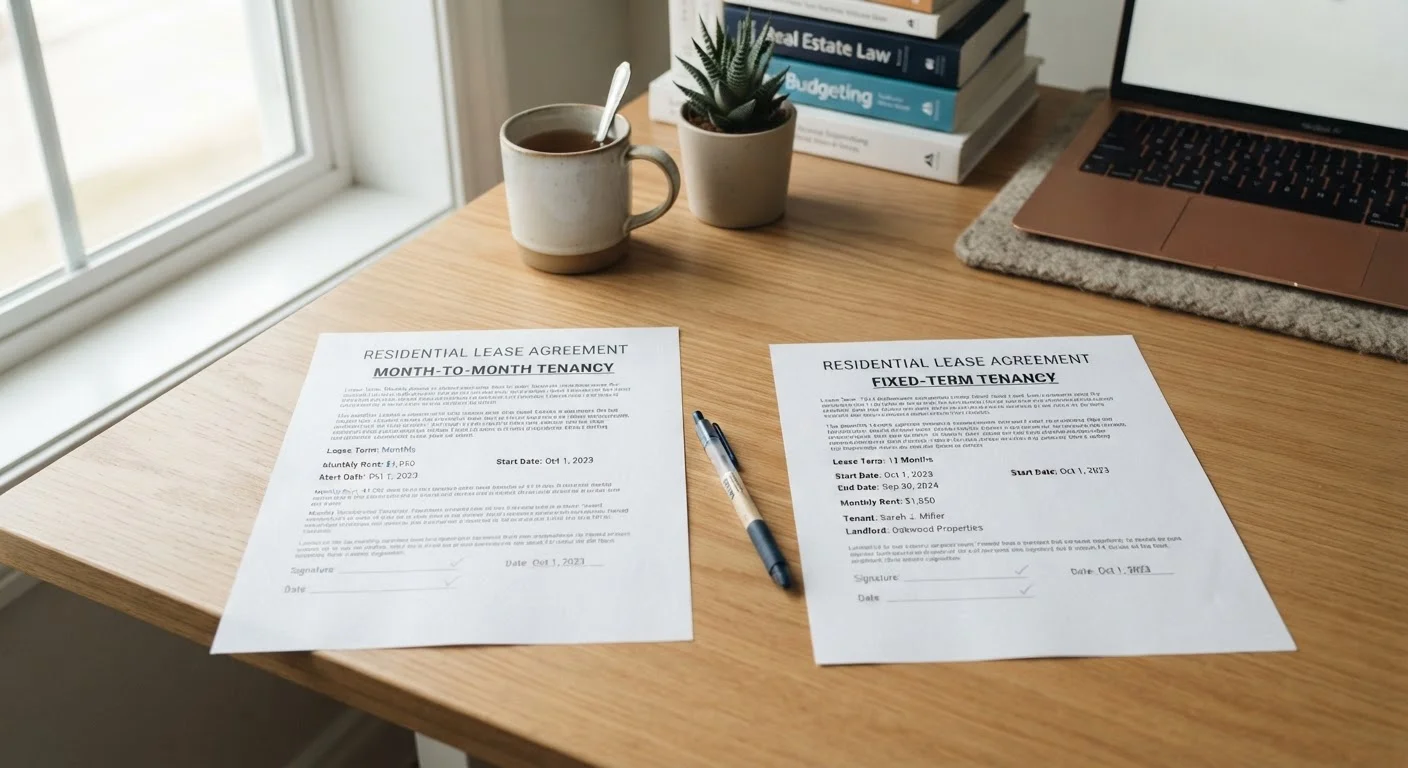
Option A
Month-to-Month Lease
The flexible, roll-as-you-go rental arrangement.
Best for: Renters who need short-term housing, expect life changes soon, or want the ability to move without a long notice penalty.
Option B
Fixed-Term Lease
The stable, predictable commitment for settled renters.
Best for: Renters who want locked-in rent, long-term housing security, and a clear legal agreement covering a defined period.
How Each Lease Type Works
A fixed-term lease is a binding rental contract for a defined period - most commonly 12 months, though six-month and 24-month terms exist. Both parties agree upfront on rent, rules, and end date. During that term, the landlord generally cannot raise your rent or ask you to leave without cause, and you're expected to fulfill the full term or face consequences for early exit.
A month-to-month lease (sometimes called a periodic tenancy) renews automatically each month under the same basic terms, but either party can end it with proper notice - typically 30 days, though some states require 60. Month-to-month arrangements sometimes begin that way from the start, or they arise when a fixed-term lease expires and neither party signs a renewal.
If you're new to renting, our guide for first-time renters covers the foundational steps before you sign anything.
| Criterion | Month-to-Month Lease | Fixed-Term Lease |
|---|---|---|
| Lease length | Renews monthly, no set end date | Defined term (e.g., 6, 12, or 24 months) |
| Rent stability | Can change with proper notice | Locked in for the full term |
| Renter flexibility | Exit with 30-60 days' notice | Leaving early may trigger fees |
| Landlord flexibility | Can end tenancy with notice | Cannot remove tenant without cause mid-term |
| Typical monthly cost | Often higher than fixed-term | Often lower; incentivizes commitment |
| Best market conditions | Slower or transitional markets | Competitive, high-demand markets |
| Legal complexity | Simpler terms, state law governs notice | More detailed; early-exit clauses apply |
The Real Trade-Offs: Flexibility vs. Stability
The core tension comes down to what you value more right now. Month-to-month leases offer genuine freedom - you can leave with short notice if a job offer, a family situation, or simply a better apartment comes along. That freedom, however, is not free. Landlords often charge a premium (sometimes 10-25% more per month) for month-to-month arrangements because they face greater uncertainty.
Landlords also retain more flexibility under month-to-month agreements. In most states, they can terminate the arrangement without cause by giving adequate notice, which means your housing is less secure than under a fixed-term contract. State law governs exactly how much notice is required and what tenant protections apply, so it's worth checking your local rules.
Fixed-term leases remove that uncertainty in exchange for commitment. Your rent is locked in, your tenancy is protected for the duration, and the landlord has clear legal obligations. The trade-off: leaving early can cost you. Most leases include early termination clauses - commonly one to two months' rent - or allow the landlord to pursue you for unpaid rent through the remainder of the term. Our article on lease clauses that catch renters off guard goes deeper on what to watch for in these agreements.
~43M
Renter households in the US
According to the US Census Bureau, approximately 43 million households in the United States were renter-occupied as of recent estimates.
30-60 days
Typical notice to end a month-to-month lease
Most states require either 30 or 60 days of written notice from either party to terminate a month-to-month rental agreement.
1-2 months
Common early-termination penalty range
Many fixed-term leases include early termination fees equivalent to one to two months' rent, though terms vary widely by landlord and state.
Matching the Right Lease to Your Life Stage
Neither lease type is universally superior - the right choice depends on where you are in life. Consider a month-to-month arrangement if you're exploring a new city, finishing a degree, awaiting a job relocation, or planning a home purchase in the near future. The flexibility is worth the premium when your timeline is genuinely uncertain.
A fixed-term lease makes more sense if you've settled on a neighborhood, have stable employment, and want protection from rent increases. Families with school-age children, for example, often benefit greatly from the certainty a 12-month term provides. The same logic that applies to locking in a rate on a mortgage - explored in our article on fixed-rate vs. adjustable-rate mortgages - applies here: predictability has real financial value.
Also factor in the rental market itself. In high-demand cities, landlords may be unwilling to offer month-to-month from the start, especially for desirable units. Understanding the broader financial and lifestyle trade-offs of renting vs. buying can help you put this decision in context.
State and Local Law Matters Significantly
Tenant rights under both lease types vary considerably by state and even by city. Some jurisdictions require longer notice periods, limit rent increases on month-to-month agreements, or offer additional protections against no-cause evictions. Before signing any lease, verify the rules in your specific location through your state's tenant rights office or a local housing authority. This article provides general educational information and is not legal advice.
The content on this site is for informational purposes only and is not a substitute for professional advice. Always consult a qualified professional for guidance specific to your situation.