

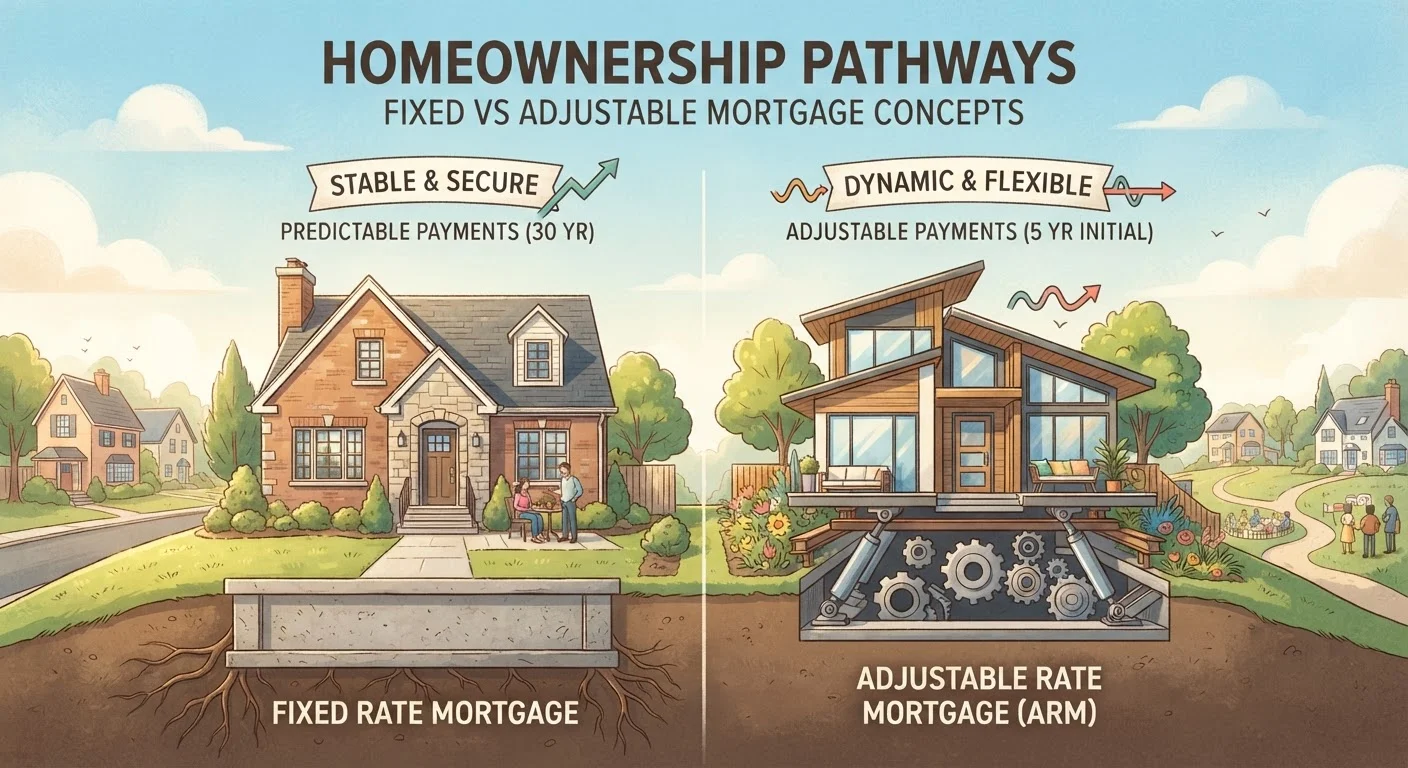
Option A
Fixed-Rate Mortgage
The predictable, long-term stability choice.
Best for: Homebuyers who plan to stay in the home long-term and want consistent monthly payments regardless of market shifts.
Option B
Adjustable-Rate Mortgage (ARM)
The flexible, lower-initial-cost alternative.
Best for: Buyers who expect to move or refinance within a few years and can tolerate some payment variability over time.
How Each Mortgage Type Works
A fixed-rate mortgage charges the same interest rate for the entire loan term - typically 15 or 30 years. Your principal and interest payment never changes, though property taxes and insurance held in escrow can fluctuate. This structure is the most common choice among American homebuyers, valued for its predictability.
An adjustable-rate mortgage (ARM) starts with a fixed rate for an introductory period - commonly 5, 7, or 10 years - after which the rate adjusts at regular intervals, usually annually. The rate is tied to a benchmark index (such as the Secured Overnight Financing Rate, or SOFR) plus a set margin determined by the lender. When the index moves, your rate and payment follow, within defined limits called caps.
ARM loan names reflect their structure: a 5/1 ARM has a five-year fixed period, then adjusts every one year. A 7/6 ARM is fixed for seven years, then adjusts every six months. Understanding this nomenclature helps you evaluate what you're actually agreeing to. For a broader look at how fixed and variable cost structures affect household finances, see our overview of fixed vs. variable expenses.
| Criterion | Fixed-Rate Mortgage | Adjustable-Rate Mortgage (ARM) |
|---|---|---|
| Interest rate over time | Stays the same for loan life | Fixed initially, then adjusts periodically |
| Initial rate | Typically higher | Typically lower |
| Payment predictability | High - principal and interest constant | Low after introductory period |
| Best loan term fit | 15- or 30-year terms | Short-to-medium ownership horizon |
| Rate change limits | None needed - rate never changes | Governed by initial, periodic, and lifetime caps |
| Risk exposure | Low - insulated from rate increases | Moderate to higher after fixed period ends |
| Complexity | Simple and straightforward | More complex; requires understanding index, margin, caps |
The Rate Difference and What It Actually Means
ARMs generally carry lower initial interest rates than fixed-rate loans. That gap can translate into meaningfully lower monthly payments during the introductory period - sometimes hundreds of dollars per month - and lower total interest paid if you exit the loan before adjustments begin.
However, once an ARM's fixed period ends, payment certainty disappears. Most ARMs include three types of caps: an initial cap (how much the rate can change at the first adjustment), a periodic cap (how much it can change at each subsequent adjustment), and a lifetime cap (the maximum total increase over the loan's life). A common cap structure is 2/2/5, meaning the rate can rise no more than 2% at the first adjustment, 2% per adjustment afterward, and 5% total. Still, even capped increases can significantly raise your monthly payment.
30 years
Most common fixed-rate mortgage term in the U.S.
The 30-year fixed-rate mortgage has been the dominant loan product for American homebuyers for decades, according to federal housing finance data.
2/2/5
Common ARM cap structure
Many ARMs carry a 2/2/5 cap, limiting rate changes to 2% at first adjustment, 2% per subsequent period, and 5% over the loan's lifetime.
5-10%
Share of mortgages that are ARMs in recent years
ARM originations have historically fluctuated with interest rate environments, rising when fixed rates climb and shrinking when fixed rates are low, per Mortgage Bankers Association data.
If you later want to convert an ARM to a fixed-rate loan - or lower your rate after a market shift - refinancing is one avenue worth understanding. Keep in mind that refinancing carries its own costs and qualification requirements.
Choosing Based on Your Situation
The right mortgage structure depends heavily on how long you plan to own the home. If your horizon is short - say, you're buying a starter home before upgrading, or relocating for work in several years - the ARM's introductory savings may outweigh the uncertainty of future adjustments you'll never face.
Long-term buyers face a different calculus. Locking in a fixed rate insulates you from rising rates over decades. If rates fall substantially, refinancing is always an option, though it isn't free or guaranteed. Anyone still weighing whether homeownership is the right move at all may find useful context in our article on renting vs. buying trade-offs.
ARM Caps Don't Eliminate Risk
While caps prevent unlimited rate increases, they don't guarantee affordability. A 2/2/5 cap on a loan that starts at 6% could ultimately reach 11% - adding hundreds of dollars to monthly payments. Always model worst-case payment scenarios before choosing an ARM. Your lender is required to provide this information in your loan disclosures.
Your financial resilience matters too. If a significant payment increase - even a capped one - would strain your budget, a fixed-rate loan offers a safer baseline. This is general educational information; a licensed mortgage professional can help you evaluate both loan types against your actual income, credit profile, and long-term plans.
This article is for informational purposes only and does not constitute financial or mortgage advice. Consult a licensed mortgage lender or financial professional before making decisions about your home loan.
The content on this site is for informational purposes only and is not a substitute for professional advice. Always consult a qualified professional for guidance specific to your situation.