

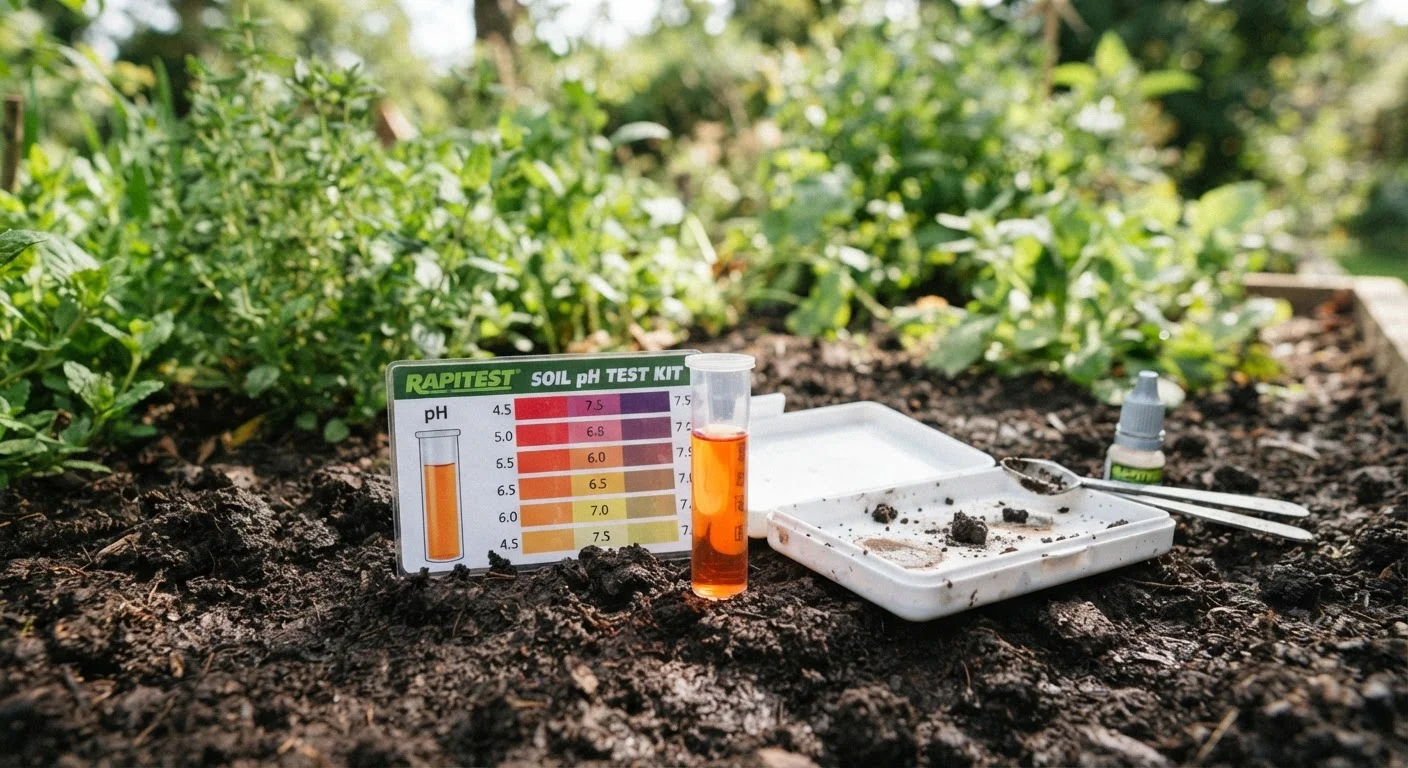
Why pH Controls What Your Plants Can Actually Use
You can have a soil packed with nutrients and still end up with yellowing, stunted plants. The reason is often pH. Think of soil pH as a gate that opens or closes access to nutrients. When the gate is set to the right position - roughly pH 6.0 to 7.0 for most plants - nitrogen, phosphorus, potassium, calcium, and a host of trace minerals flow freely into plant roots. Shift too far in either direction and those nutrients become chemically locked up, unavailable regardless of how much fertilizer you add.
Iron and manganese, for example, become less available in alkaline soils, producing symptoms that look like a nutrient deficiency even when the minerals are physically present. Meanwhile, highly acidic soils can cause manganese and aluminum to become so available that they reach toxic levels for sensitive plants. Understanding pH isn't academic - it's practical information that changes what you plant and how you amend your soil.
6.0-7.0
Optimal pH range for most vegetables
This range is widely cited by university extension programs as the zone where nutrient availability is most balanced for common food crops.
4.5-5.5
Ideal pH range for blueberries
Blueberries are among the most acid-demanding of common garden fruits, according to extension horticulture resources.
10x
Acidity change per pH unit on the scale
Because pH is logarithmic, a soil reading of 5.0 is ten times more acidic than a reading of 6.0 - a difference that has significant effects on nutrient chemistry.
Reading the Scale: Acidic, Neutral, and Alkaline
The pH scale runs from 0 to 14. Here's a quick orientation for gardeners:
- Below 6.0: Acidic soil. Common in the eastern U.S., the Pacific Northwest, and areas with heavy tree cover. Blueberries, azaleas, and rhododendrons love this range. Most vegetables and lawn grasses struggle.
- 6.0 to 7.0: Slightly acidic to neutral. The ideal range for the widest variety of vegetables, fruits, and ornamentals.
- Above 7.0: Alkaline soil. Typical in the arid West and Midwest. Some ornamentals and drought-tolerant plants tolerate alkalinity, but most edibles show nutrient deficiency symptoms.
Your region's rainfall patterns, underlying rock type, and land-use history all shape your soil's natural pH. This is one reason common gardening assumptions that work in one region can fail completely in another.
How to Test Your Soil pH
There's no reliable shortcut for knowing your pH - you have to test. There are two practical routes:
- Home test kits or test strips: Available at garden centers, these use a chemical reaction with a soil-and-water mixture to produce a color that corresponds to a pH range. They're inexpensive and give a useful ballpark reading within minutes.
- Cooperative Extension soil test: University Extension programs in most states offer low-cost or subsidized soil testing. You mail in a small soil sample and receive a detailed report that includes pH, nutrient levels, and specific amendment recommendations for your crops. This is the more precise and informative option.
When collecting a sample, take small plugs from several spots across your garden bed - six to eight inches deep - and mix them together. A single scoop from one corner won't represent the whole bed accurately. If you're planning a raised bed, the soil mix you fill it with will have its own pH, which is worth testing before planting. See our complete raised bed guide for more on soil preparation in those systems.
Test Before You Amend - Every Time
It's tempting to add lime or sulfur based on what you think your soil needs, but guessing can move pH in the wrong direction. A soil test costs very little and gives you a precise starting point. Your local Cooperative Extension office is an excellent and often overlooked resource for inexpensive, accurate analysis with region-specific guidance.
Adjusting pH: What Actually Works
Once you know your pH, you can decide whether to amend or simply choose plants suited to your existing conditions. If amendment is needed, here are the proven methods:
To raise pH (make soil less acidic):
Ground agricultural limestone - commonly called garden lime - is the standard approach. Pelletized lime is easier to spread; powdered lime acts somewhat faster. Apply based on your soil test recommendation, as the amount needed depends on both how far your pH is from the target and your soil's texture (clay soils need more lime than sandy soils to shift the same amount).
To lower pH (make soil more acidic):
Elemental sulfur is the most reliable amendment. Soil bacteria convert it to sulfuric acid over time, gradually lowering pH. The process is slow - plan for several months. Acidifying fertilizers containing ammonium sulfate also have a mild acidifying effect over repeated applications.
Organic matter helps buffer pH in both directions, making it more stable over time. Regularly incorporating compost is one of the most consistent ways to maintain healthy soil chemistry alongside proper fertilization. Our article on organic vs. synthetic fertilizers explains how different fertilizer types interact with your soil's pH over the long term.
One important note: pH adjustments are gradual. Test again after a full growing season before deciding your soil needs more amendment. Over-liming is a real and common mistake that can push pH too high and create its own set of nutrient problems.
Frequently Asked Questions
Most vegetables perform well in soil with a pH between 6.0 and 7.0, with 6.5 being a common sweet spot. At that range, key nutrients like nitrogen, phosphorus, and potassium are most readily available to plant roots. Some crops, like blueberries, are exceptions and prefer significantly more acidic conditions.
Inexpensive pH test kits and test strips are widely available at garden centers and allow for a quick rough reading. For greater accuracy, your local Cooperative Extension Service can perform a full soil analysis for a modest fee, often providing amendment recommendations alongside the results.
Soil pH changes slowly. After applying lime to raise pH or sulfur to lower it, you may wait three to six months - or even a full growing season - before seeing a meaningful shift. Testing again after that window is essential before making additional amendments.
These household items can produce a temporary, highly localized effect but are not reliable or practical for garden-scale pH adjustment. Their impact dissipates quickly and can be unpredictable. Agricultural lime and elemental sulfur are the established tools for meaningful pH correction.
Yes. In regions with heavy rainfall, soils tend to become more acidic over time because rainwater is naturally slightly acidic and leaches basic minerals from the soil. This is why gardeners in the Pacific Northwest or the Southeast often deal with persistently low pH, while arid regions tend toward alkaline soils.
The content on this site is for informational purposes only and is not a substitute for professional advice. Always consult a qualified professional for guidance specific to your situation.