

Our Verdict
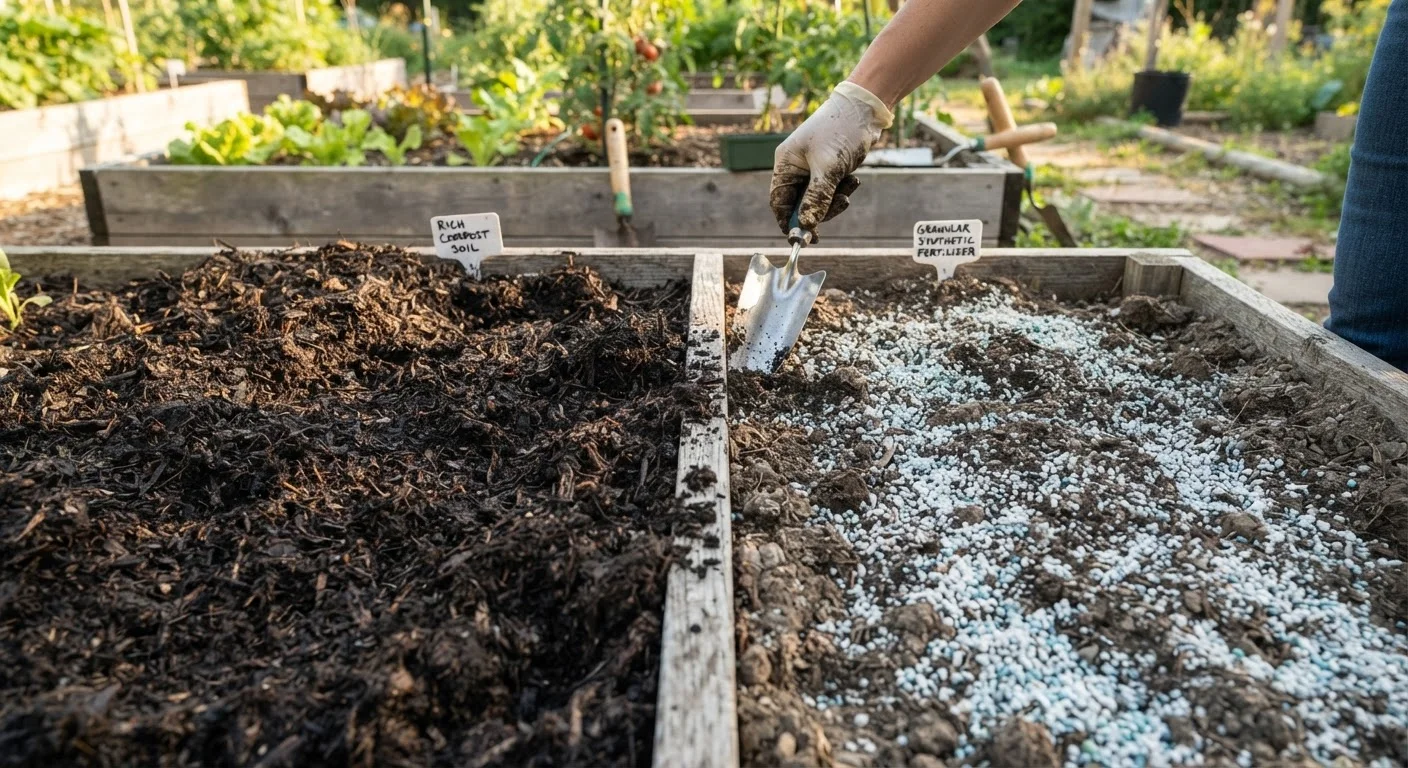
Neither organic nor synthetic fertilizer is categorically better - each suits different goals, soil conditions, and timelines. Synthetic fertilizers excel when a plant needs a fast, precise nutrient boost. Organic fertilizers work more slowly but build the kind of living soil that becomes more productive with each passing season.
| Best for | Recommended |
|---|---|
| Gardeners focused on long-term soil health and microbial activity | Organic fertilizer |
| Those needing rapid correction of a specific nutrient deficiency | Synthetic fertilizer |
| New lawns or gardens where establishing growth quickly matters | Synthetic fertilizer |
| Established vegetable or perennial gardens managed season over season | Organic fertilizer |
How Each Type Delivers Nutrients
The most fundamental difference between organic and synthetic fertilizers is how nutrients reach plant roots - and how fast.
Synthetic fertilizers contain nutrients in water-soluble mineral form. Plants can absorb them almost immediately after application, which is why you may see greening or new growth within days. The tradeoff is that soluble nutrients can also leach through the soil quickly, especially in sandy or heavily irrigated soils, reducing efficiency and raising the potential for runoff into nearby waterways.
Organic fertilizers - including compost, bone meal, blood meal, and fish emulsion - contain nutrients bound up in organic matter. Soil microorganisms must break that matter down before plants can access the nutrients. This process takes weeks or months depending on soil temperature, moisture, and microbial activity. The slow release is generally seen as an advantage for consistent, sustained feeding rather than a single nutrient surge.
Understanding your soil's starting point matters enormously here. For a deeper look at how soil chemistry shapes nutrient availability, see our plain-language guide to soil pH.
What Happens to Your Soil Over Time
Single-season results rarely tell the full story. The more revealing difference between these two approaches shows up in soil biology over multiple growing seasons.
Regular use of organic fertilizers tends to increase organic matter content in soil - a meaningful benefit. Higher organic matter improves soil structure, making it less compacted and better able to hold both water and air. It also feeds a thriving community of bacteria, fungi, earthworms, and other organisms that naturally cycle nutrients and suppress some soil-borne diseases.
Synthetic fertilizers, by contrast, feed the plant but not the soil ecosystem directly. Used in isolation over many years, they can gradually reduce organic matter as the microbial community shrinks without organic inputs to sustain it. Heavy applications can also lead to salt accumulation in soil, which stresses roots and can reduce germination rates over time.
That said, synthetic fertilizers used judiciously - at label rates, timed to plant needs - do not inevitably damage soil. The concern is primarily with chronic overuse or imbalanced application.
| Organic Fertilizer | Synthetic Fertilizer | |
|---|---|---|
| Nutrient release speed | Slow, weeks to months | Fast, days to a week |
| Soil biology impact | Feeds microbial communities | Minimal direct benefit to microbes |
| Risk of over-application | Lower risk of plant burn | Higher risk if label rates exceeded |
| Long-term soil structure | Improves with regular use | Neutral to slightly degrading alone |
| Cost per nutrient unit | Generally higher | Generally lower |
| Nutrient precision | Variable, depends on source | Exact ratios on label |
| Runoff and leaching risk | Lower, slower release | Higher, especially in wet conditions |
Cost, Convenience, and Practical Considerations
For many homeowners, budget and ease of use shape fertilizer decisions as much as soil science does.
Synthetic fertilizers are typically less expensive per pound of actual nutrient delivered, and they require smaller application volumes because their nutrient concentrations are high. Granular and liquid formulations are widely available and relatively simple to apply with a basic spreader or hose-end sprayer.
Organic fertilizers tend to cost more per unit of nutrient, require larger volumes to achieve equivalent nutrient supply, and can be bulkier to handle. Compost, however, can be made at home at low cost - a meaningful long-term savings. Organic options also have a wider margin for application error; they're harder to over-apply to the point of plant damage than concentrated synthetic formulations.
For gardeners establishing new turf or a planting bed from scratch, the starting conditions matter a great deal. Our guide to grass seed vs. sod covers how fertilizer timing intersects with lawn establishment methods.
Test Before You Apply
A soil test takes the guesswork out of fertilizer decisions. Many university cooperative extension programs offer low-cost testing that tells you exactly which nutrients your soil is lacking - and which it already has in excess. Applying fertilizer without this information can lead to wasted product, unnecessary cost, and nutrient imbalances that work against plant health rather than for it.
Choosing an Approach That Fits Your Goals
Most experienced gardeners don't treat organic and synthetic fertilizers as an either/or choice. A practical middle path is to use organic amendments - compost, aged manure, cover crops - as the foundation for building long-term soil health, while reserving synthetic fertilizers for targeted interventions: a mid-season nitrogen boost for heavy-feeding crops, or a phosphorus application when a soil test reveals a genuine deficiency.
Before applying any fertilizer, a basic soil test (available through many cooperative extension offices) is the most reliable way to know what your soil actually needs. Applying nutrients your soil already has in abundance wastes money and can create imbalances that reduce plant health.
Whatever you choose, following application rates on product labels isn't just a suggestion - it's how you avoid the most common pitfalls of both categories. More fertilizer is rarely better, and the environmental consequences of excess - whether from organic runoff or synthetic leaching - fall downstream of your garden, not just in it.
The content on this site is for informational purposes only and is not a substitute for professional advice. Always consult a qualified professional for guidance specific to your situation.