

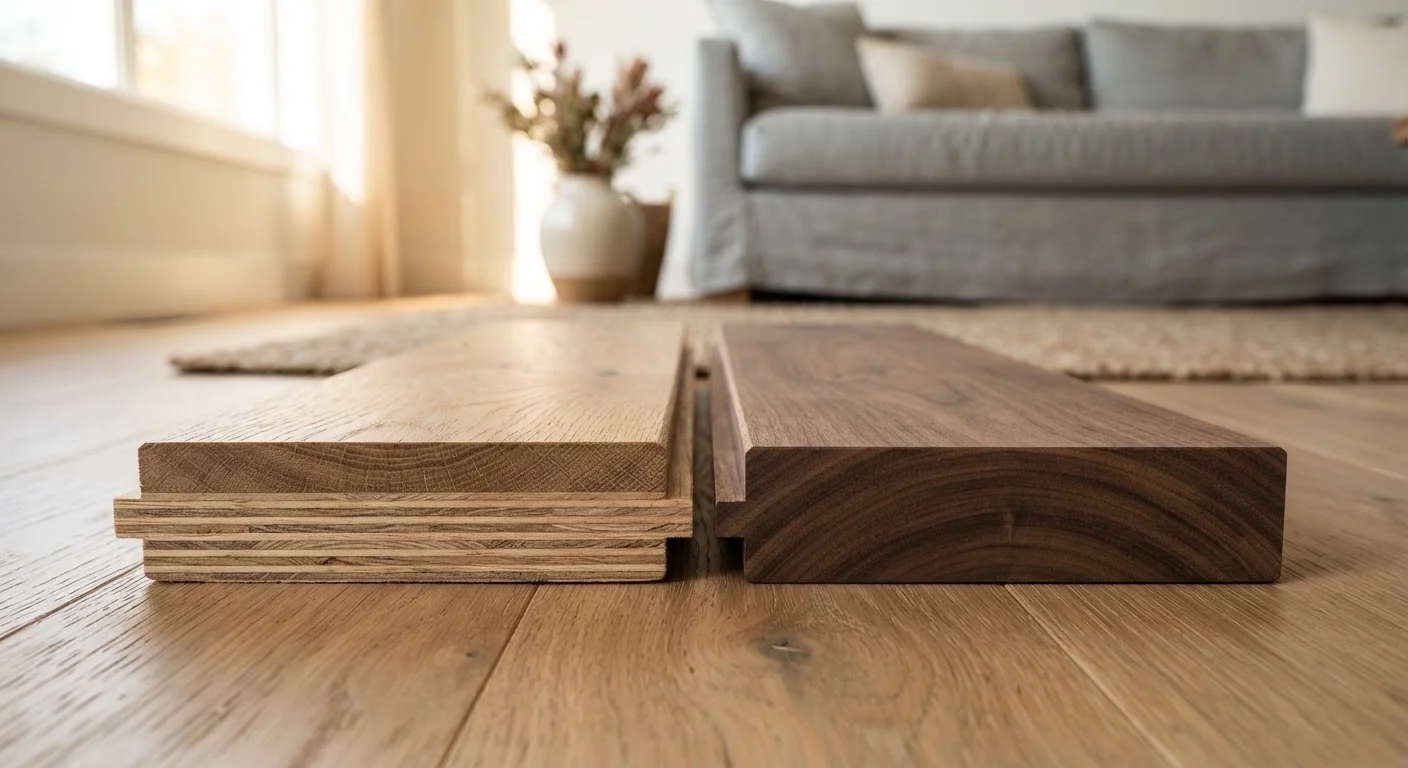
Option A
Engineered Hardwood
The versatile, moisture-tolerant modern option.
Best for: Homeowners installing flooring in basements, over radiant heat, or in climates with significant humidity swings.
Option B
Solid Hardwood
The traditional, refinishable long-term investment.
Best for: Above-grade installations in stable, dry interior environments where long-term refinishing potential is a priority.
How Each Type Is Constructed
The most important difference between these two flooring types isn't visible from the top - it's what's underneath the surface.
Solid hardwood is milled from a single piece of wood, typically ¾ inch thick. Every plank is one uniform material from top to bottom, which gives it a generous wear layer that can be sanded down and refinished multiple times. Species like red oak, maple, and hickory are common choices, each with distinct hardness ratings and grain patterns.
Engineered hardwood uses a real hardwood veneer on top - typically 1-6 mm thick - bonded over several layers of cross-directional plywood or high-density fiberboard. This layered construction is specifically designed to counteract wood's natural tendency to expand and contract with moisture changes. The result is a product that looks nearly identical to solid hardwood from above but behaves quite differently under stress.
Understanding this structural difference is the foundation for every other comparison in this article. To learn more about how build quality signals hold up across materials, see our guide to solid construction indicators.
| Criterion | Engineered Hardwood | Solid Hardwood |
|---|---|---|
| Construction | Hardwood veneer over plywood core | Single solid wood plank |
| Typical thickness | 3/8" - 9/16" | 3/4" |
| Moisture resistance | Good - stable in humidity swings | Poor - susceptible to cupping and warping |
| Below-grade installation | Generally approved | Not recommended |
| Radiant heat compatibility | Often compatible | Rarely compatible |
| Refinishing potential | 1-3 times (veneer dependent) | 5-8 times over lifetime |
| Installation methods | Nail, glue, or float | Nail-down only |
| Estimated lifespan | 25-30+ years | 80-100+ years (with refinishing) |
Moisture Resistance and Where Each Can Be Installed
Moisture is where these two flooring types diverge most sharply in practical terms.
Solid hardwood is highly sensitive to humidity. In rooms where moisture levels fluctuate significantly - bathrooms, laundry rooms, or basements - solid planks can cup, buckle, or gap as they absorb and release moisture. For this reason, solid hardwood is generally limited to above-grade installations in well-conditioned interior spaces.
Engineered hardwood's cross-ply core gives it meaningfully better dimensional stability. Most engineered products are approved for below-grade (basement) installation, and many are compatible with radiant floor heating systems - something solid hardwood typically cannot accommodate without significant risk of warping.
25-30+
Years typical engineered hardwood lifespan
Industry estimates suggest quality engineered hardwood lasts 25-30 years or more under normal residential use conditions.
5-8x
Refinishing cycles for solid hardwood
A standard ¾-inch solid hardwood plank can typically withstand 5 to 8 sanding and refinishing cycles across its lifetime.
1-6 mm
Engineered hardwood veneer thickness range
Veneer thickness varies significantly by product and directly determines how many times an engineered floor can be refinished.
That said, neither product is truly waterproof. Prolonged standing water will damage both. If water resilience is a top priority, luxury vinyl plank (LVP) may be a more appropriate category to consider entirely.
Refinishing Potential and Long-Term Durability
This is the area where solid hardwood holds a clear advantage - but with an important nuance.
A standard ¾-inch solid hardwood floor can typically be sanded and refinished anywhere from 5 to 8 times over its lifetime, depending on how much material is removed each cycle. That means a well-maintained solid floor can last 80-100 years or more, adapting to style changes along the way.
Engineered hardwood's refinishing potential depends almost entirely on the thickness of its veneer layer. Thinner veneers (1-2 mm) may only allow one light refinish, while premium engineered products with a 4-6 mm wear layer can be refinished two or three times. When evaluating engineered options, the veneer thickness is one of the most important specifications to check.
It's worth distinguishing between durability and longevity here - two qualities that aren't always the same thing. Our article on durability vs. longevity explains why a floor can be hard-wearing in daily use but still have a shorter serviceable lifespan depending on how it's constructed.
Installation Methods and Subfloor Requirements
Solid hardwood is almost always installed using the nail-down method, which requires a wood subfloor - typically plywood - of adequate thickness and flatness. It cannot be floated, and concrete subfloors require a wood sleeper system before installation.
Engineered hardwood offers more flexibility. Depending on the product, it can be nailed, stapled, glued, or floated directly over plywood or concrete. This versatility makes it easier to work with in renovation scenarios where the subfloor type is a constraint. If you're weighing how much subfloor prep your project requires, the considerations overlap with those discussed in our floor renovation planning guide.
Both types require the flooring material to acclimate to the room's temperature and humidity before installation - typically 3 to 5 days. Skipping this step is one of the most common causes of post-installation problems regardless of which type you choose.
This article is for general informational purposes. Installation requirements, product specifications, and local building codes vary. Consult a qualified flooring professional before beginning any flooring project, especially in below-grade or moisture-prone areas.
The content on this site is for informational purposes only and is not a substitute for professional advice. Always consult a qualified professional for guidance specific to your situation.