

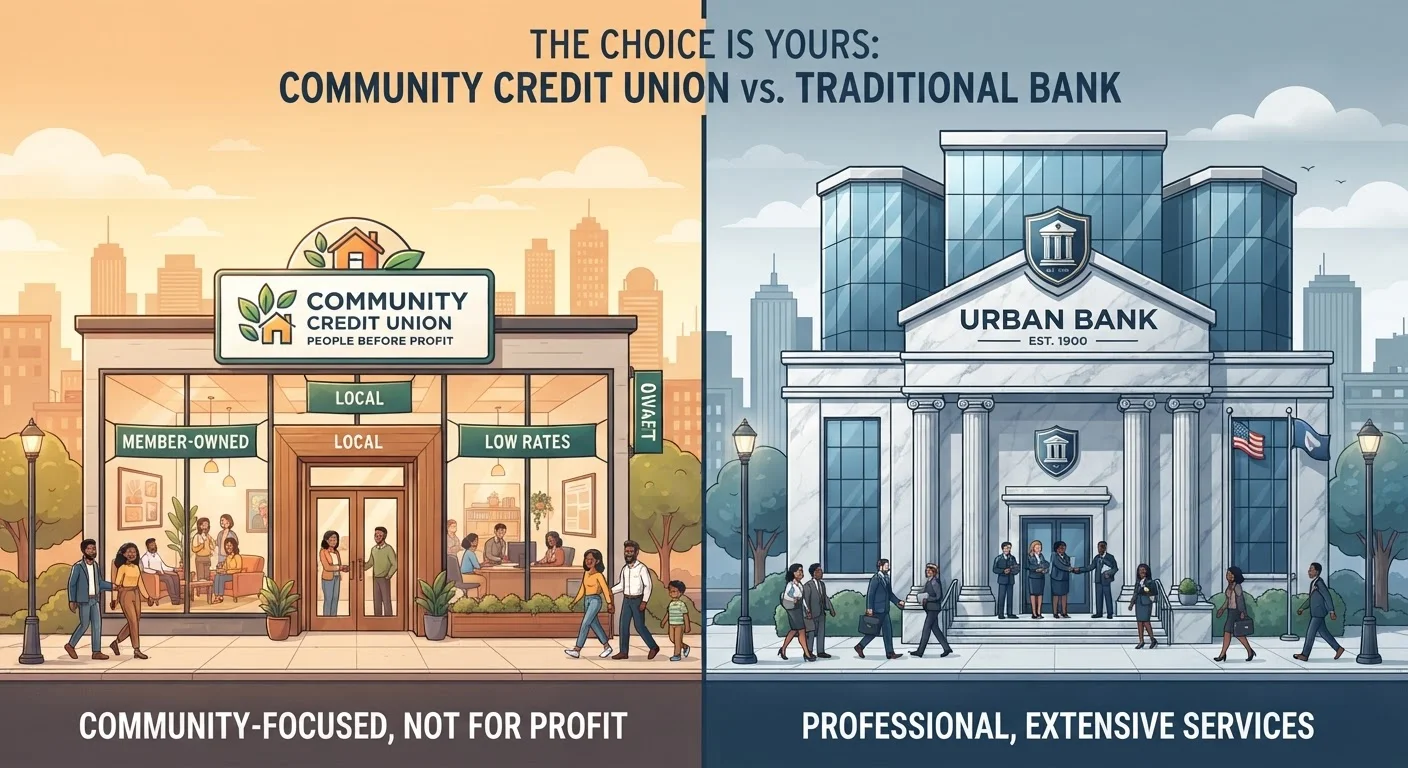
Option A
Credit Unions
The member-owned, not-for-profit cooperative.
Best for: Consumers who qualify for membership and want a relationship-focused institution with potentially lower fees and better loan rates.
Option B
Traditional Banks
The shareholder-owned, for-profit financial institution.
Best for: Consumers who prioritize broad branch and ATM access, full digital banking suites, and a wide range of specialized financial products.
Ownership Structure: The Root Difference
Everything that distinguishes a credit union from a traditional bank flows from one foundational fact: who owns it.
A credit union is a member-owned cooperative. When you deposit money and become a member, you hold a small ownership stake. The institution is governed by a volunteer board elected by members, and any surplus earnings are typically returned in the form of lower loan rates, higher deposit yields, or reduced fees. There are no outside shareholders to satisfy.
A traditional bank is a for-profit corporation owned by shareholders. Its primary financial obligation runs to those shareholders, which means profit generation is a core operating goal. That doesn't make banks predatory by design, but it does mean the incentive structure points in a different direction than a cooperative.
This structural gap shapes nearly every practical difference you'll encounter - from fee schedules to how a loan officer approaches your application. For a broader foundation on how these institutions fit into everyday financial life, see our guide to credit and banking basics.
| Criterion | Credit Unions | Traditional Banks |
|---|---|---|
| Ownership | Member-owned cooperative | Shareholder-owned corporation |
| Profit motive | Not-for-profit; surplus returned to members | For-profit; surplus distributed to shareholders |
| Eligibility | Must meet field of membership | Open to anyone |
| Deposit insurance | NCUA (up to $250,000) | FDIC (up to $250,000) |
| Typical loan rates | Often lower | Varies; can be higher |
| Fee structure | Generally fewer/lower fees | More variable; waivers often available |
| Branch & ATM network | Smaller; shared networks available | Typically larger and wider |
| Digital banking tools | Variable; often less advanced | Generally more robust |
| Product range | Core products; varies by institution | Broader; includes investment and business |
| Governance | Elected volunteer board | Corporate board; shareholder-accountable |
Membership, Access, and Deposit Insurance
One meaningful practical difference is eligibility. Anyone can open an account at a federally insured bank. Credit unions, by contrast, require that you meet a field of membership - a defined group based on employer, geographic community, association, or family relationship. Some credit unions have broad community charters that are easy to qualify for; others are tightly scoped to a specific employer or profession.
On the safety side, both institution types carry federal deposit insurance up to $250,000 per depositor, per ownership category - but through different agencies. Banks are insured by the FDIC (Federal Deposit Insurance Corporation). Credit unions are insured by the NCUA (National Credit Union Administration). The coverage mechanics are structured similarly, so your deposits are protected at comparable levels regardless of which type of institution you choose.
~140M
Americans with credit union membership
According to NCUA data, credit union membership in the U.S. has grown steadily, with over 140 million members as of recent reporting periods.
$250,000
Federal deposit insurance limit per depositor
Both FDIC (banks) and NCUA (credit unions) insure deposits up to $250,000 per depositor, per ownership category, per institution.
4,600+
Federally insured credit unions in the U.S.
The NCUA reports thousands of federally insured credit unions operating across the country, ranging from small community institutions to large national cooperatives.
Access logistics can differ meaningfully. Large banks often operate thousands of branch and ATM locations. Credit unions typically have smaller physical footprints, though many participate in shared branching networks and fee-free ATM cooperatives that extend their effective reach considerably.
Fees, Rates, and the Everyday Cost of Banking
Because credit unions don't distribute profits to outside shareholders, they have structural flexibility to offer more favorable pricing. In practice, this often shows up as lower interest rates on personal loans and auto loans, fewer or lower account maintenance fees, and slightly higher yields on savings products. However, these advantages aren't universal - individual credit unions vary considerably, and some banks are highly competitive on fees.
If fees are a concern, our article on banking fees that quietly drain accounts breaks down the most common charges and what triggers them - useful context whether you bank at a credit union or a traditional bank.
Traditional banks, particularly larger ones, may charge monthly maintenance fees, higher overdraft fees, and steeper out-of-network ATM costs. Many have introduced fee waivers tied to minimum balances or direct deposit, so the actual cost depends heavily on how you use the account. The honest framing: shop the specifics of any account you're considering, not just the institution type.
For borrowers building or repairing credit, both institution types offer secured and unsecured products. Understanding how deposits work in a secured card context, for example, can clarify your options - see our piece on secured vs. unsecured credit cards for that distinction.
This Is General Information, Not Personal Financial Advice
The comparisons in this article describe general structural differences between institution types. Your actual experience will depend on the specific institution, account type, and your financial profile. For decisions about where to bank or borrow, consult a licensed financial professional who can evaluate your individual circumstances.
The content on this site is for informational purposes only and is not a substitute for professional advice. Always consult a qualified professional for guidance specific to your situation.