

Why Bank Fees Stay Under the Radar
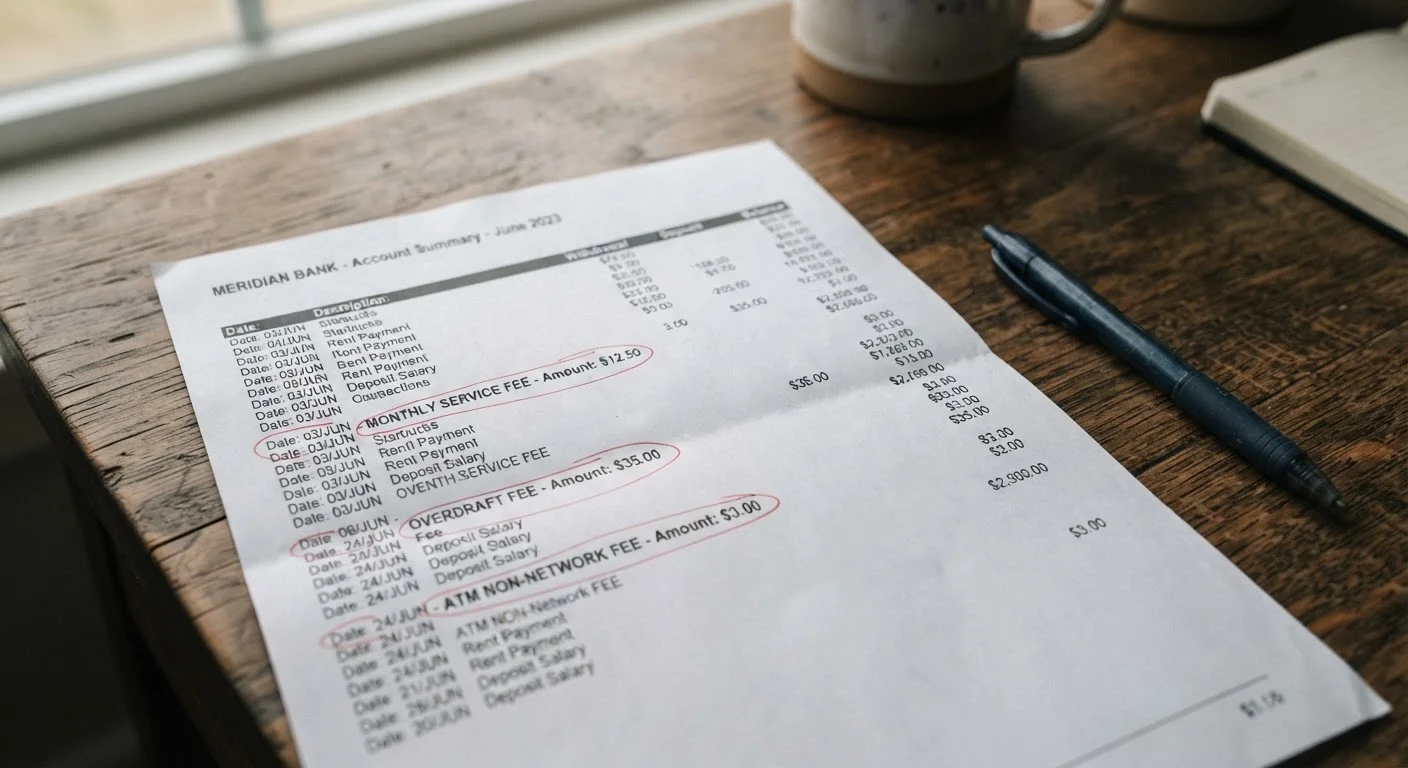
Bank fees rarely announce themselves. They appear as small line items on statements most people scan quickly, and individually they can seem negligible - a few dollars here, a small charge there. But the Consumer Financial Protection Bureau has consistently found that overdraft and other account fees cost American consumers billions of dollars each year in aggregate. The individual harm is real: a $12 monthly maintenance fee runs $144 annually, and that's before any penalty charges enter the picture.
The mechanics behind these fees are worth understanding because most of them are either avoidable or negotiable once you know what triggers them. Reading your bank statement carefully is the first line of defense - it surfaces charges you may not realize are recurring. The list below covers the most common fee types, what causes each one, and how to spot them before they compound.
Start With Your Fee Schedule
Every bank is required to provide a fee disclosure document - sometimes called a schedule of fees or account terms. This document lists every potential charge and the exact conditions that trigger or waive it. It's more reliable than a branch conversation or a marketing brochure. Download or request it and keep a copy for reference.
The Most Common Banking Fees and What Triggers Them
Monthly Maintenance Fees
Many checking and savings accounts carry a recurring monthly charge simply for existing. These fees typically range from $5 to $15 per month, though some premium accounts charge more. The trigger is straightforward: you hold the account, the fee applies - unless you satisfy a waiver condition.
Common waiver conditions include maintaining a minimum daily or average balance, receiving a qualifying direct deposit each month, or making a minimum number of debit card transactions. The key detail is that waiver thresholds are set by the bank, not by regulation, so they vary widely. Check your account's fee schedule rather than the marketing page to find the exact numbers that apply to your account.
Waiver conditions exist for most maintenance fees - but you have to know the exact threshold to meet them.
Overdraft Fees
An overdraft fee is charged when a transaction is approved despite your account having insufficient funds. Historically, these fees have ranged from $25 to $35 per occurrence at many large banks, and until recent regulatory pressure prompted changes, multiple overdraft fees could stack in a single business day.
What surprises many account holders is that overdraft protection - the feature that allows the transaction to go through instead of declining it - is usually an opt-in service that itself carries a fee. Without opting in, most debit card transactions and ATM withdrawals are simply declined at no charge. Automatic bill payments and checks, however, may still overdraw the account depending on how your account agreement handles them. Review your overdraft settings in your account profile to understand your current exposure.
Opting out of overdraft coverage for debit purchases means the transaction declines rather than triggering a fee.
Out-of-Network ATM Fees
Using an ATM outside your bank's network typically generates two separate fees: one from your own bank for using a foreign ATM, and a surcharge from the ATM's operator for using their machine. Combined, these can run $4 to $6 or more per withdrawal - an especially steep cost if the withdrawal amount is small.
Your bank's fee and the operator surcharge appear as distinct line items on your statement, which is why some people underestimate the full cost. Checking your bank's ATM locator before traveling or withdrawing larger amounts less frequently when network ATMs aren't accessible are two straightforward ways to reduce this cost.
Two separate charges hit your account for each out-of-network ATM use - one from your bank, one from the machine's owner.
Excessive Transaction Fees on Savings Accounts
Federal Regulation D historically limited certain savings account withdrawals to six per month, and while the Federal Reserve suspended that limit in 2020, many banks still impose their own excess transaction fees on savings accounts. Exceeding the bank's internal threshold - often six withdrawals per statement cycle - can trigger a per-transaction charge or even prompt the bank to convert the account to a checking account.
This fee catches people off guard when they use a savings account as a frequent transfer buffer. If you move money between accounts regularly, confirm your bank's current policy on savings transaction limits and fees before building that habit into your routine.
Some banks still charge excess transaction fees on savings accounts even though the federal six-withdrawal rule is suspended.
Dormancy and Inactivity Fees
Accounts with no customer-initiated activity for an extended period - often six to twelve months, though the threshold varies by institution - can be classified as dormant. At that point, some banks begin charging a monthly inactivity fee, which quietly draws down whatever balance remains.
A separate legal process called escheatment eventually transfers the funds to the state if the account remains unclaimed long enough, but fee deductions can reduce the balance substantially before that happens. If you have old accounts you don't use regularly, either close them formally or set a calendar reminder to make a small transaction periodically to keep them active. Keeping a simple account inventory as part of your budget helps prevent these accounts from falling off your radar entirely.
A single small transaction every few months is enough to reset the inactivity clock on most accounts.
Paper Statement Fees
As banks push customers toward digital banking, many now charge a monthly fee - typically $1 to $3 - for mailing a paper statement. This is one of the smallest fees on this list but also one of the easiest to eliminate: enrolling in electronic statements in your account settings usually removes it immediately.
If you prefer paper records for budget tracking or dispute resolution, download and print your own statements from the online portal rather than paying for delivery. Keeping your own digital archive also makes it easier to spot patterns and unauthorized charges across months.
Switching to electronic statements is typically a one-click fix that eliminates paper statement fees immediately.
Fee Structures Change Over Time
Banks periodically revise their fee schedules, sometimes with limited advance notice. Regulatory changes - such as recent CFPB guidance on overdraft practices - can also prompt banks to adjust what they charge. Reviewing your account's fee disclosure once a year, or whenever you receive a change-in-terms notice in the mail or by email, helps you stay current on what applies to your account.
Putting It Together: A Practical Spot-Check
The fastest way to audit your own exposure is to pull three months of statements and search for any charge that isn't a purchase or a payment. Flag every fee line, note whether it repeated, and look up the trigger in your account's fee schedule - a document your bank is required to provide and that is usually accessible through your online account portal.
If you find fees you don't recognize or didn't expect, call your bank and ask directly whether any can be waived or whether switching account tiers would eliminate them. Banks do negotiate, particularly for long-standing customers with clean histories. If the fee structure doesn't work for your habits, credit unions and online banks often operate with fewer or lower fees by design - worth comparing before assuming your current arrangement is the only option. For a broader look at how small recurring costs erode financial progress, see the hidden costs that quietly drain savings over time.
This article is for general informational purposes only and does not constitute personalized financial or banking advice. Fee structures, waiver policies, and account terms vary by institution. Consult your bank's account disclosures or a licensed financial professional for guidance specific to your situation.
The content on this site is for informational purposes only and is not a substitute for professional advice. Always consult a qualified professional for guidance specific to your situation.