

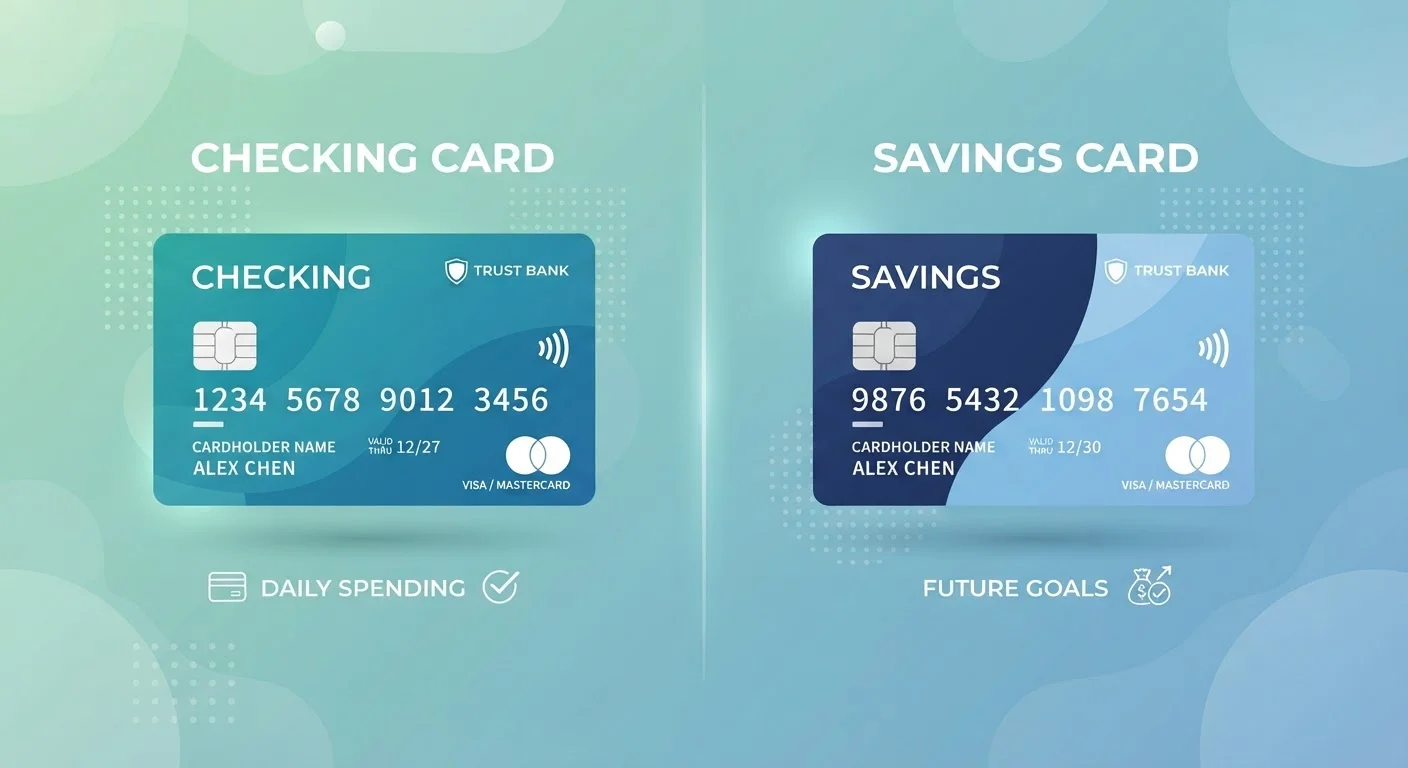
Option A
Checking Account
Your everyday transaction hub.
Best for: Managing daily spending, paying bills, and receiving direct deposits.
Option B
Savings Account
A dedicated place to grow reserves.
Best for: Building an emergency fund, setting aside money for future goals, and earning interest.
What Each Account Is Actually Built to Do
Both checking and savings accounts are deposit accounts - meaning the bank or credit union holds your money and you retain access to it. But their designs reflect two very different jobs.
A checking account is engineered for movement. It's where money comes in via paycheck or direct deposit and goes out through debit card purchases, bill payments, ATM withdrawals, and electronic transfers. There's typically no limit on how many transactions you can make per month, and most checking accounts don't pay meaningful interest - because they're not meant to be a place where money sits.
A savings account is engineered for accumulation. It earns interest on the balance you maintain, and - importantly - it's designed to be slightly less frictionless than checking. That mild inconvenience is intentional: money in savings should be harder to spend impulsively than money in checking.
For a broader look at where these accounts fit within the banking landscape, see how credit unions and traditional banks differ in the way they offer these products.
| Criterion | Checking Account | Savings Account |
|---|---|---|
| Primary purpose | Daily transactions and cash flow | Accumulation and short-term reserves |
| Interest earned | Little to none | Yes, expressed as APY |
| Transaction limits | Unlimited | May be limited by institution policy |
| Debit card access | Standard | Rarely included |
| Check writing | Typically available | Generally not available |
| Overdraft risk | Yes, if balance is insufficient | Lower risk due to infrequent use |
| Best for | Bills, purchases, payroll | Emergency fund, goal saving |
The Interest Gap and What It Actually Means
One of the most concrete differences between account types is interest. Checking accounts often pay little to no interest - some pay a nominal amount, but it's rarely a meaningful factor. Savings accounts, by contrast, are expected to pay interest, expressed as an APY.
APY reflects the annualized rate of return including the effect of compounding. Even a modest APY on a savings account means your money is incrementally working for you. However, it's important to be clear-eyed: savings account interest rates vary considerably across institutions and economic conditions. The interest earned rarely outpaces inflation over time, which is why a savings account is correctly understood as a tool for preservation and short-term accumulation, not long-term growth.
If you're thinking about what comes after building your savings reserve, understanding the difference between saving and investing is a useful next step.
~4-5%
Peak high-yield savings APY range (2023-2024)
Following Federal Reserve rate increases, many high-yield savings accounts offered notably higher APYs than in prior years - though rates fluctuate with monetary policy.
~3-6 months
Common emergency fund target in expenses
Many personal finance frameworks suggest keeping three to six months of essential expenses in an accessible savings account as a financial buffer.
Access Rules, Fees, and Things to Watch
Checking accounts typically come with a debit card, paper check capability, and unlimited electronic transfers. Fees vary by institution - common charges include monthly maintenance fees (often waivable with minimum balance or direct deposit requirements), overdraft fees, and ATM fees for out-of-network withdrawals.
Savings accounts have historically been subject to a federal rule - Regulation D - that limited certain types of withdrawals to six per month. The Federal Reserve suspended this limit in 2020, but individual banks may still enforce their own restrictions. Exceeding a bank's internal limit can trigger fees or even account conversion. Always check your institution's current terms.
Regulation D: A Suspended - But Relevant - Rule
Federal Regulation D once capped certain savings account withdrawals at six per month, with fees or account changes triggered by excess transactions. The Federal Reserve removed this federal requirement in April 2020, granting banks flexibility. However, many institutions still maintain their own internal withdrawal limits. Before relying heavily on a savings account for regular access, verify your bank's current policy in writing.
Fees matter more than many people initially realize. A savings account that charges a monthly maintenance fee could offset months of earned interest if the balance is low. Before opening either account type, review the fee schedule carefully.
For those managing both debt and savings goals simultaneously, the trade-off between paying down debt and building savings is worth understanding before deciding how much to keep in each account.
Using Both Accounts Together
The most effective approach for most households isn't choosing one account over the other - it's using both intentionally. A common structure: your paycheck lands in checking, covering bills and daily expenses, while a fixed portion automatically moves to savings each pay period.
This separation does two things. First, it makes it visually and psychologically clear how much discretionary money you actually have. Second, it builds savings steadily without requiring willpower at every paycheck. Automating savings transfers can reinforce this structure, though it's not a fix for underlying cash flow problems.
Over time, the ratio of how much you're saving relative to income often matters more than the raw balance in either account. Why your savings rate matters more than your balance explains why that number is the more meaningful benchmark for financial progress.
This article is for general informational and educational purposes only and does not constitute personalized financial advice. Consult a qualified financial professional for guidance specific to your situation.
The content on this site is for informational purposes only and is not a substitute for professional advice. Always consult a qualified professional for guidance specific to your situation.