

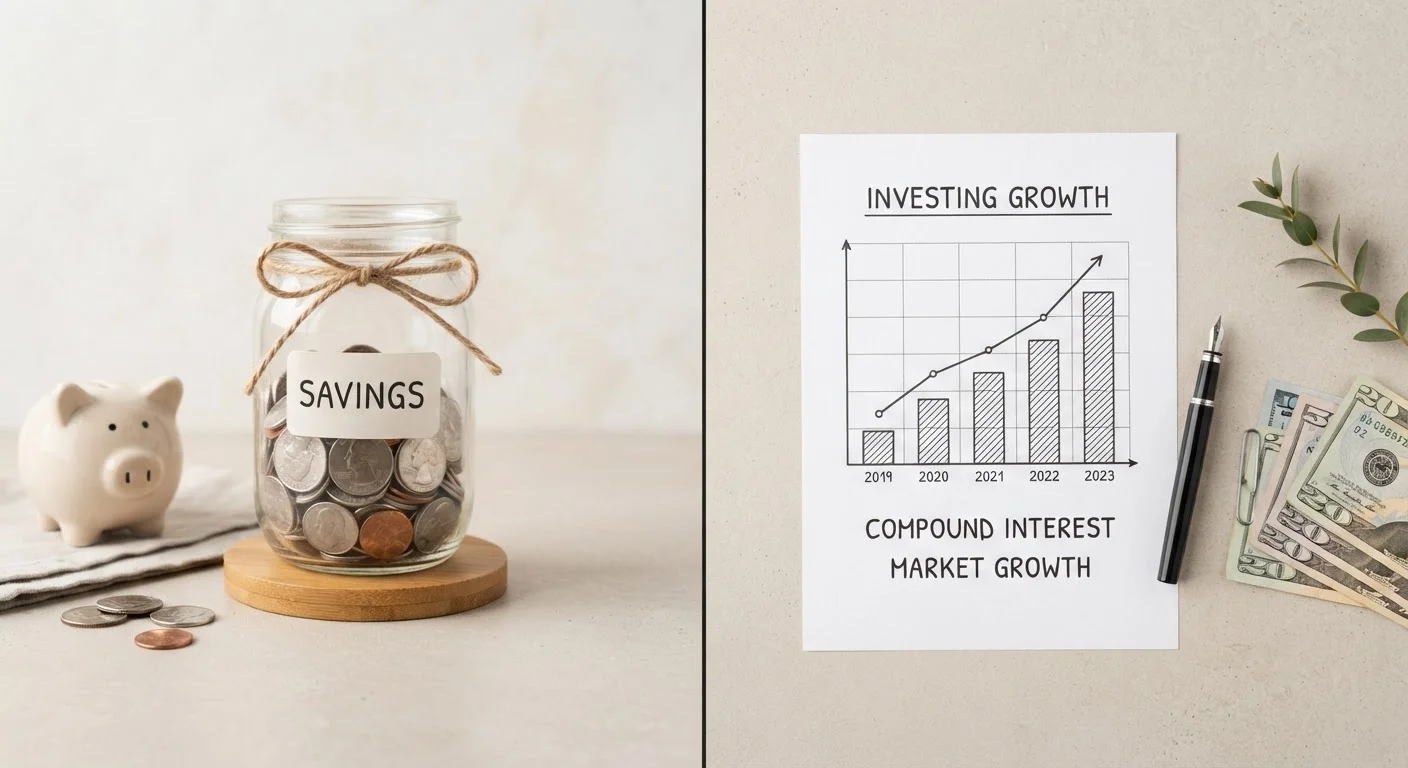
Option A
Saving
The reliable, low-risk foundation for near-term financial security.
Best for: Short-term goals, emergency funds, and money you can't afford to lose in the near term.
Option B
Investing
The long-term growth engine that works through market participation.
Best for: Long-horizon goals like retirement, where time can help offset the inherent risk of market fluctuations.
What Each Term Actually Means
The words saving and investing get used interchangeably in everyday conversation, but they describe fundamentally different actions with different risk profiles and purposes.
Saving means setting money aside in a low-risk vehicle - a bank savings account, a money market account, or a certificate of deposit (CD) - where the principal (the original amount you deposited) is generally protected. Returns are modest: you earn interest, but growth is slow by design. The payoff is stability and accessibility.
Investing means deploying money into assets - such as stocks, bonds, mutual funds, or real estate - with the expectation that they may grow in value over time. The crucial difference is risk: investment values fluctuate, and there is a real possibility of losing some or all of what you put in. That risk is the price of potential higher growth over the long run.
Neither approach is inherently better. They solve different problems at different stages of a financial picture.
| Criterion | Saving | Investing |
|---|---|---|
| Primary purpose | Preserve money, maintain access | Grow money over time |
| Typical risk level | Very low - principal protected | Variable - principal can decline |
| Typical return potential | Low (interest rates) | Higher potential, no guarantee |
| Best time horizon | Short term (under 3 years) | Long term (5+ years) |
| Liquidity | Generally high - quick access | Varies; selling may take time |
| Common vehicles | Savings accounts, CDs, money market | Stocks, bonds, mutual funds, ETFs |
| Inflation risk | Purchasing power may erode | Growth may outpace inflation over time |
Why the Distinction Matters in Practice
Confusing the two can lead to costly missteps in either direction. Using a low-yield savings account for a 30-year retirement goal may mean your money grows more slowly than inflation erodes its purchasing power. Parking money you'll need next year in volatile assets exposes you to the risk of a poorly timed market dip forcing you to sell at a loss.
Time horizon is the most important variable. Money you need soon should be insulated from market swings. Money you won't touch for a decade or more can, in principle, ride out market volatility in pursuit of growth - though there are no guarantees.
~44%
Americans without sufficient emergency savings
A 2023 Bankrate survey found roughly 44% of U.S. adults said they could not cover a $1,000 emergency expense from savings alone.
2-3 months
Minimum emergency fund commonly cited
Many personal finance frameworks suggest three to six months of essential expenses in liquid savings before prioritising investment contributions.
A useful mental model: think of saving as building the floor of your financial house, and investing as constructing the upper floors. You generally want the floor solid before you build higher. That typically means having an emergency fund - covering several months of essential expenses - before committing meaningful dollars to investments. Our article on why your savings rate matters explores why consistent saving habits underpin any sound financial strategy.
Common Mistakes and How to Avoid Them
One of the most frequent errors is treating a brokerage account like a savings account - moving money in and out based on short-term needs and locking in losses when markets dip. Investments generally work best when left alone long enough to recover from volatility.
The flip side is keeping every spare dollar in a low-yield savings account out of fear of risk. While caution is understandable, holding excess cash beyond your emergency fund and near-term needs in a savings vehicle may mean your long-term goals fall behind inflation over time.
Automation can help enforce discipline on the saving side. Automating savings transfers removes the friction of manual decisions, though it doesn't substitute for a broader financial strategy. On the investing side, consistent, regular contributions - rather than lump-sum timing - can reduce the impact of short-term market swings over time.
If you're unsure how to calibrate the split between what you save and what you invest given your situation, a licensed financial adviser can help you build a plan grounded in your actual goals and circumstances. This article provides general education only and is not personalised financial advice.
This article is for general informational and educational purposes only and does not constitute personalised financial, investment, or tax advice. Consult a qualified financial professional before making decisions about your own finances.
The content on this site is for informational purposes only and is not a substitute for professional advice. Always consult a qualified professional for guidance specific to your situation.