

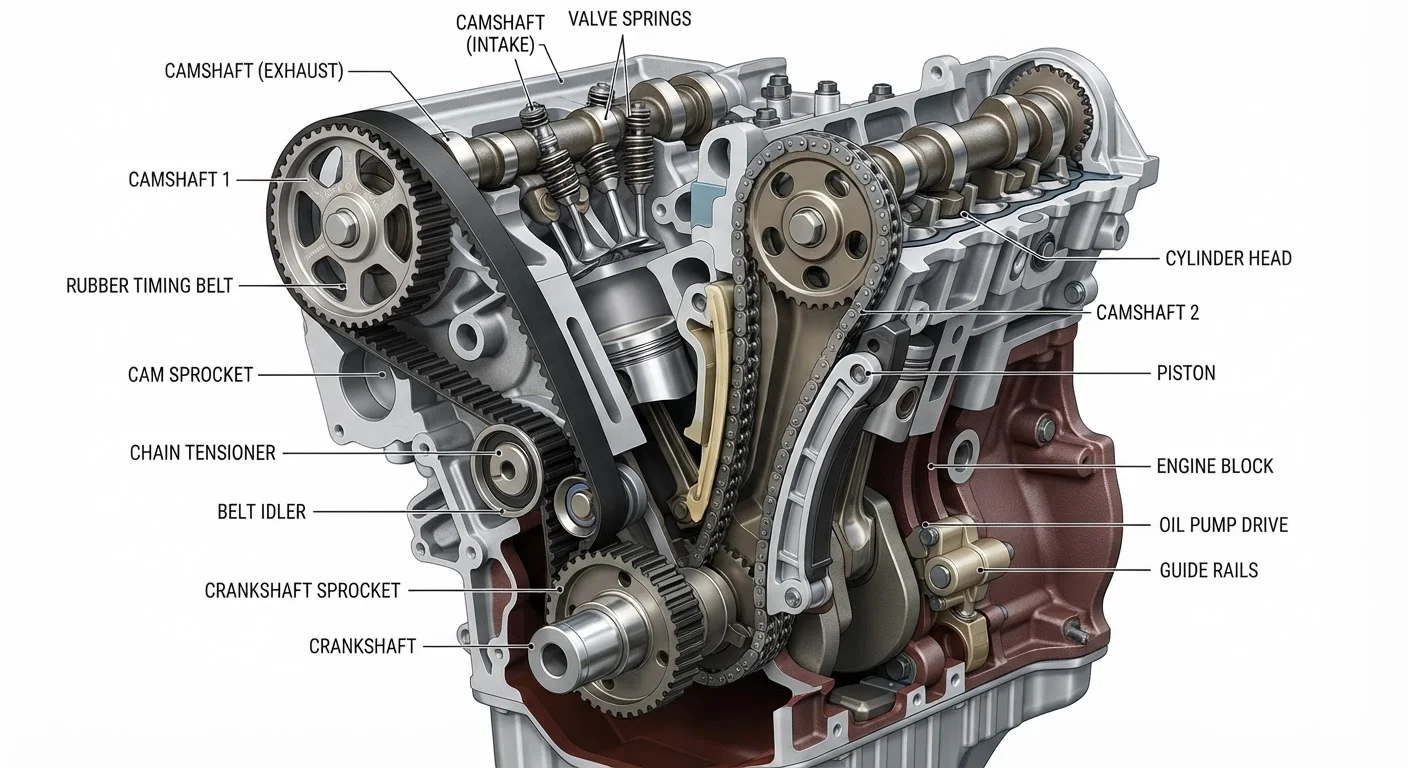
Option A
Timing Belt
The scheduled-replacement rubber component.
Best for: Drivers who want a quieter, lighter engine and are comfortable following a strict replacement schedule.
Option B
Timing Chain
The durable, low-maintenance metal alternative.
Best for: Drivers who prefer a set-it-and-forget-it approach and prioritize long-term engine durability.
What These Components Actually Do
Both the timing belt and timing chain serve the same critical function: synchronizing the crankshaft and camshaft so that engine valves open and close at precisely the right moment. Get that timing wrong - even slightly - and the engine runs poorly or not at all. In an interference engine (one where the valves and pistons share the same space at different times), a snapped timing belt or severely worn chain can send pistons crashing into open valves, destroying the engine in an instant.
The key difference is materials and design. A timing belt is a toothed rubber belt - quieter, lighter, and less expensive to manufacture, but subject to degradation over time regardless of how the car is driven. A timing chain is a metal link chain, similar in concept to a bicycle chain, running in an oil-lubricated environment inside the engine. This makes it significantly more durable under normal conditions.
Whether your car uses a belt or chain depends entirely on the manufacturer's design choice - you can't easily identify which system you have by looking at the outside of the engine. Check your owner's manual or ask a mechanic to confirm.
Maintenance Requirements: Where the Gap Gets Real
This is where the practical difference hits your wallet and your calendar.
| Criterion | Timing Belt | Timing Chain |
|---|---|---|
| Material | Rubber with fiber reinforcement | Metal links |
| Typical lifespan | 60,000-100,000 miles | Engine lifetime (with proper oil care) |
| Scheduled replacement | Yes - required | No - unless worn or damaged |
| Failure warning | Often none - sudden failure | Rattling or noise at startup |
| Lubrication | Dry (runs outside oil system) | Oil-lubricated inside engine |
| Engine noise | Quieter operation | Slightly louder |
| Interference engine risk | High if belt snaps | Lower, but chain stretch still risky |
A timing belt has a finite service life measured in both miles and time. Most manufacturers specify replacement somewhere between 60,000 and 100,000 miles, but the rubber also degrades with age - so a low-mileage car driven infrequently may still need a new belt after several years. Because belt failure is often sudden and without obvious warning, mechanics typically recommend replacing related components (water pump, tensioners, idler pulleys) at the same time to avoid paying for labor twice.
A timing chain, by contrast, is lubricated by engine oil and is designed to last the engine's lifetime. However, "designed to last" is not a guarantee. Chains can stretch gradually, and the tensioners that keep them taut can wear. The most common warning sign is a rattling or chattering noise from the engine during the first few seconds after a cold start - a sound worth having evaluated promptly. Critically, neglecting oil changes accelerates chain wear significantly, so staying current on oil service is the main way you protect a chain-equipped engine. See our guide to oil change intervals for what that actually means in practice.
How to Find Out Which System You Have
The easiest way is to check your owner's manual - it will list the timing system and any required replacement intervals. You can also ask a mechanic during your next service visit, or search your vehicle's year, make, and model alongside "timing belt or chain" using a reputable automotive reference source. Do not assume based on the vehicle's age or price point alone, as manufacturers have used both systems across all market segments.
Cost Implications and What to Watch For
Timing belt replacement is a legitimate planned expense. Labor costs dominate the bill because accessing the belt typically requires significant disassembly. Costs vary widely by vehicle make and model, but the job is rarely cheap - and skipping it is far more expensive if the belt fails. If your car is approaching the manufacturer's interval, treat it as a non-negotiable service appointment.
$500-$1,000+
Typical timing belt replacement cost
Labor-intensive access means costs vary significantly by vehicle; luxury and all-wheel-drive models often run higher.
~60%
New vehicles estimated to use timing chains
Industry analysts have noted a shift toward timing chains in newer engine designs over the past two decades, though belt-equipped engines remain common.
Timing chain repairs, while uncommon, are not cheap when they do occur. Chain stretch, tensioner failure, or guide wear can require engine disassembly. The good news is that these problems tend to develop gradually and show warning signs before becoming critical - unlike a belt, which can snap without notice.
For a broader view of which maintenance tasks are realistic to handle yourself versus which belong in a professional bay, our DIY vs. shop maintenance comparison is worth reviewing. Timing belt replacement, for most drivers, firmly belongs in the shop category.
This article is for general informational purposes only. Always consult your vehicle's owner's manual and a qualified mechanic for guidance specific to your make, model, and driving conditions.
The content on this site is for informational purposes only and is not a substitute for professional advice. Always consult a qualified professional for guidance specific to your situation.