

Option A
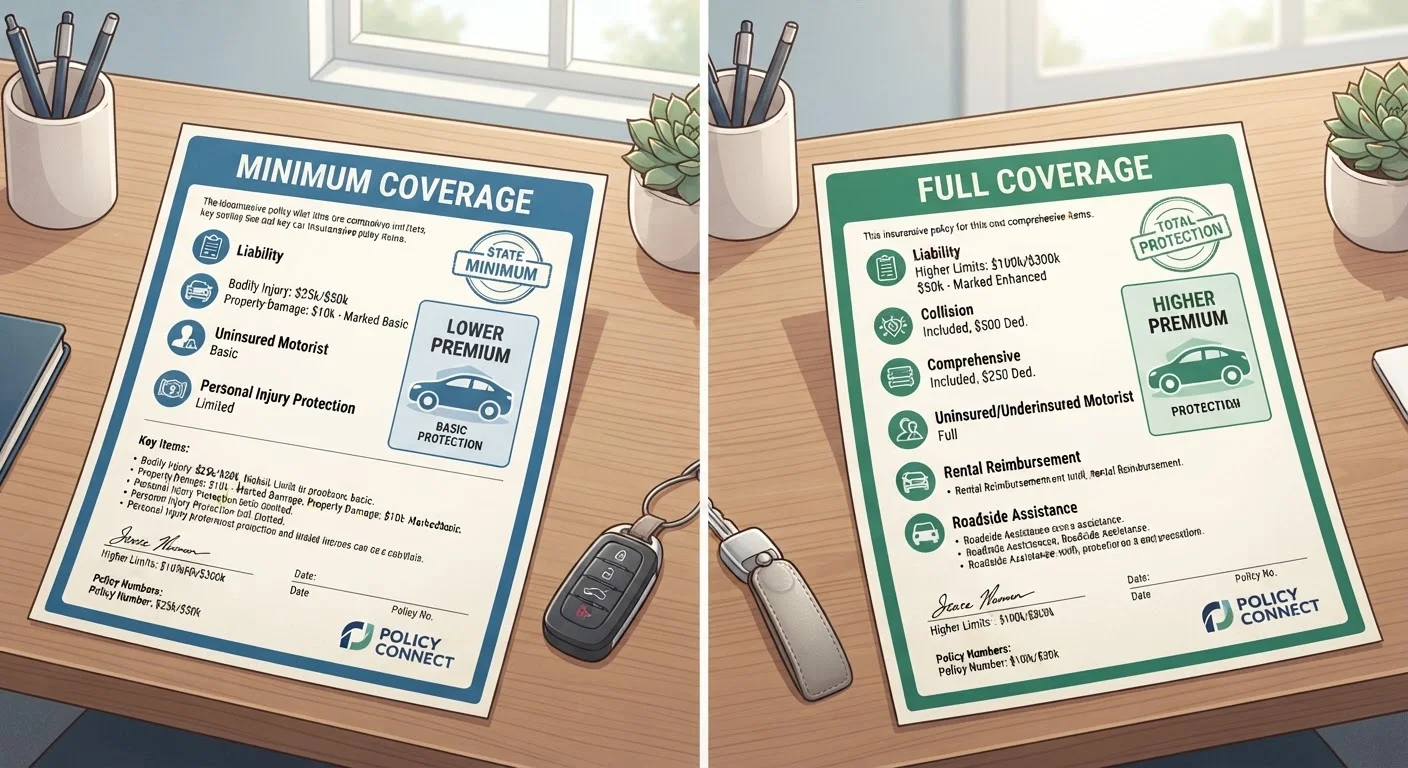
Minimum Coverage
The legal baseline - just enough to drive lawfully.
Best for: Drivers with older, low-value vehicles who can absorb out-of-pocket costs for their own car.
Option B
"Full Coverage"
The broader protection bundle - not an official policy type.
Best for: Drivers with financed or leased vehicles, or anyone who can't afford to replace their car out of pocket.
What "Minimum Coverage" Actually Means
Every U.S. state (except New Hampshire, which has unique rules) requires drivers to carry a minimum level of auto insurance to operate a vehicle legally. What that minimum looks like varies significantly by state, but it almost always centers on liability coverage - specifically, bodily injury liability and property damage liability.
Bodily injury liability pays for injuries you cause to other people in an accident you're responsible for. Property damage liability covers damage you cause to someone else's car or property. These coverages protect others, not you or your vehicle.
State minimums are expressed as split limits - for example, 25/50/25 means $25,000 per injured person, $50,000 per accident for bodily injury, and $25,000 for property damage. These numbers can look reasonable until you factor in real medical and repair costs. For a deeper look at how these pieces fit together, see our breakdown of core coverage types.
Critically: minimum coverage pays nothing toward repairing or replacing your own car after an accident, regardless of fault. A theft, a hailstorm, or a collision you caused - none of those are covered under a liability-only policy.
| Criterion | Minimum Coverage | "Full Coverage" |
|---|---|---|
| Official policy term? | Yes - legally defined by each state | No - industry shorthand only |
| Covers damage to others | Yes (liability required) | Yes (liability included) |
| Covers your own vehicle | No | Yes (collision + comprehensive) |
| Required by lenders | No - insufficient for loans | Yes - typically required |
| Covers theft or weather damage | No | Yes (via comprehensive) |
| Typical cost | Lower premium | Higher premium |
| Financial risk to you | High if your car is damaged | Lower, subject to deductibles |
What "Full Coverage" Actually Means
Here's the plain truth: "full coverage" is not an official insurance term. No state defines it, and no insurer is required to use it consistently. It's industry shorthand - a convenient phrase that typically means a policy combining liability, collision, and comprehensive coverage.
- Collision coverage pays to repair or replace your vehicle after it's damaged in a crash, regardless of who caused it.
- Comprehensive coverage covers non-collision events - theft, vandalism, weather damage, animal strikes, and similar incidents.
When a lender or dealership says your loan requires "full coverage," they mean those two additional coverages must be added to your policy. What the phrase does not guarantee is that every possible scenario is covered. Medical payments, uninsured motorist protection, gap insurance, and roadside assistance are all separate add-ons that may or may not be included. For more on one critical gap, see our piece on uninsured motorist coverage.
The word "full" can create a false sense of security. Before assuming you're comprehensively protected, read your declarations page carefully and understand exactly what coverages and limits you're actually carrying. Our plain-language auto insurance guide walks through how to read a policy without getting lost in the fine print.
~13%
Uninsured drivers on U.S. roads
According to the Insurance Research Council, roughly 1 in 8 drivers in the U.S. carries no insurance - a key reason uninsured motorist coverage matters even for fully insured drivers.
Varies widely
State minimum liability limits
State-required minimums range from as low as $10,000 in property damage liability to $100,000 or more in some states, meaning "minimum" is not a uniform standard across the country.
Making the Right Call for Your Situation
The decision between minimum and broader coverage isn't really a binary choice - it's a sliding scale based on your specific circumstances. A few factors that matter most:
- Your vehicle's current market value
- If your car is worth $4,000 and collision coverage costs $600 a year with a $1,000 deductible, the math gets tight quickly. A general rule of thumb is to reconsider collision and comprehensive when annual premiums exceed 10% of the vehicle's market value - though that's a guideline, not a guarantee.
- Whether you have a loan or lease
- This is non-negotiable. Lenders require collision and comprehensive, and dropping them while financing a vehicle violates the loan agreement. The lender may even force-place insurance on your behalf at a far higher cost.
- Your financial cushion
- Minimum coverage shifts risk onto you. If you can comfortably absorb the loss of your vehicle, that's a reasonable trade-off. If you can't, it isn't.
Also consider that state minimum liability limits are often inadequate after a serious accident. A multi-car collision or severe injury can generate costs far beyond what minimum policies pay - leaving you personally responsible for the difference. For a detailed look at that risk, see our article on where drivers get the liability calculation wrong.
This article is for general informational purposes only and does not constitute personalized insurance or financial advice. Coverage requirements, terms, and availability vary by state and insurer. Consult a licensed insurance professional to evaluate your specific situation.
The content on this site is for informational purposes only and is not a substitute for professional advice. Always consult a qualified professional for guidance specific to your situation.