

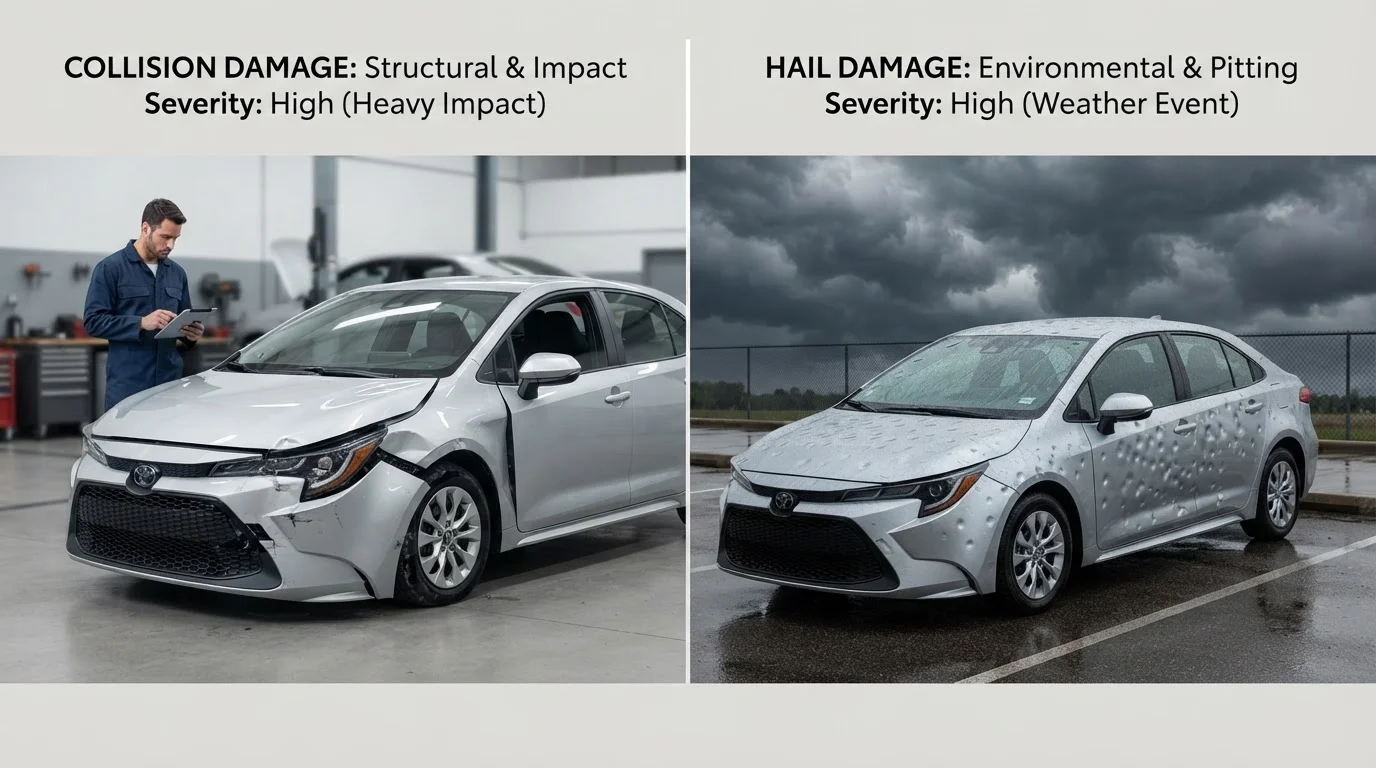
Option A
Collision Coverage
The coverage that responds when your car hits something.
Best for: Drivers who want protection when they're at fault in an accident or when another driver causes damage but lacks adequate insurance.
Option B
Comprehensive Coverage
The coverage that handles damage from forces outside your control.
Best for: Drivers in areas prone to theft, severe weather, wildlife, or other non-collision risks.
The Core Distinction: What Triggers Each Coverage
The clearest way to separate these two coverages is by asking a single question: what caused the damage?
Collision coverage pays for repairs to your car when it makes contact with another vehicle or a physical object - a guardrail, a pole, another car in a parking lot, or even your own garage door. It doesn't matter who caused the accident. If your vehicle sustains damage through impact, collision coverage is the relevant policy component.
Comprehensive coverage handles nearly everything else. Insurers sometimes call it "other than collision" coverage, which is actually a more precise name. It responds to damage from theft, vandalism, falling objects (tree limbs, hail), flooding, fire, and animal strikes - situations where no collision occurred but your vehicle still took a loss.
For a broader look at how these two fit alongside liability protection, see our guide to the three core coverage types.
| Criterion | Collision Coverage | Comprehensive Coverage |
|---|---|---|
| What triggers it | Impact with vehicle or object | Theft, weather, animals, fire, vandalism |
| Also called | Collision | Other than collision (OTC) |
| Whose vehicle is covered | Your own vehicle | Your own vehicle |
| Required by law | No | No |
| Often required by lenders | Yes | Yes |
| Typical relative cost | Higher premium | Lower premium |
| Deductible applies | Yes | Yes (often lower) |
| Payout basis | Actual cash value | Actual cash value |
How Deductibles and Payouts Work
Both collision and comprehensive are physical damage coverages, meaning they pay for damage to your own vehicle rather than to someone else's property. Each carries a separate deductible - the amount you pay out of pocket before the insurer covers the rest.
Common deductible choices range from $250 to $1,500. Choosing a higher deductible typically lowers your premium but increases what you'd owe after a claim. Comprehensive deductibles are often set lower than collision deductibles, because comprehensive claims (particularly theft or total loss from a storm) tend to involve larger payouts.
In both cases, the insurer pays up to the car's actual cash value (ACV) - what the vehicle was worth at the time of loss, factoring in depreciation. This means a payout may be considerably less than what you originally paid for the car.
~$522
Average annual collision coverage premium
According to the National Association of Insurance Commissioners (NAIC), the average annual expenditure for collision coverage was approximately $522 in recent reporting years.
~$168
Average annual comprehensive coverage premium
NAIC data indicates comprehensive coverage costs drivers significantly less per year than collision, reflecting the different risk profiles each coverage addresses.
Understanding this distinction matters when you're evaluating whether to carry one, both, or neither coverage - especially on older vehicles. For more context on how these choices interact with policy terms, see what "full coverage" actually means.
When You Might Carry One Without the Other
It's technically possible to carry comprehensive without collision, though the reverse is less common. Some drivers in rural areas - where animal strikes and severe weather are a bigger concern than traffic accidents - make this calculation deliberately. Comprehensive is also generally less expensive than collision, so it can offer meaningful protection at a lower cost.
Dropping both coverages makes the most sense when a vehicle's market value is modest. A useful rule of thumb: if your annual combined premium for both coverages is close to what you'd receive in a payout after a total loss, the math may not work in your favor. A licensed insurance agent can help you run those numbers for your specific situation.
If your vehicle is financed or leased, this decision is largely out of your hands. Lenders typically require both coverages to protect their investment. Letting either lapse can trigger what's called "force-placed insurance" - a policy the lender purchases on your behalf at a higher cost and with narrower protections.
For a fuller picture of your overall auto insurance framework, Auto Insurance Decoded walks through how each coverage type fits together.
The content on this site is for informational purposes only and is not a substitute for professional advice. Always consult a qualified professional for guidance specific to your situation.