

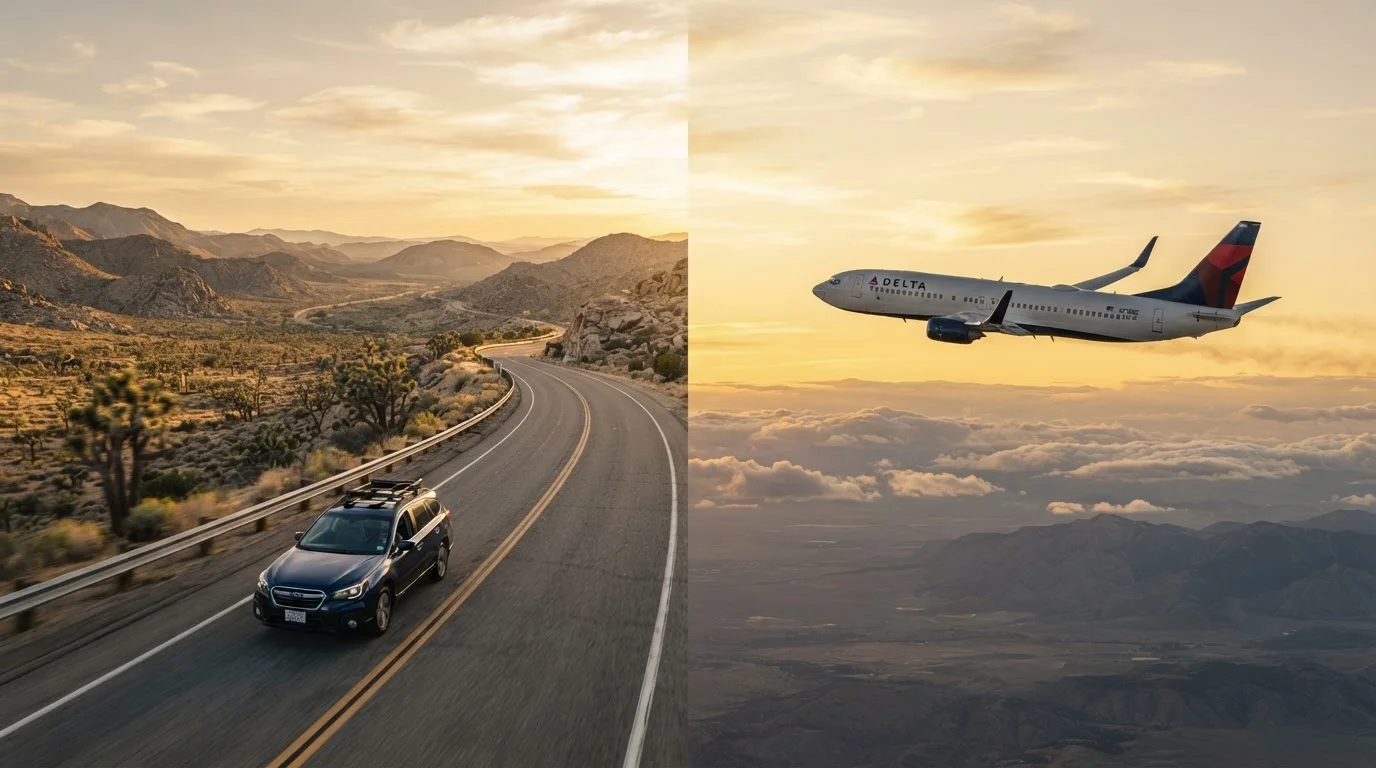
Option A
Road Trip
The flexible, all-in-one journey experience.
Best for: Families, groups, or travelers with lots of gear who value flexibility and scenic routes over speed.
Option B
Flying
The fastest way to cover serious distance.
Best for: Solo travelers or couples covering 500+ miles who prioritize time savings and want to minimize physical fatigue.
Breaking Down the Real Cost of Driving
A road trip looks affordable until you line up every expense honestly. Gas is the obvious start: at an average of 25 miles per gallon and fuel prices that vary widely by region and season, a 500-mile drive each way could easily cost $80-$120 in fuel alone for a typical sedan - more for SUVs and trucks. That figure doubles for the round trip.
Then come the costs travelers often undercount. Tolls on major corridors - the Northeast, parts of Florida, Illinois interstates - can add $30-$80 per crossing. Food on the road tends to be pricier than eating at home, especially when fast-food fatigue sets in and sit-down restaurants start looking appealing. And if your trip stretches beyond a single day of driving, even one modest motel night adds $100 or more to the ledger.
Don't overlook wear on your vehicle. The IRS standard mileage rate (used as a general proxy for vehicle operating costs) accounts for depreciation, oil, tires, and maintenance - not just gas. Running those numbers on a 1,000-mile round trip often reveals a total vehicle cost well above the fuel price alone.
| Criterion | Road Trip | Flying |
|---|---|---|
| Base cost (solo traveler, 500 mi) | ~$80-$150 in gas/tolls | $150-$300+ with fees |
| Cost for family of four | Same gas, shared cost | 4× airfare multiplier |
| Door-to-door time | 8-10 hrs (500 mi) | 5-6 hrs total (with airport) |
| Luggage flexibility | Unlimited, no extra charge | Fees per bag, size limits |
| Overnight stops needed | Yes, for trips 700+ miles | No - fly same day |
| Pet-friendly | Generally yes | Complex, often costly |
| Flexibility mid-trip | High - reroute anytime | Low - rebooking fees apply |
| Parking at destination | Vehicle already there | Rental or rideshare needed |
For a deeper look at expenses that quietly inflate seemingly affordable trips, see The Hidden Costs Tucked Inside Seemingly Cheap Trips.
What Flying Actually Costs from Curb to Curb
The advertised airfare is rarely what you pay. Budget carriers in particular are well known for unbundling costs that once came standard. A $99 base fare can quickly climb when you add a checked bag ($30-$45 each way), a carry-on on some carriers ($25-$40), and a seat selection fee to avoid sitting in a middle seat at the back. Round-trip for one person can realistically land between $200 and $350 before you've left the house.
Airport parking is another significant variable. Long-term lots at major airports typically run $20-$35 per day. A five-day trip means $100-$175 in parking - or you opt for a rideshare to the airport, which carries its own cost plus tip. On the other end, ground transportation from the destination airport (rental car, rideshare, or transit) adds more.
$30-$45
Average checked bag fee, each way
Most major US carriers charge per checked bag each direction, with fees varying by airline tier and booking method.
~25¢-30¢
Per-mile vehicle operating cost estimate
The IRS standard mileage rate (used as a general cost proxy) reflects fuel, depreciation, oil, and tire wear over time.
400-600 mi
Typical driving-to-flying break-even range
Travel planning guides commonly cite this range as where flying starts to become time- and cost-competitive for solo domestic travelers.
Time also functions as a cost. Factor in arriving two hours early for domestic flights, layovers if your route isn't direct, and time at baggage claim. A flight that shows as two hours in the air often consumes five to six hours of your actual day.
Some of these assumptions are worth pressure-testing - Budget Travel Myths That Are Costing American Travelers Money takes a closer look at beliefs that don't always hold up.
Finding Your Break-Even Point
For most travelers, the crossover where flying becomes genuinely competitive on cost falls somewhere between 400 and 600 miles - roughly the distance from Chicago to Nashville, or Atlanta to Washington, D.C. Below that range, driving is usually cheaper even for solo travelers. Beyond it, the math increasingly favors flying, particularly once you price in overnight stops or lost work time.
Group size changes everything. A family of four flying means multiplying the airfare by four. That same family driving shares one tank of gas and one set of tolls. Even with a larger vehicle's lower fuel economy, the per-trip cost is usually far lower than four tickets plus fees.
The most honest approach is to build a side-by-side estimate before you commit. List every driving cost - fuel at your car's actual MPG, tolls by route, planned food spend, any overnight stays - then list every flying cost including bags, parking or rideshare, and destination ground transport. The gap between those totals often surprises travelers in both directions.
For a structured way to run that comparison before booking, Before You Book: A Planning Checklist for Cost-Conscious US Trips walks through each line item. And if you're weighing a full road trip against flying in and renting a car, Road Trip vs. Fly-and-Drive explores that hybrid option in detail.
The content on this site is for informational purposes only and is not a substitute for professional advice. Always consult a qualified professional for guidance specific to your situation.