

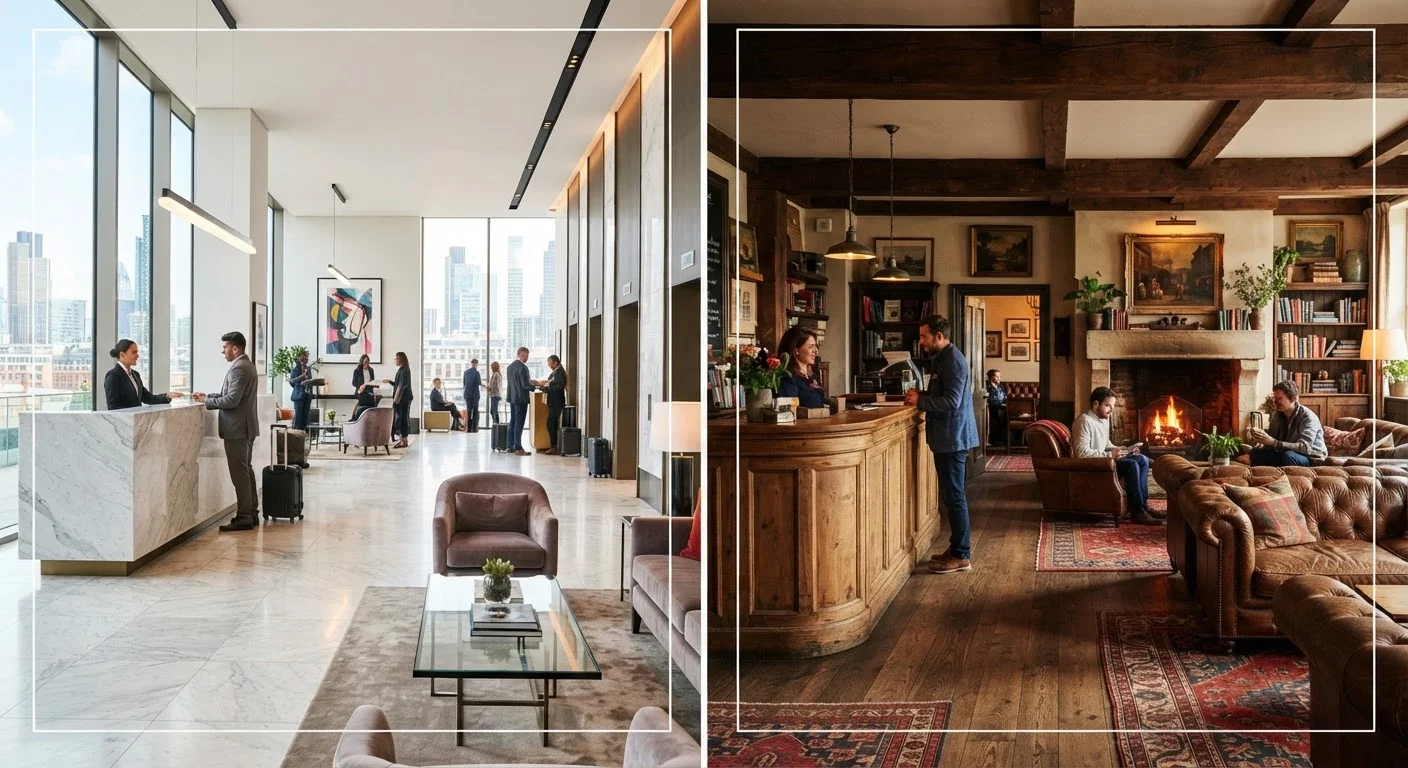
Option A
City Hotel (Chain or Full-Service)
The reliable, amenity-rich urban anchor.
Best for: Travelers who prioritize consistency, on-site conveniences, and seamless booking experiences.
Option B
Boutique Inn
The character-driven, locally rooted alternative.
Best for: Travelers who want a distinctive, place-specific stay with personal service and neighborhood immersion.
What Actually Separates These Two Lodging Types
The difference between a city hotel and a boutique inn goes well beyond aesthetics. A full-service city hotel - whether part of a national chain or an independently operated high-rise - is engineered for scale. Hundreds of rooms, multiple dining outlets, a fitness center, valet parking, and a front desk staffed around the clock are standard expectations. These properties are built to handle volume efficiently and consistently, which is exactly why so many travelers default to them.
A boutique inn, by contrast, is defined by its smallness and specificity. Typically under 100 rooms (often far fewer), boutique properties lean into a distinct personality - whether that's a converted Victorian home in Savannah, a surf-inspired coastal lodge in California, or a design-forward urban inn in a walkable Portland neighborhood. The experience feels curated rather than standardized.
Neither approach is objectively superior. The right fit depends heavily on why you're traveling, how you like to spend your time, and what you genuinely need from a place to sleep. For a broader look at how your destination type influences lodging options, see urban vs. rural retreat considerations.
Amenities, Service, and the Day-to-Day Experience
| Criterion | City Hotel | Boutique Inn |
|---|---|---|
| Typical room count | 100-1,000+ rooms | Under 100 rooms |
| Service style | Efficient, standardized | Personal, owner-driven |
| Amenities | Gym, room service, business center | Varies; often minimal but curated |
| Price predictability | Transparent with loyalty rates | Variable; can be premium |
| Loyalty programs | Widely available | Rarely available |
| Location tendency | Near transit hubs, business districts | Neighborhoods, historic areas |
| Atmosphere | Consistent, brand-defined | Distinctive, place-specific |
| Best trip type | Business, family, conference travel | Romantic, cultural, experiential |
City hotels win on raw amenity count almost every time. If you need a gym at 6 a.m., a restaurant that serves food past 10 p.m., or a concierge who can arrange airport transfers across a complex itinerary, a full-service property delivers. Loyalty programs - which let frequent travelers accumulate points toward future stays - are another major draw that boutique properties often can't match.
Boutique inns counter with something harder to quantify: attentiveness. Because staff-to-guest ratios tend to be higher relative to room count, interactions feel more personal. Owners or innkeepers are often on-site and genuinely invested in your stay. Breakfast may be house-made and regionally inspired rather than a buffet of packaged items. These details matter enormously to certain travelers and feel irrelevant to others - knowing which camp you're in is half the decision.
~30%
Travelers citing 'local character' as a lodging priority
Industry hospitality surveys consistently find a significant share of leisure travelers rank authentic, locally connected experiences as a key factor in accommodation choice.
57%
Hotel guests who belong to at least one loyalty program
According to general hospitality industry research, loyalty program membership influences repeat booking behavior significantly, favoring chain properties.
Cost, Location, and What You're Really Paying For
A common assumption is that boutique inns are the budget-friendly alternative to big hotels. That's not reliably true. In many markets - think a historic inn in a popular coastal town or a design hotel in a trendy urban district - boutique rates comfortably exceed those of a nearby chain property. What you're paying for is character, distinctiveness, and a sense of place, not necessarily lower cost.
City hotels, meanwhile, benefit from economies of scale and corporate rate structures that can make them genuinely competitive, especially when you factor in loyalty discounts or package deals. Resort fees (additional daily charges common at larger properties) can erode that advantage, so always read the full rate before assuming a lower nightly price is the full story. The guide to reading hotel listings without being misled is a useful next step once you've narrowed your options.
Location is another cost-adjacent factor. City hotels cluster near convention centers, airports, and transit corridors - convenient for arrivals but sometimes disconnected from a city's more interesting pockets. Boutique inns often sit within walkable neighborhoods, which can reduce transportation costs and immerse you more authentically in daily local life. If your itinerary involves a mix of driving and urban exploration, how you're arriving at your destination may also influence which lodging type makes more logistical sense.
For travelers who want to explore lodging options beyond both of these categories, accommodation alternatives beyond the hotel room covers the full spectrum of trade-offs.
The content on this site is for informational purposes only and is not a substitute for professional advice. Always consult a qualified professional for guidance specific to your situation.