

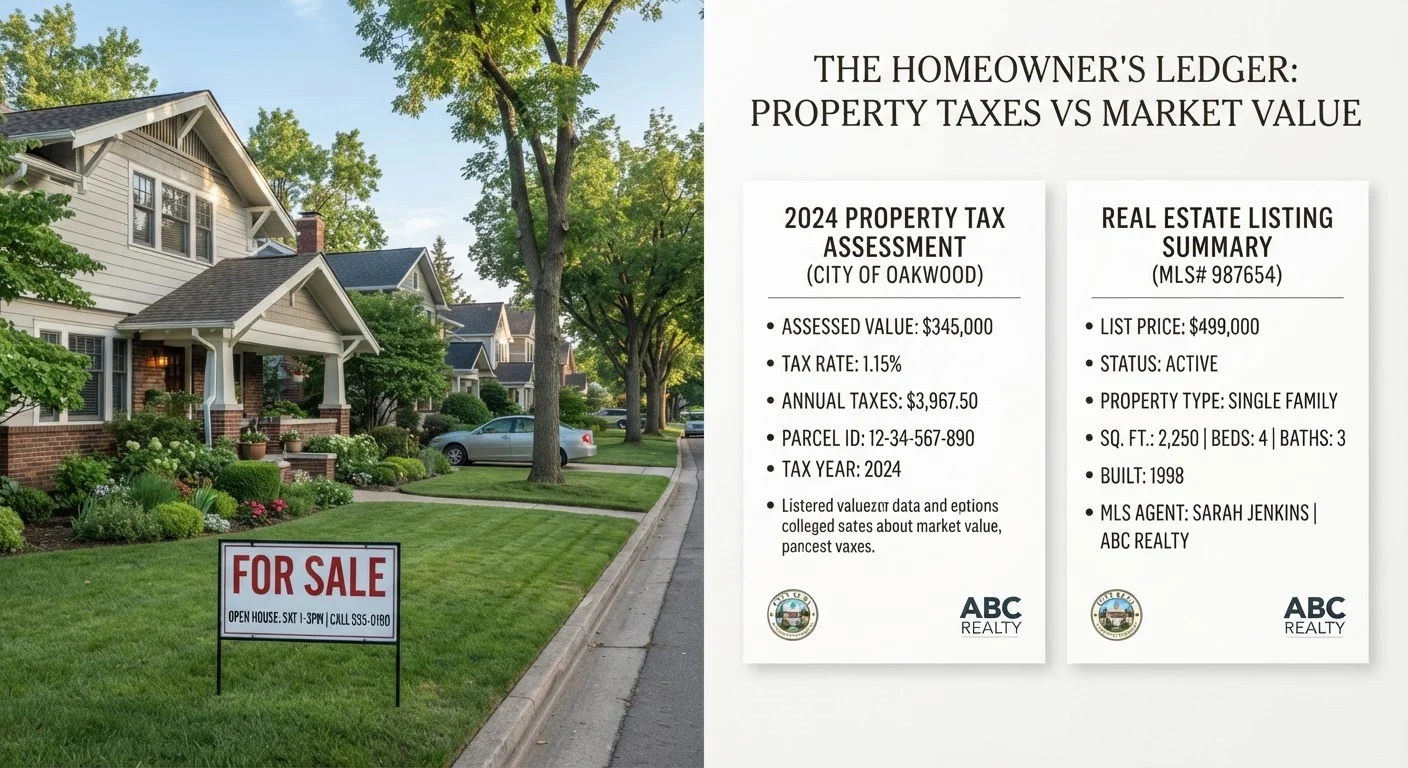
Option A
Assessed Value
The government's official valuation for tax purposes.
Best for: Understanding your annual property tax bill and challenging a potentially inaccurate assessment.
Option B
Market Value
What buyers and sellers agree a home is actually worth.
Best for: Pricing a home for sale, making an offer, or evaluating your equity position.
Two Numbers, Two Very Different Purposes
If you've ever noticed that the value on your property tax bill looks nothing like what homes are selling for in your neighborhood, you've already stumbled onto one of the most common points of confusion in homeownership: assessed value and market value are not the same thing, and they're not meant to be.
Each number exists for a specific purpose, determined through a separate process by different parties. Conflating the two can lead to misreading your equity, misunderstanding your tax bill, or missing an opportunity to appeal an unfair assessment. Understanding the distinction is one of the most practical tools a homeowner can have.
| Criterion | Assessed Value | Market Value |
|---|---|---|
| Set by | Local government assessor | Buyers, sellers, and appraisers |
| Primary purpose | Calculating property taxes | Pricing, buying, and lending |
| How often updated | Annually or on a set cycle | Continuously, with market conditions |
| Typical relationship | Often lower than market value | Generally higher than assessed value |
| Can you challenge it? | Yes, through a formal appeal | Negotiated, not formally appealed |
| Used by lenders? | Rarely | Yes, for appraisals and loan approval |
What Is Assessed Value?
Assessed value is the dollar figure assigned to your property by your local government's assessor's office. It exists for one primary reason: to calculate your annual property tax bill. Local governments multiply the assessed value by the local tax rate (often called the mill rate) to arrive at what you owe each year.
Assessors typically don't visit every property each year. Instead, they rely on mass appraisal techniques - using sales data, property characteristics, and neighborhood comparisons - to estimate values across large numbers of homes simultaneously. Many jurisdictions also apply an assessment ratio, meaning your assessed value is set at a fixed percentage of estimated market value. A common ratio is 80% or even lower, though this varies widely by state and county.
For a deeper look at how local governments calculate your bill, see our guide to property tax calculations.
Assessment Ratios Vary Widely by Location
Some states assess property at 100% of estimated market value, while others use ratios as low as 10-20%. This means a low assessed value doesn't necessarily signal a problem - it may simply reflect your jurisdiction's standard practice. Check your local assessor's website or your tax bill documentation to find the ratio that applies in your area.
What Is Market Value?
Market value is what a knowledgeable, willing buyer would reasonably pay a knowledgeable, willing seller for a property - assuming neither is under pressure to complete the transaction. It reflects real-world supply and demand, local economic conditions, interest rates, and the specific features of the home.
Market value is most formally estimated through a professional appraisal, conducted by a licensed appraiser who analyzes recent comparable sales (commonly called comps), the home's condition, and neighborhood trends. Lenders require appraisals before approving most mortgage loans. Real estate agents also estimate market value through a Comparative Market Analysis (CMA) when helping clients price a home or make an offer.
Market value is fluid - it shifts as economic conditions change, inventory levels fluctuate, and buyer demand rises or falls. Understanding what genuinely moves that number is covered in our article on factors that raise and lower home value.
~80%
Common assessment-to-market ratio
Many U.S. jurisdictions set assessed value at roughly 80% or less of estimated market value, though the exact ratio varies significantly by state and county.
30-60 days
Typical appeal window per year
Most local governments allow homeowners a limited annual window to formally contest their property's assessed value; missing this deadline usually means waiting until the next cycle.
When Each Value Matters Most - and What to Do With That Knowledge
The practical question for most homeowners isn't which value is "correct" - it's which one applies to the situation at hand.
For property taxes: Your assessed value drives your bill. If you believe your home has been over-assessed - perhaps because the assessor used inaccurate data about square footage, lot size, or condition - you have the right to appeal. Most local governments offer a formal appeals window each year. Gathering recent comparable sales and a current appraisal can strengthen your case considerably.
For buying or selling: Market value is what guides negotiations. A listing priced well above market value will likely sit unsold; one priced below may attract multiple offers. Understanding the local market gives buyers and sellers leverage in negotiations.
For equity and refinancing: Lenders care about market value, not assessed value. When you refinance, a licensed appraiser determines the value used to calculate your loan-to-value ratio - which affects your rate and whether you'll need private mortgage insurance (PMI).
Having a clear grasp of these two values puts you in a much stronger position at every stage of homeownership - from your first tax bill to a future sale.
This article is for general informational and educational purposes only and does not constitute legal, tax, or financial advice. Consult a qualified professional for guidance specific to your situation.
The content on this site is for informational purposes only and is not a substitute for professional advice. Always consult a qualified professional for guidance specific to your situation.