

Why Portion Perception Is Harder Than It Looks
Most people believe they have a reasonably accurate sense of how much they're eating. Research on visual estimation consistently suggests otherwise. Studies in behavioral nutrition have found that people across a wide range of backgrounds and dietary knowledge levels tend to underestimate portions of energy-dense foods and overestimate portions of lower-calorie ones - a pattern that holds even among nutrition professionals in some contexts.
This isn't a failure of willpower or attention. It's a predictable outcome of how human perception works when confronted with variable containers, unfamiliar foods, and environments designed around convenience rather than clarity. Understanding the specific ways these misjudgments occur is the first step toward a more grounded relationship with food quantity - without turning every meal into a measurement exercise.
For a broader foundation on how food concepts fit together, see Nutrition from Scratch, which covers portion awareness alongside other core nutrition basics.
Treating the labeled serving size as the expected or recommended amount to eat.
Why it happens: Nutrition Facts labels list a standardized serving size for comparison purposes, not as a dietary prescription. Many people interpret the number as a signal of how much they should consume.
Underestimating portions of foods perceived as healthy or "light."
Why it happens: When a food is mentally categorized as wholesome - nuts, olive oil, whole-grain bread - people tend to be less attentive to quantity, assuming more is fine because the food itself is beneficial.
Using plate or bowl size as a proxy for an appropriate portion.
Why it happens: People tend to fill available space. Larger vessels create a visual expectation that a full plate or bowl is the right amount, a well-documented phenomenon in behavioral nutrition research.
Eating directly from a package and losing track of cumulative quantity.
Why it happens: Without a defined endpoint, eating from a bag, box, or serving dish removes natural stopping cues. Each individual piece feels small, but the total accumulates quickly and invisibly.
Ignoring how liquid calories are portioned and perceived.
Why it happens: Drinks - including juice, smoothies, coffee beverages, and alcohol - are rarely measured the way solid food is, and their caloric contribution is frequently underestimated or forgotten entirely.
Assuming that restaurant portions represent a standard amount.
Why it happens: Restaurant servings are sized for satisfaction and value, not nutritional guidance. Repeated exposure to large restaurant portions can recalibrate a person's internal baseline upward over time.
A Clearer Framework: Anchors Instead of Estimates
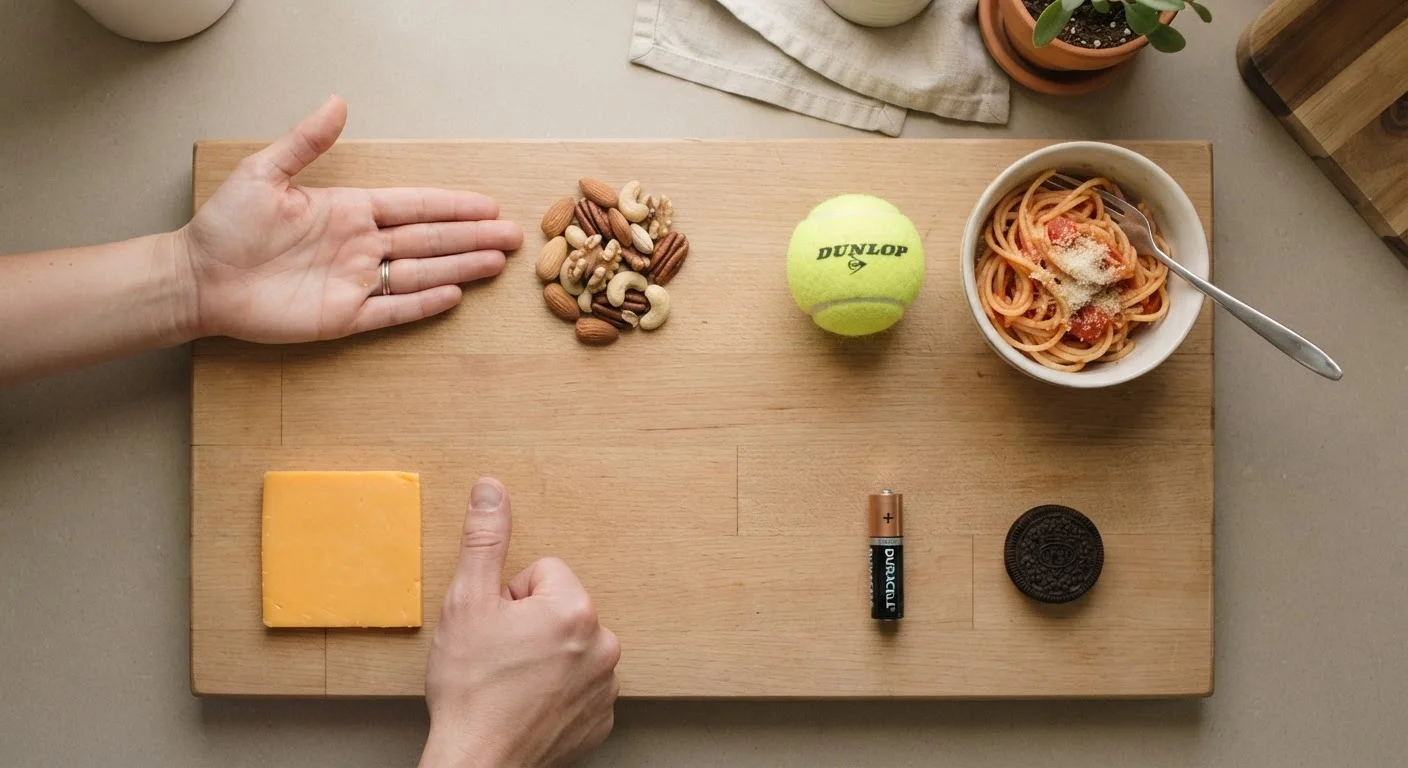
Rather than trying to eyeball portions with precision, a more reliable approach involves using consistent physical reference points - sometimes called "portion anchors." Because your hand scales roughly with your body, hand-based comparisons (a palm for protein portions, a cupped hand for grains, a thumb for fats) offer a portable, personalized guide that doesn't require any tools.
2-3x
How much portions have grown since the 1980s
The National Heart, Lung, and Blood Institute has documented that common restaurant and packaged food portions are substantially larger than they were several decades ago.
~92%
Food consumed when served larger portions
Research published in nutrition behavioral journals has found that people tend to eat the majority of what is placed in front of them, regardless of initial hunger level.
This approach isn't about hitting an exact number. It's about building a stable mental model that stays consistent across different settings - a restaurant, a friend's kitchen, a work lunch. Consistency matters more than precision here. The goal is calibrated awareness, not clinical measurement.
It's also worth pairing this habit with a better understanding of food labels. The Nutrition Facts label guide explains how serving size information on packaging actually works - and why the listed serving often doesn't reflect real-world eating patterns.
For a complementary perspective on how proportions work across a whole meal, Building a Balanced Plate explores food group ratios without prescriptive rules. And if nutrition myths have shaped how you think about quantities - particularly around "healthy" foods - common nutrition myths is worth a read.
This article is for general informational purposes only and is not a substitute for personalized nutrition or medical advice. Consult a registered dietitian or qualified healthcare professional for guidance specific to your health needs.
The content on this site is for informational purposes only and is not a substitute for professional advice. Always consult a qualified professional for guidance specific to your situation.