

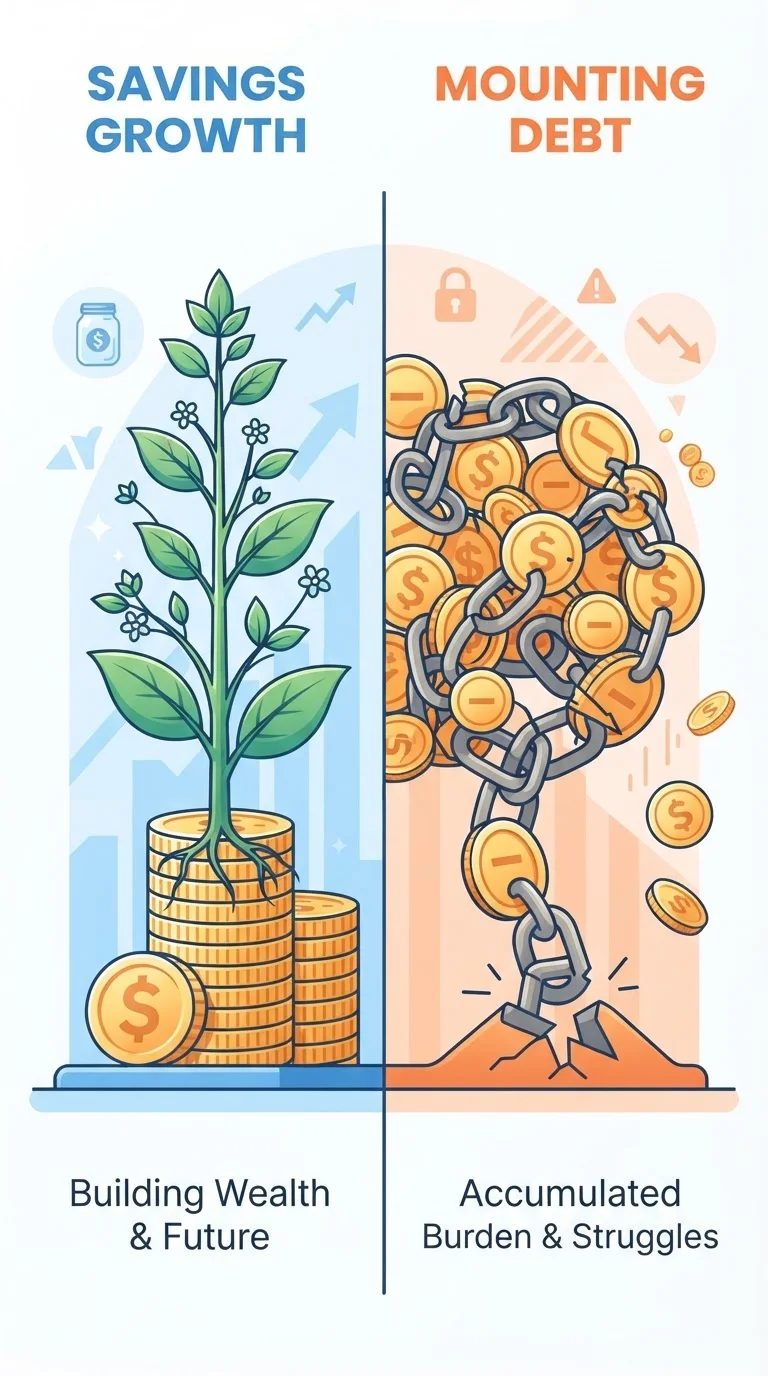
The Basic Mechanic: Interest on Interest
Most people understand that borrowing money costs money, and that saving money earns money. What compound interest adds to that picture is a feedback loop: the interest generated in one period becomes part of the balance that generates interest in the next period.
Consider a straightforward example. If you deposit $1,000 at a 5% annual interest rate, simple interest pays you $50 at the end of the year - every year, the same $50. Compound interest works differently. In year one, you also earn $50. But in year two, interest is calculated on $1,050, giving you $52.50. In year three, the base is $1,102.50, and so on. The amounts seem small early on, but the gap between simple and compound outcomes widens considerably over longer time horizons.
The same logic applies in reverse for debt. If interest is compounding on an unpaid credit card balance, every month that the balance isn't paid in full, new interest is charged not just on what you originally borrowed, but on prior unpaid interest as well.
Daily
Compounding frequency on most U.S. credit cards
Most major U.S. credit cards compound interest daily on unpaid balances, meaning even a few extra days before payment increases what you owe.
APY vs. APR
Key metrics separating savings yield from borrowing cost
APY reflects the true annual yield of a savings account after compounding; APR states a loan's rate before compounding frequency is factored in - comparing both helps you see the full picture.
The Savings Side: When Compounding Works For You
For savers, compounding is a structural advantage - one that rewards consistency and patience. The key variable is time. The longer money stays in a compounding environment, the more meaningful the effect becomes. This is why financial educators often describe early saving habits as disproportionately valuable compared to larger amounts saved later.
Compounding frequency matters too. A savings account that compounds daily will produce a slightly higher effective return than one compounding monthly at the same stated rate. That difference is why understanding what your account actually offers - including how and how often interest is applied - is worth knowing before you park your money somewhere.
APY, or Annual Percentage Yield, is the number that captures the compounding effect in a single figure. When comparing deposit accounts, APY is more useful than the nominal interest rate alone, because it already reflects how often compounding occurs. For a deeper explanation of how these terms interact, see our reference on interest rate terms every borrower should know.
Use APY to Compare Savings Accounts
When evaluating deposit accounts, always compare the APY rather than the stated interest rate. APY already reflects compounding frequency, so it gives you an apples-to-apples comparison of what your money will actually earn over a year. A higher APY at the same deposit amount means more growth over time.
The Debt Side: When Compounding Works Against You
The same mechanism that grows savings can significantly inflate what you owe. Credit cards are the most common example: they typically compound interest daily on any unpaid balance. If you carry a $3,000 balance at a 22% APR and make only minimum payments, the compounding effect means you are paying interest on interest month after month - and your total repayment amount grows well beyond the original $3,000.
The practical implication is that the cost of debt is not linear. It accelerates. A balance that seems manageable in year one can feel overwhelming by year three if the underlying rate is high and the compounding is frequent. This is one reason why understanding whether you are the saver or the borrower in any given financial arrangement is so important.
If you are navigating both debt and saving simultaneously, it helps to recognize that the interest rate on debt often exceeds what a savings account pays - meaning compounding on the debt side can outpace what compounding earns on the savings side. Our article on managing debt and saving at the same time walks through how to think about that trade-off.
Putting the Mechanic to Work
Understanding compound interest is not just theoretical - it changes how you interpret financial decisions. When evaluating a savings or deposit account, the APY tells you the real annual yield after compounding. When reviewing a loan or credit card, the APR tells you the stated rate, but compounding frequency determines the true annual cost.
Building habits that work with compounding - rather than against it - generally means reducing high-interest debt as aggressively as your situation allows, and establishing a consistent saving practice even if the starting balance is modest. Tools like automatic transfers can reinforce the discipline behind consistent saving; automating savings is one approach worth understanding in full before relying on it.
Compound interest is neither inherently good nor bad - it is a neutral mechanism that amplifies whatever financial behavior you bring to it. The side of the equation you are on is largely determined by the choices you make about borrowing, saving, and how quickly you act on each.
This article is for general informational purposes only and does not constitute personalized financial or investment advice. Consult a qualified financial professional for guidance specific to your situation.
Frequently Asked Questions
Simple interest is calculated only on the original principal. Compound interest is calculated on the principal plus any interest already earned or owed. Over time, compound interest causes balances to grow or accumulate much faster than simple interest.
It depends entirely on which side of the equation you are on. If you are saving or investing, compounding works in your favor by growing your balance over time. If you are carrying high-interest debt, compounding works against you by increasing what you owe.
The more frequently interest compounds, the faster balances change. Daily compounding produces slightly higher results than monthly compounding at the same stated rate. This applies equally to savings growth and debt accumulation.
APY stands for Annual Percentage Yield. It reflects the actual annual return or cost after compounding is factored in, making it a more accurate figure than the stated interest rate alone. Higher APY on a savings account is generally favorable; higher APY on a loan means higher true cost.
Yes, although the absolute dollar effect is modest when balances are small, the compounding habit builds over time. Starting earlier - even with modest amounts - gives interest more periods to compound, which increases the long-term effect.
The content on this site is for informational purposes only and is not a substitute for professional advice. Always consult a qualified professional for guidance specific to your situation.