

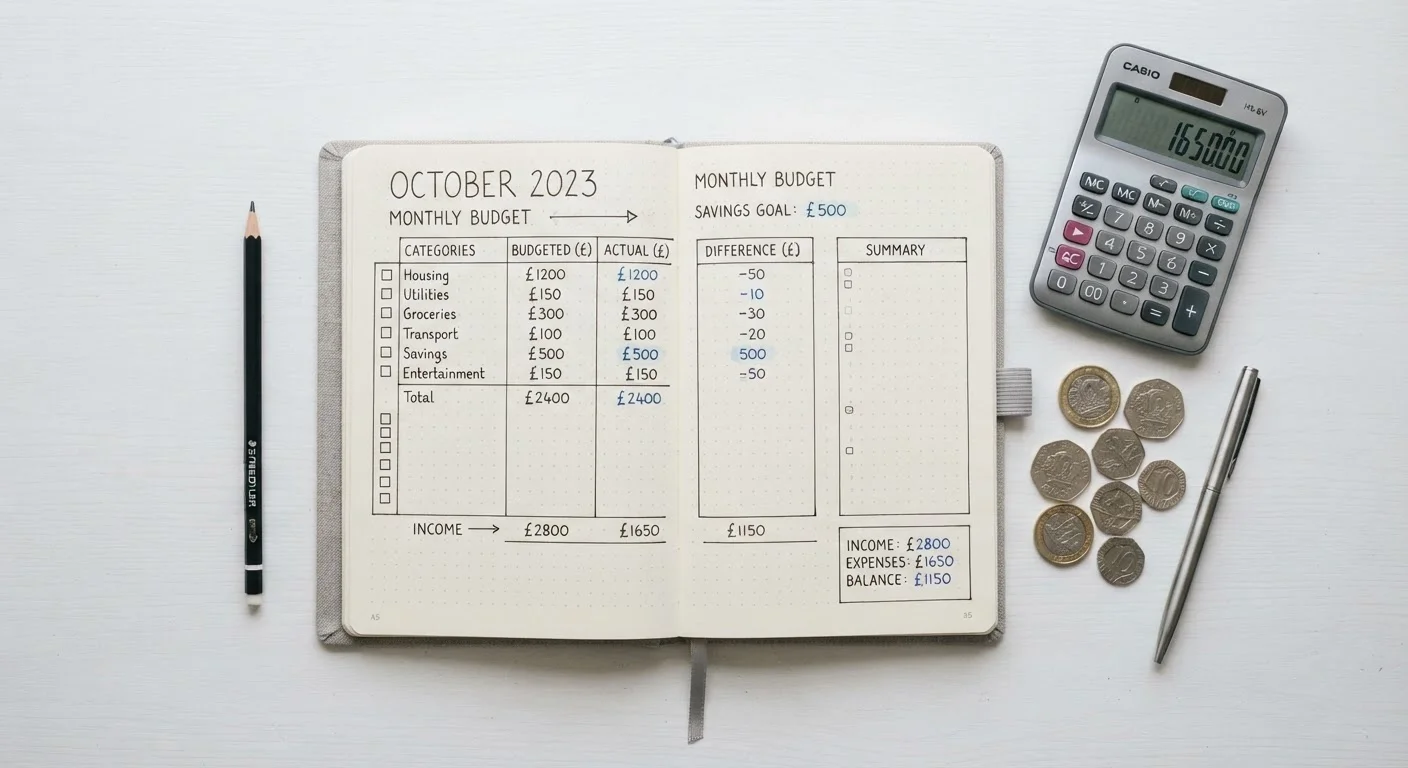
What a Budget Actually Does
A budget is simply a written plan that tells your money where to go before you spend it. That's it. It doesn't mean you stop having fun, give up coffee, or track every penny in a complicated spreadsheet. It means you decide - deliberately - how to divide your income across the things that matter to you.
Most people who skip budgeting aren't irresponsible; they're operating on a vague sense of their finances rather than clear numbers. That gap between what you think you spend and what you actually spend is where financial stress tends to live. A budget closes that gap.
Common budgeting myths - like "budgets are only for people in debt" - keep many people from starting. The reality is that a budget is just as useful when things are going fine; it's the tool that keeps things going fine.
Run your first budget audit using three months of bank statements, not your memory. Most people underestimate their actual spending by 20-30% when working from recall alone.
Memory is unreliable for discretionary spending; transaction data reveals the actual patterns driving your financial picture.
Automate transfers to savings on payday, before you have the chance to spend that money. Treating savings as a fixed expense removes the willpower variable entirely.
Behavioral economics research consistently shows that removing a decision from the spending path - paying yourself first - leads to higher savings rates than trying to save what's left over at month-end.
Know Your Numbers: Income and Expenses
Before you allocate a single dollar, you need two reliable figures: what comes in and what goes out.
Net Income
Always budget from net income - the amount that actually lands in your bank account after taxes, health insurance premiums, and any retirement contributions are deducted from your paycheck. Using your gross (pre-tax) salary inflates your available money and sets you up to overspend.
If your income varies - freelance work, hourly shifts, or tips - use a conservative monthly average based on your three lowest-earning months in the past year. This builds in a buffer automatically.
Fixed vs. Variable Expenses
- Fixed expenses stay the same each month: rent or mortgage, car payment, insurance premiums, and loan minimums.
- Variable expenses fluctuate: groceries, gas, utilities, dining out, clothing.
Separating these two categories makes it much easier to spot where flexibility exists. You can't easily cut your rent, but you can adjust discretionary spending.
~33%
Americans with a written monthly budget
Gallup polling has found that roughly one-third of U.S. adults maintain a detailed household budget, suggesting the majority operate without a formal spending plan.
$400
Emergency shortfall threshold
Federal Reserve surveys have found that a significant share of American adults would struggle to cover an unexpected $400 expense without borrowing or selling something.
Choose a Budgeting Framework
There's no single right way to budget. Three widely-used frameworks each suit different personalities and financial situations.
50/30/20
Divide your net income: 50% toward needs (housing, food, utilities, transportation), 30% toward wants (entertainment, dining, subscriptions), and 20% toward savings and debt repayment. This is a useful starting reference, though the percentages may need adjustment based on where you live and your income level.
Zero-Based Budgeting
Every dollar gets assigned a job - spending, saving, or debt payoff - until your income minus your allocations equals zero. You're not spending everything; you're accounting for everything. This method works well for people who want precise control or are actively paying down debt.
Envelope or Category Method
Assign a spending limit to each category (groceries, gas, entertainment) and track against it - traditionally with labeled cash envelopes, though digital apps replicate this concept. When a category runs out, you stop spending in it until the next month. This method is particularly effective for variable expenses that tend to creep upward.
For a hands-on walkthrough of putting any of these into practice, see building your first monthly budget from scratch.
Building Your First Budget
Starting is straightforward when broken into four steps.
- List your monthly net income from all sources.
- List all fixed expenses and subtract them first - these are non-negotiable.
- Estimate variable expenses using the last two to three months of bank or card statements as a baseline.
- Assign the remaining balance to savings goals and discretionary spending according to your chosen framework.
If your expenses exceed your income at this stage, the budget has already done its job - it surfaced a real problem that was previously invisible. Now you can address it deliberately rather than discover it through overdrafts.
Give Your First Budget a Grace Period
Expect your first month's budget to be imprecise - that's normal and not a failure. Use the real numbers that emerge to refine category amounts in month two. A budget improves through iteration, not perfection on the first attempt.
Don't aim for perfection in month one. Your first budget is a draft. Real spending numbers will refine your estimates quickly.
Handling Irregular and Unexpected Expenses
One of the most common reasons budgets fall apart is failing to plan for costs that don't arrive monthly: car registration, annual subscriptions, medical copays, holiday gifts, home repairs. These feel like surprises, but most are actually predictable if you look at a full year.
A practical approach: at the start of the year, list every non-monthly expense you can anticipate and its estimated cost. Add them up and divide by 12. Set that monthly amount aside in a dedicated savings bucket sometimes called a sinking fund. When the bill arrives, the money is already there.
For genuine emergencies - job loss, an unexpected medical bill, a major car repair - a separate emergency fund is the appropriate buffer. Most personal finance guidance suggests working toward three to six months of essential expenses, though even a modest starting fund of a few hundred dollars reduces reliance on credit. Managing that savings alongside debt considerations is covered in the Saving & Debt resource hub.
Don't Skip the Emergency Fund Step
Budgeting without any emergency savings means a single unexpected expense can force you into debt, undoing months of careful planning. Even a small initial fund changes the math significantly. Build at least a starter emergency reserve before aggressively allocating money to non-essential goals.
Keeping Your Budget Working Over Time
A budget written once and never revisited stops reflecting your real life within weeks. The habit that keeps a budget functional is a brief monthly review - typically 15 to 30 minutes at the end of each month.
During that review, compare what you planned to spend against what you actually spent. Adjust categories that were consistently off. If your income or fixed expenses change (a raise, a new lease, a paid-off loan), rebuild the budget to reflect the new reality.
Life changes - a move, a new job, a major purchase like a vehicle (see the car buying guide for how that decision fits into a broader financial picture) - are natural triggers for a full budget reset.
For the routines and mindset shifts that support long-term consistency, making a budget stick covers the practical habits in depth.
This article is for general informational and educational purposes only and does not constitute personalized financial advice. Consult a qualified financial professional for guidance specific to your circumstances.
The content on this site is for informational purposes only and is not a substitute for professional advice. Always consult a qualified professional for guidance specific to your situation.