

Start here
What a Mechanic's Estimate Actually Is
Next
Breaking Down Labor Charges
Then
Parts Costs and Markups Explained
Also cover
Diagnostic Fees and Shop Supplies
When you're ready
Questions to Ask Before You Sign
What a Mechanic's Estimate Actually Is
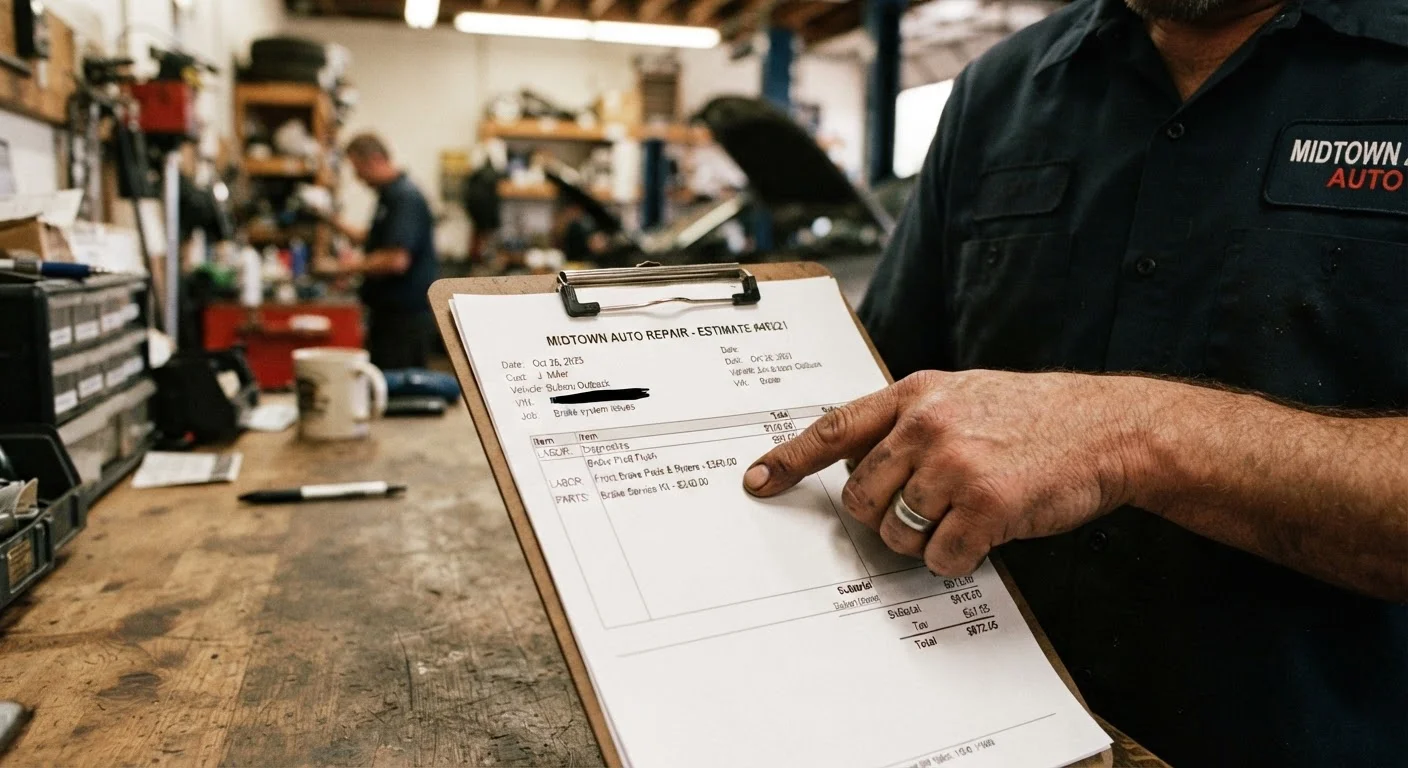
A repair estimate - sometimes called a work order or repair order - is a shop's itemized projection of what a job will cost before any work begins. It breaks the total into categories: labor, parts, fees, and taxes. Think of it as the shop's opening statement, not a final invoice.
Estimates can be written or verbal, but always insist on written documentation before authorizing anything. A written estimate gives you a reference point if the final bill looks different. Most states have consumer protection regulations that govern how much a final bill can exceed the original estimate without your sign-off - but those protections only apply when you have a paper trail.
If you're also trying to figure out whether a job is worth doing yourself, our guide on DIY vs. shop repairs walks through the trade-offs for common maintenance tasks.
Labor rate
The dollar amount a shop charges per hour of technician time. Rates differ by shop type, region, and technician specialization.
Flat-rate hours
A preset number of hours assigned to a specific repair job, drawn from an industry time guide. You pay for those hours regardless of actual time spent.
Parts markup
The difference between what a shop pays for a part wholesale and what it charges you. Markup is standard shop revenue, not a hidden fee.
Diagnostic fee
A charge for the technician's time spent identifying the cause of a problem before any repair work begins.
OEM parts
Parts made by or to the exact specifications of the original vehicle manufacturer. They match factory standards but typically cost more than aftermarket alternatives.
Remanufactured parts
Used components that have been disassembled, cleaned, and rebuilt to meet factory specifications. Often come with a warranty and cost less than new OEM parts.
Breaking Down Labor Charges
Labor is typically the largest line item on any estimate. Shops charge a labor rate - a dollar amount per hour - that reflects their overhead, location, and technician expertise. Independent shops generally charge less than dealerships; dealerships often charge more because their technicians are factory-trained for specific makes.
Most shops use a flat-rate system, meaning the job has a preset time value from an industry standard guide (such as Mitchell or Alldata). If your brake job is listed as 2.0 hours, that's what you pay in labor - even if the tech finishes in 90 minutes or takes 2.5 hours. This system is predictable for you as the customer, but it's worth knowing it exists.
Look at the estimate for a line like: Brake pad replacement - 2.0 hrs @ $120/hr = $240. That structure is standard. If labor hours seem high for a simple job, it's a fair question to raise.
Ask for the labor time breakdown
If a line item only shows a dollar total for labor, ask the service advisor to show you the hours and rate separately. This lets you verify the math and understand what you're actually paying for. Most shops will provide this without hesitation.
Parts Costs and Markups Explained
Parts on an estimate are priced above what the shop pays wholesale. This markup - often ranging from 20% to 50% or more depending on the part and shop - is a legitimate and standard source of revenue for repair shops. You generally won't see the wholesale price listed; you'll see the retail price the shop charges you.
Estimates should specify what type of parts are being used:
- OEM (Original Equipment Manufacturer): Parts made to the same specifications as the originals in your car. Typically more expensive.
- Aftermarket: Parts made by third-party manufacturers. Quality varies significantly by brand and product category.
- Remanufactured: Used cores rebuilt to factory spec. Common for alternators, starters, and brake calipers. Often carry a warranty.
Ask which category applies to your repair. For powertrain or safety-critical components, the choice between OEM and aftermarket is worth discussing with the shop - not to second-guess them, but to understand what you're getting.
Diagnostic Fees and Shop Supplies
When a vehicle comes in with an undiagnosed problem, the shop charges a diagnostic fee to cover the technician's time investigating the issue. This might involve connecting a scan tool to read fault codes, inspecting components, or road testing. Diagnostic fees are legitimate - skilled diagnosis takes time - but they vary widely, from around $75 to $175 or more.
The key question to ask upfront: If I approve the repair, will the diagnostic fee be applied toward the labor cost? Many shops do apply it; many don't. Knowing before you commit avoids surprise.
You may also see a shop supplies or shop materials line. This covers small consumables - rags, spray cleaner, wire ties, and similar items a tech uses during the job. It's usually a flat charge or a small percentage of labor. It's a standard line, but not unreasonable to ask what it covers if the amount looks large.
Diagnostic fees and repair approvals are separate decisions
Paying a diagnostic fee does not obligate you to have the repair done at that shop. Once you know what the problem is, you're free to take that information and get a second opinion on the repair cost. A reputable shop will understand this.
Questions to Ask Before You Sign
Reading the estimate is step one. Asking the right questions before authorizing work is step two. Here's a practical checklist:
- Is this estimate written and itemized? Never accept a verbal ballpark as a substitute.
- What happens if additional problems are found? Confirm the shop will contact you before doing any work beyond the estimate.
- Can I have my old parts back? Getting your replaced parts returned confirms the work was done. Some states require shops to return them on request.
- What warranty covers this repair? Labor and parts warranties vary by shop. Get the terms in writing.
- Are parts OEM, aftermarket, or remanufactured? Know what you're paying for.
- Does the diagnostic fee apply to the repair cost? Ask this before the tech starts.
For similar guidance on decoding line items in other documents, see how we break down dealership fees and add-ons - many of the same principles apply.
Understanding an estimate doesn't require mechanical knowledge. It just requires knowing what each line is supposed to represent and being willing to ask a direct question when something isn't clear.
Frequently Asked Questions
In most U.S. states, a shop must get your approval before exceeding the original estimate by a set threshold - often around 10%. Always ask what the shop's policy is and confirm that any additional work requires your authorization before it's performed.
Flat-rate labor means the shop charges a preset number of hours for a job regardless of how long it actually takes. These hours come from industry standard time guides. It can work in your favor if the tech finishes quickly, but the charge stays the same either way.
For larger or unexpected repairs, getting a second opinion is a reasonable step. It's not about distrust - it's about making an informed decision with your own money. Most reputable shops won't object to this.
OEM parts are made by the original equipment manufacturer and are identical to what came in your car from the factory. Aftermarket parts are produced by third parties and can vary in quality. Ask which type a shop is using, since both the cost and warranty coverage may differ.
Shop supplies cover small consumables a technician uses during a repair - things like rags, cleaner, and fasteners. Shops typically add a flat charge or a percentage to cover these items. It's a standard line item, but it's fair to ask for an explanation if it seems high.
Many shops will allow this, but some decline or may not warranty the labor if supplied parts fail. Ask ahead of time. Supplying your own parts removes the markup but also shifts the risk of a defective part to you.
The content on this site is for informational purposes only and is not a substitute for professional advice. Always consult a qualified professional for guidance specific to your situation.