

Our Verdict
Dealerships offer more structure, financing convenience, and consumer protections, making them a safer path for buyers who value peace of mind or need financing. Private sellers can deliver real savings, but require more due diligence, a higher comfort level with risk, and ideally a cash-ready position. Neither option is inherently superior - the right fit depends on your situation.
| Best for | Recommended |
|---|---|
| Buyers who want financing options, warranties, and a formal buying process | Dealership |
| Cash buyers comfortable doing their own research and inspections | Private Seller |
| First-time buyers who want more legal recourse if something goes wrong | Dealership |
| Experienced buyers seeking a specific used vehicle at a lower price | Private Seller |
How the Two Buying Channels Actually Work
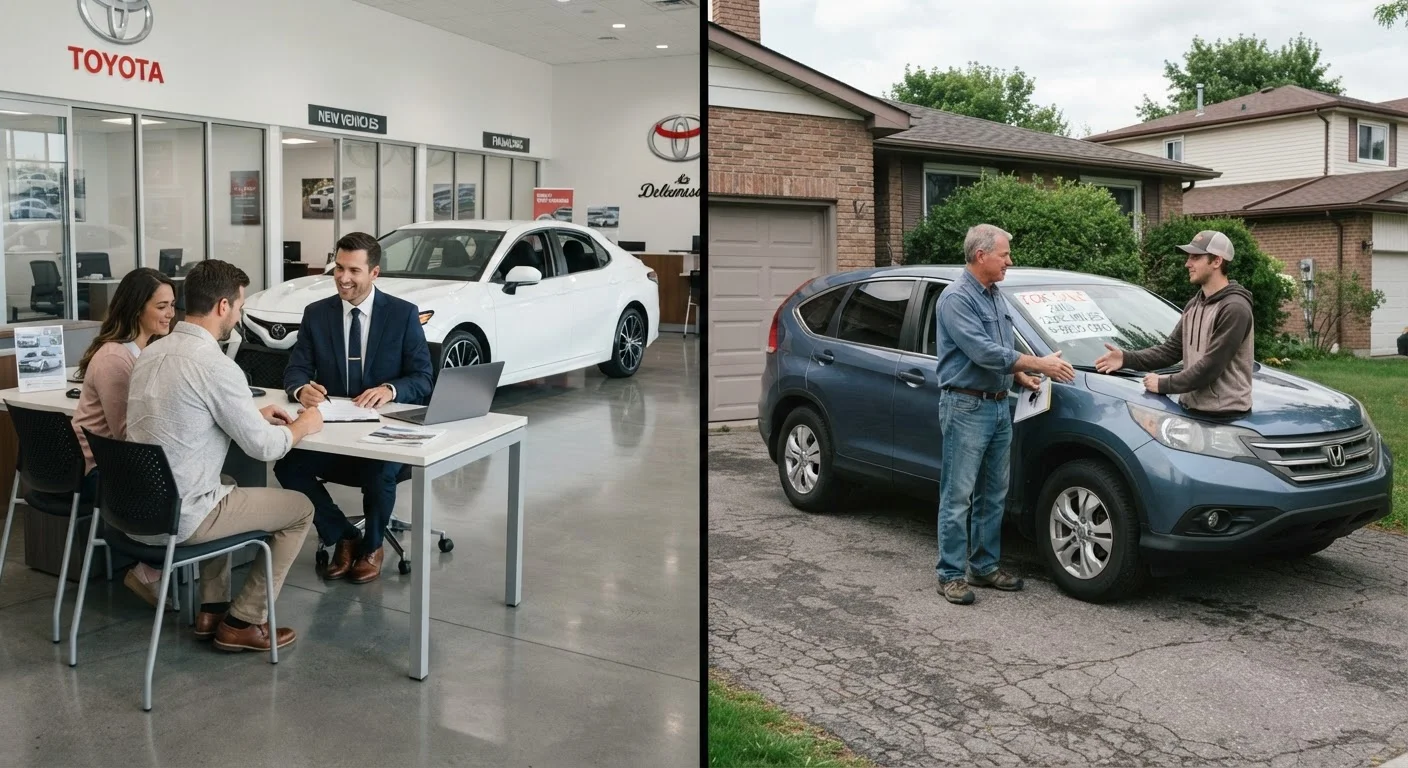
When you buy a car from a dealership - whether franchised (representing a specific brand) or independent - you're entering a regulated commercial transaction. Dealers are licensed businesses subject to state and federal consumer protection laws, required to make certain disclosures, and often able to arrange financing on the spot.
A private seller, on the other hand, is typically an individual offloading their personal vehicle. The transaction is more informal: you negotiate directly, paperwork is minimal, and the legal framework is much thinner. As a general rule, private sales are treated as "as-is" in most states, meaning the seller isn't obligated to fix anything or accept a return after the deal closes.
Understanding these structural differences upfront is what shapes every other part of the experience - from negotiation to financing to what happens if a problem surfaces after you've driven away.
Price, Negotiation, and What You're Actually Paying For
Private sellers often list vehicles below market retail prices. Because they're not carrying overhead costs - lot fees, staff, advertising - there's sometimes genuine room for savings. That said, a lower sticker price doesn't always mean a better deal if the vehicle has hidden issues.
Dealerships build margin into their prices, but you're also paying for services: vehicle reconditioning, a formal title transfer process, and in many cases a limited warranty or certified pre-owned (CPO) designation. CPO vehicles are inspected to manufacturer standards and typically include some form of extended coverage - something a private seller can't offer.
Negotiation feels different in each setting. A private seller may be more emotionally attached to the car and either very flexible or surprisingly firm. A dealership has more levers - trade-in value, financing rate, add-ons - that can complicate what looks like a simple price discussion. Dealer financing deserves its own scrutiny, since the convenience of one-stop shopping can come with higher interest rates than you'd get arranging your own loan.
| Private Seller | Dealership | |
|---|---|---|
| Typical price | Often below retail market | At or above market, includes overhead |
| Financing available | Rarely - usually cash or buyer-arranged loan | Yes, often multiple lender options |
| Warranty coverage | None in most cases | As-is, limited, or CPO warranty options |
| Consumer legal protections | Minimal - "as-is" in most states | FTC Buyers Guide, state lemon laws apply |
| Negotiation style | Direct, one-on-one with owner | Multi-variable, may involve multiple staff |
| Title transfer process | Buyer typically handles DMV paperwork | Dealer usually manages title and registration |
| Return or recourse options | Very limited once sale closes | More options, varies by state and dealer policy |
Consumer Protections: Where the Two Paths Diverge Most
This is where the gap between private and dealer transactions is most significant. Dealers are bound by the FTC's Used Car Rule, which requires them to display a Buyers Guide on every used vehicle disclosing whether the car comes with a warranty or is sold as-is. They must also comply with state lemon laws and truth-in-lending regulations when financing is involved.
Private sellers operate under far fewer obligations. In most states, a private sale carries no implied warranty, and the seller's only major legal duty is not to actively misrepresent the vehicle's condition. To understand what sellers are and aren't required to tell you, review what disclosure laws actually cover - the rules may be narrower than you'd expect.
For a broader comparison of how buyer protections shift depending on who you're buying from, see how third-party and direct-retailer transactions compare.
Always Arrange an Independent Inspection
Even if a vehicle looks clean and the seller is transparent, an independent mechanic inspection is money well spent - typically $100-$200. It can uncover issues that aren't visible to the untrained eye and give you leverage in negotiating price. Never skip this step in a private sale, and consider it even at a dealership for high-mileage or older vehicles.
Due Diligence: What You Should Do Either Way
Regardless of which route you take, several steps are non-negotiable. Pull a vehicle history report using the VIN - this can surface prior accidents, title issues, odometer discrepancies, and ownership history. Know that a clean report doesn't guarantee a problem-free car; it just tells you what's been officially recorded.
A pre-purchase inspection (PPI) by an independent mechanic is arguably the single most useful thing a buyer can do, especially in a private sale. Most sellers - legitimate ones, at least - will agree to this. If a seller refuses, treat that as a red flag.
Before you even get to the lot or driveway, know what questions to ask the seller upfront. Service records, accident history, and whether any warning lights have been cleared recently are all fair game - and the answers tell you as much about the seller's honesty as they do about the car itself.
This article is for general informational purposes only and does not constitute legal, financial, or professional advice. Consult qualified professionals for guidance specific to your situation.
The content on this site is for informational purposes only and is not a substitute for professional advice. Always consult a qualified professional for guidance specific to your situation.