

What the Declarations Page Actually Is
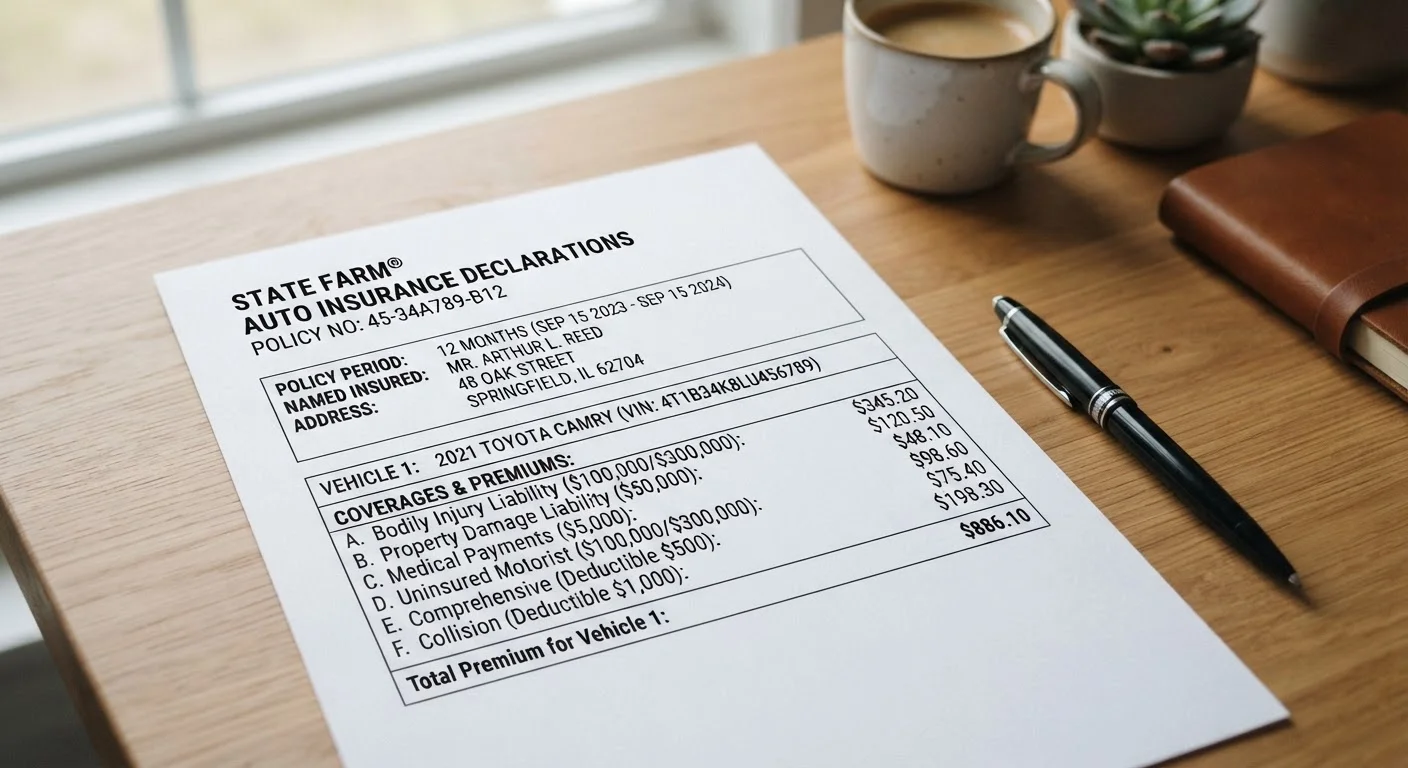
Your auto insurance declarations page - often called the dec page - is the condensed summary that sits at the front of your full policy. It tells you who is covered, what vehicles are on the policy, what types of coverage you carry, how much coverage you have, and what you'll pay. Think of it as the label on the package; the full policy document is everything inside.
You receive a new dec page every time your policy starts, renews, or changes. Most insurers now deliver it electronically, but a paper version is still common. If you've never looked at yours carefully, now is the time - it's the fastest way to confirm whether your coverage matches what you actually need.
For a broader foundation on how auto insurance works, see Auto Insurance Decoded.
Breaking Down Every Section
Once you know what you're looking at, the dec page follows a predictable structure. Here's what each part means:
Named Insured and Address
The top of the page lists the named insured - the person (or people) who own the policy. This matters because named insureds have rights that other listed drivers may not, including the ability to cancel coverage or make changes. Verify the spelling and address are correct; errors can sometimes affect claims.
Policy Number and Policy Period
Your policy number is your reference for any call or claim. The policy period shows the exact start and end dates. Coverage doesn't carry over automatically after the end date unless you've renewed - confirm renewal before that date arrives.
Vehicles Listed
Each vehicle covered by the policy appears here, usually with the year, make, model, and VIN. If a vehicle is missing or a VIN is wrong, contact your insurer immediately. Only listed vehicles are covered under the policy.
Coverage Types and Limits
This is the heart of the dec page. Each coverage type - liability, collision, comprehensive, uninsured motorist, medical payments, and others - appears as a line item with its corresponding limit. Liability limits often appear in split format, such as 100/300/100, which means $100,000 per injured person, $300,000 per accident, and $100,000 in property damage. For a plain-language explanation of what each coverage does, see Liability, Collision, and Comprehensive Explained.
Deductibles
Collision and comprehensive coverage each carry a deductible - the portion you pay before the insurer steps in. A $500 deductible means a $2,000 repair costs you $500; the insurer pays $1,500. Your deductible amount appears next to each applicable coverage on the dec page.
Lienholders or Additional Interests
If you financed your vehicle, your lender is listed here. This is required - lenders have a financial interest in the vehicle and must be notified when covered losses occur.
Endorsements
Any modifications to your standard coverage appear as endorsements. Common examples include roadside assistance, rental reimbursement, or a gap coverage waiver. These additions change what you're actually protected against, so scan this section carefully.
Premium Breakdown
The dec page typically shows your total premium and may break it down by vehicle or coverage type. This is useful when comparing policies - see Reading an Auto Insurance Quote Without Getting Overwhelmed for a side-by-side approach.
How to Use Your Dec Page Proactively
Your dec page isn't just paperwork - it's a practical tool. Review it at each renewal to catch coverage gaps before they matter. Ask yourself: Have I added a driver? Changed vehicles? Taken out a loan? Each scenario may require a policy update that won't appear on last year's dec page.
If you're considering switching insurers, use your current dec page as a reference checklist to ensure your new policy matches or improves on every line item. A side-by-side comparison can prevent accidental coverage drops. Our guide on switching auto insurers without coverage gaps walks through exactly this process.
And if you ever need to file a claim, your dec page tells you immediately what's applicable - before you've even called your insurer. Understanding it in advance takes the guesswork out of a stressful situation. For what comes next, see what happens after you file an auto insurance claim.
This article provides general information about auto insurance documents and is not personalized insurance, legal, or financial advice. Coverage terms, limits, and exclusions vary by insurer and state. Always read your complete policy document and consult a licensed insurance professional for guidance specific to your situation.
The content on this site is for informational purposes only and is not a substitute for professional advice. Always consult a qualified professional for guidance specific to your situation.