

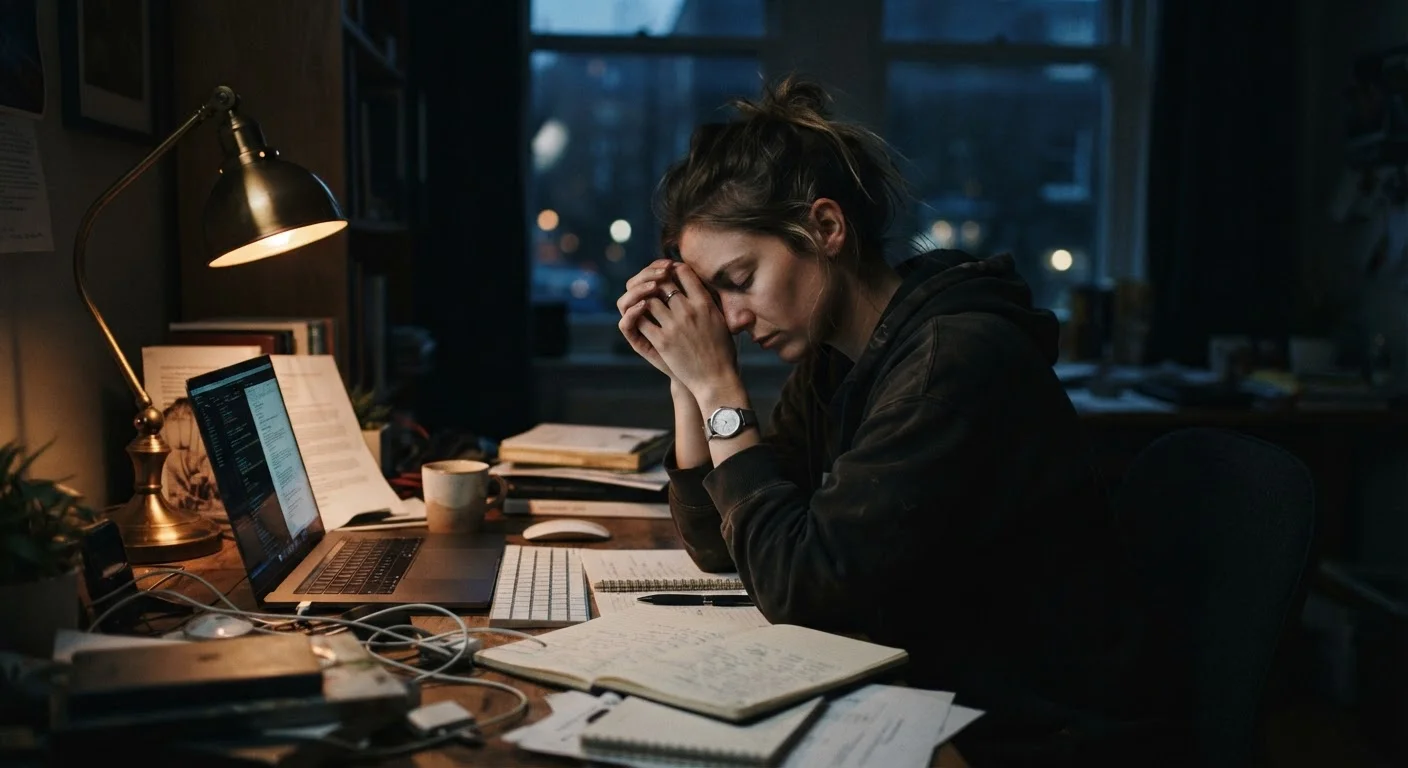
When Coping Becomes the Problem
Stress prompts action. When pressure mounts, most people reach for something that feels like relief - scrolling social media, replaying a frustrating conversation with a friend, or pushing through exhaustion late into the night. These responses are understandable. Many of them are socially encouraged. And nearly all of them can backfire.
The tricky thing about maladaptive coping - a term psychologists use to describe responses that provide short-term relief but worsen the underlying problem - is that it rarely feels like a mistake while you're doing it. It feels like surviving. Understanding why certain habits amplify stress, rather than ease it, is one of the most practical tools available for protecting your mental wellbeing. For a closer look at how unchecked stress can escalate into something more serious, see how burnout differs from everyday stress.
Using screens or passive scrolling as a primary stress-relief strategy.
Why it happens: Digital distraction is frictionless and immediately available, making it the path of least resistance when stress peaks. It feels like a break.
Sacrificing sleep to gain more hours in a stressful period.
Why it happens: When demands pile up, sleep feels like the most negotiable item on the schedule. Productivity culture often frames this as discipline.
Venting repeatedly without moving toward resolution or perspective.
Why it happens: Expressing frustration provides momentary relief, and social connection is a genuine stress buffer - but rumination disguised as venting keeps the stress response active.
Avoiding the source of stress entirely rather than engaging with it incrementally.
Why it happens: Avoidance reliably reduces anxiety in the short term, which reinforces the behavior - even though it typically allows the stressor to grow or compound.
Seeking repeated reassurance from others without addressing underlying worry.
Why it happens: Reassurance feels soothing, and asking for it is socially easy. But when the underlying concern isn't processed, the relief is temporary and the cycle repeats.
Abandoning healthy routines - exercise, meals, social contact - precisely when stress is highest.
Why it happens: Stress narrows focus and energy, making it easy to deprioritize the habits that feel less urgent but are actually most protective.
What to Do Differently
Replacing a backfiring habit doesn't require a complete wellness overhaul. Research consistently suggests that small, repeatable behaviors - when practiced deliberately - tend to outperform dramatic interventions over time. The goal is to shift from habits that suppress or amplify stress toward ones that help your nervous system actually process it.
~33%
Adults reporting extreme stress levels
The American Psychological Association's Stress in America surveys have consistently found that a significant share of U.S. adults report stress levels they consider extreme, yet a majority say they handle stress poorly.
1 in 3
Adults getting insufficient sleep regularly
The CDC has reported that roughly one-third of American adults regularly sleep fewer than the recommended seven hours per night - a pattern that compounds stress reactivity.
Start by noticing which habits you reach for most often when under pressure, and ask honestly: do I feel better after this, or just temporarily distracted? If the answer is the latter, that's a useful signal. Simple substitutions - a ten-minute walk instead of a doom-scroll, one honest conversation instead of a spiral of venting - can gradually recalibrate your stress response without requiring perfect conditions. The guide to building a stress-management routine covers how to make those shifts stick even on the hardest days.
It's also worth recognizing that not every stressor needs to be solved immediately. Sitting with some discomfort, rather than rushing to neutralize it, is a skill that tends to reduce overall stress reactivity over time. For a broader picture of daily habits that support emotional health, everyday habits that quietly support emotional wellbeing offers a research-informed starting point.
This article is for general informational and educational purposes only and is not a substitute for professional mental health advice, diagnosis, or treatment. If you are experiencing significant or persistent stress, anxiety, or related symptoms, please consult a qualified healthcare or mental health professional.
The content on this site is for informational purposes only and is not a substitute for professional advice. Always consult a qualified professional for guidance specific to your situation.