

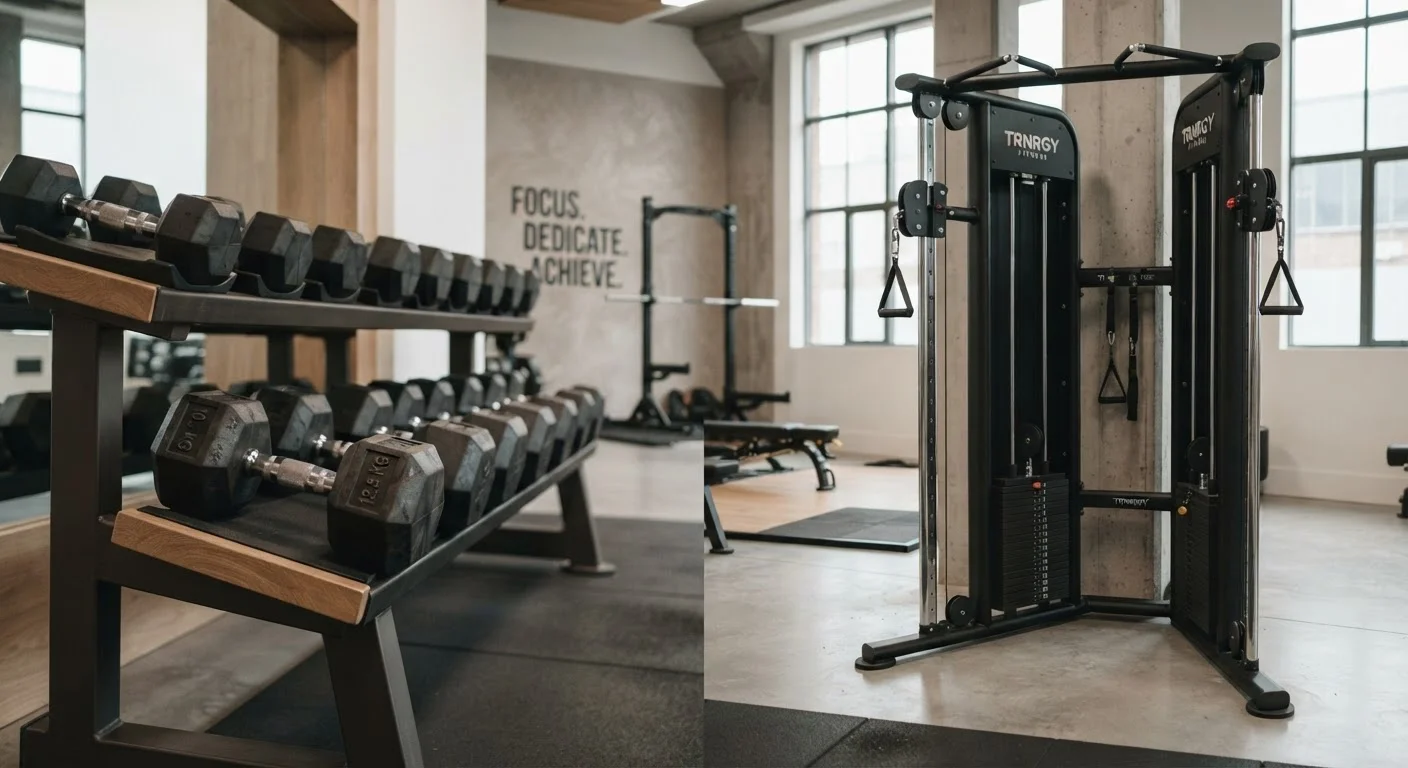
Option A
Free Weights
The versatile, functional strength-builder.
Best for: People who want to train multiple muscle groups simultaneously and build real-world movement patterns.
Option B
Resistance Machines
The structured, guided path to isolated strength.
Best for: People learning proper form, returning from injury, or targeting specific muscles with controlled movement.
What Sets Them Apart
Free weights - dumbbells, barbells, kettlebells, and similar tools - require your body to control the movement in three-dimensional space. That means more muscles are recruited with every rep, including the small stabilising muscles around your joints. This is often described as a higher "motor demand," and it's one reason free weight training is closely linked to functional fitness - the kind of strength that carries over into everyday activities like lifting, carrying, and climbing.
Resistance machines, by contrast, guide your limbs through a predetermined arc. The seat, pads, and frame handle the stabilisation work for you, so your target muscle can be loaded with less technical complexity. This trade-off - reduced stabiliser engagement in exchange for greater control - is neither good nor bad by default. It's a design feature that makes machines genuinely useful in the right context.
| Criterion | Free Weights | Resistance Machines |
|---|---|---|
| Muscle recruitment | High - includes stabilisers | Moderate - isolates target muscle |
| Learning curve | Steeper - form is critical | Gentler - movement is guided |
| Injury risk (improper use) | Higher without coaching | Lower for beginners |
| Functional carryover | Strong - mimics real movements | Limited - fixed movement arc |
| Versatility | High - many exercises, small space | Lower - each machine targets fewer movements |
| Solo training safety | Spotter often needed for heavy lifts | Generally safe to train alone |
| Cost and accessibility | Lower cost; home-friendly | Higher cost; gym-dependent |
The Case for Free Weights
Free weights shine when the goal is to develop strength that transfers beyond the gym. Compound lifts like the deadlift, overhead press, and squat train multiple joints and muscle groups simultaneously, which aligns with how the body actually moves. Research in exercise science consistently suggests that multi-joint, free weight movements produce strong adaptations in both strength and coordination.
There's also a practical argument: versatility. A single pair of adjustable dumbbells can replicate dozens of movement patterns, making them a cost-effective option for home training. That said, free weights do carry a steeper learning curve and a higher risk of improper form - particularly with heavier barbell lifts. Working with a certified personal trainer when starting out is widely recommended. For ideas on weaving these movements into a sustainable schedule, see how to build a weekly movement routine.
The Case for Resistance Machines
Machines earn their place in gyms for good reasons. Because the movement path is controlled, beginners can focus on the muscle being worked rather than on balancing and stabilising - which reduces cognitive overload when learning to train. This makes machines particularly accessible for older adults, people returning from injury (with a healthcare provider's clearance), and anyone who lacks access to a coach.
Machines also allow you to train to fatigue more safely without a spotter. A chest press machine, for example, poses far less risk if you reach failure mid-rep than a loaded barbell bench press would. For isolation goals - for instance, building the quadriceps or targeting the rear deltoid - certain machines provide levels of focused load that are difficult to replicate with free weights alone.
A Note on Injury and Rehabilitation
If you are recovering from an injury or managing a chronic condition, neither free weights nor machines should be used without guidance from a qualified healthcare or rehabilitation professional. A physical therapist or certified strength and conditioning specialist can help design a programme appropriate for your specific situation. General fitness advice, including this article, is not a substitute for that personalised guidance.
How to Choose - and Why You May Not Have To
The most honest answer to "which is better?" is: it depends - and often, both. Many evidence-informed training programmes combine free weights for compound, multi-joint movements with machines for targeted accessory work or safer volume at the end of a session. This hybrid approach lets you capture the functional benefits of free weights and the precision of machines within the same workout.
Your decision should be shaped by your current fitness level, any injury history, what equipment you have access to, and your specific goals. If you're chasing overall athletic performance, free weights will likely feature more prominently. If you're managing a specific limitation or just getting started, machines lower the barrier to consistent training - and consistency is arguably the most important variable of all. It's also worth remembering that many common fitness myths can make this choice feel more rigid than it needs to be.
If your strength gains plateau regardless of which method you use, understanding why workout progress stalls can help you reassess your approach intelligently.
This article is for general informational and educational purposes only and is not a substitute for personalised advice from a qualified fitness professional or healthcare provider. Consult a professional before beginning any new exercise programme, especially if you have existing health conditions or injuries.
The content on this site is for informational purposes only and is not a substitute for professional advice. Always consult a qualified professional for guidance specific to your situation.