

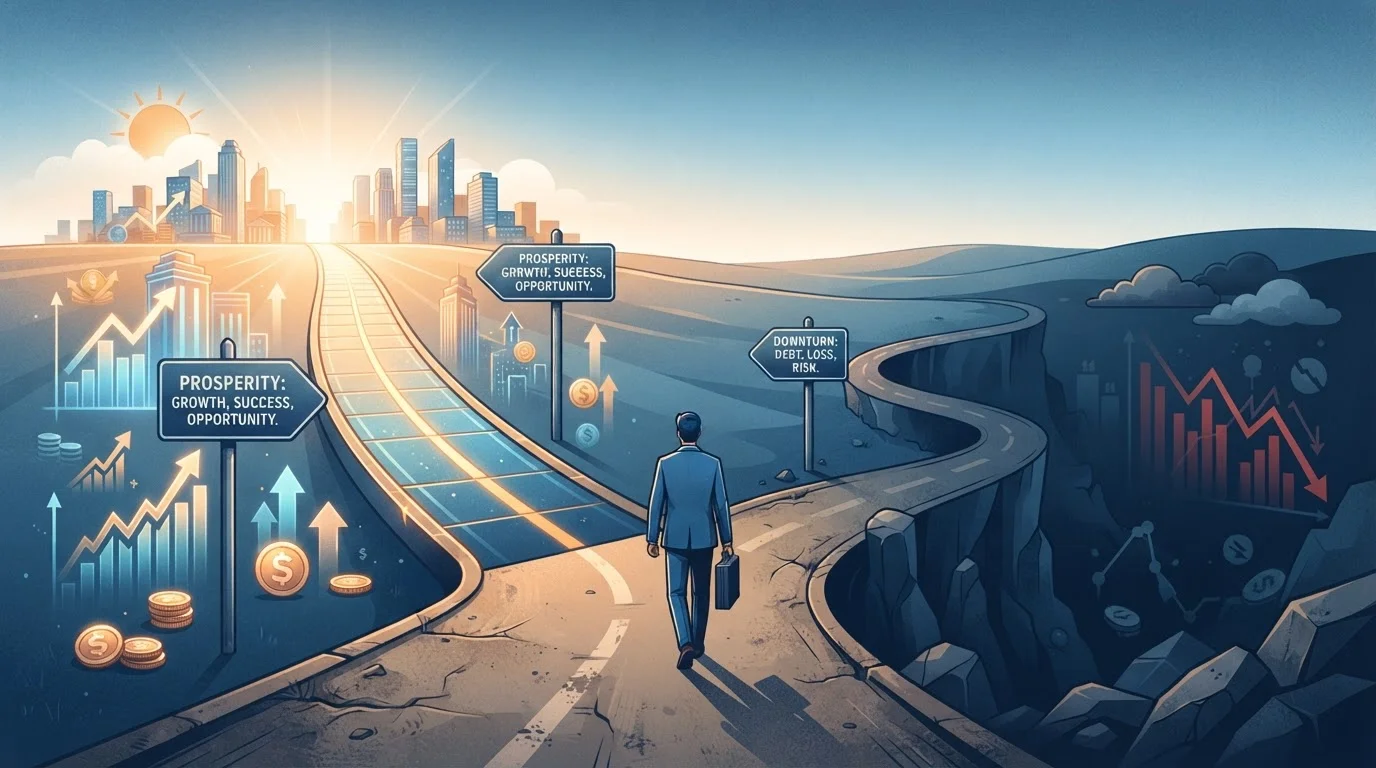
Option A
Good Debt
Borrowing that may build value or earning potential over time.
Best for: Financing investments in assets or capabilities that are likely to grow in worth or increase future income.
Option B
Bad Debt
High-cost borrowing tied to depreciating or consumed goods.
Best for: Situations where borrowing is unavoidable short-term, but that should be minimized and paid off quickly.
The Core Distinction: What Makes Debt 'Good' or 'Bad'?
The terms good debt and bad debt are simplifications, but they point to a real and useful distinction: some borrowing is structured in ways that may build financial stability over time, while other borrowing tends to drain resources with little lasting return.
The key variables are usually interest rate, what the borrowed money finances, and whether that asset or investment holds or grows in value. Debt used to acquire something that appreciates - or that boosts earning power - is generally categorized as good debt. Debt used to finance something that depreciates rapidly or is consumed immediately, especially at a high interest rate, falls into the bad debt category.
That said, this framing has limits. Even well-structured debt can become a burden if the underlying assumptions don't hold, or if total debt load becomes unmanageable. Common myths about debt - like the idea that all debt is equally harmful - can distort how people prioritize their finances.
| Criterion | Good Debt | Bad Debt |
|---|---|---|
| Typical interest rate | Lower (e.g., mortgage, federal student loans) | Higher (e.g., credit cards, payday loans) |
| What it finances | Assets or opportunities that may grow in value | Consumable goods or depreciating items |
| Long-term financial impact | May build equity or earning potential | Tends to erode net worth over time |
| Common examples | Mortgages, student loans, some business loans | Credit card balances, high-rate auto loans, payday loans |
| Risk level | Lower, but not zero - depends on circumstances | Higher, especially if balance grows over time |
Examples in Practice
Mortgages are the most commonly cited example of good debt. They carry relatively low interest rates compared to other borrowing products, and real property has historically tended to retain or increase value over time. The borrower also builds equity - ownership stake - with each payment, rather than simply paying for something that disappears.
Student loans occupy a more complicated space. Education financing can raise lifetime earning potential, which is why it earns the good debt label. But the outcome depends heavily on the field of study, the total amount borrowed, and eventual income. Understanding how student loan debt works is essential before treating it as automatically worthwhile.
Credit card balances are the canonical bad debt. Average interest rates on revolving credit card balances are substantially higher than those on mortgages or federal student loans. When a balance isn't paid in full each month, interest compounds rapidly on purchases that may have already been consumed. What sets credit card debt apart from other borrowing is worth understanding in detail.
High-rate personal loans and payday loans similarly fall into bad debt territory - the cost of borrowing often far outweighs any short-term benefit, and the debt is typically backed by nothing that holds value.
~20%
Average credit card interest rate (APR)
The Federal Reserve has tracked average credit card rates on revolving balances well above 19-20% in recent years, substantially higher than typical mortgage rates.
6-7%
Typical 30-year fixed mortgage rate range
Freddie Mac and other housing data sources have reported 30-year fixed mortgage rates in broadly this range in recent years, though rates fluctuate with market conditions.
Why 'Good Debt' Isn't Risk-Free
Labeling debt as good can create a false sense of security. A mortgage is only advantageous if the homeowner can sustain payments and if the property market supports the investment over time - neither of which is guaranteed. Student debt only pays off if career outcomes align with what was projected when borrowing. Business loans carry the risk that the venture underperforms.
The more practical question isn't just what category does this debt fall into, but what are the actual terms, and can this be managed within my current and reasonably expected financial situation? Before committing extra income toward any debt, it helps to think through the trade-offs. Weighing whether to accelerate debt payoff is a useful exercise regardless of debt type.
The Interest Rate Is Usually the Deciding Factor
When evaluating any debt, the annual percentage rate (APR) is often more revealing than the category label. A lower-rate debt used to finance something productive is generally preferable to a high-rate debt for anything - regardless of what the loan is called. Comparing APRs across different types of debt gives a clearer picture of true borrowing cost than labels alone.
This article is for general informational purposes only and does not constitute personalized financial or legal advice. For guidance specific to your situation, consider consulting a licensed financial professional.
The content on this site is for informational purposes only and is not a substitute for professional advice. Always consult a qualified professional for guidance specific to your situation.